
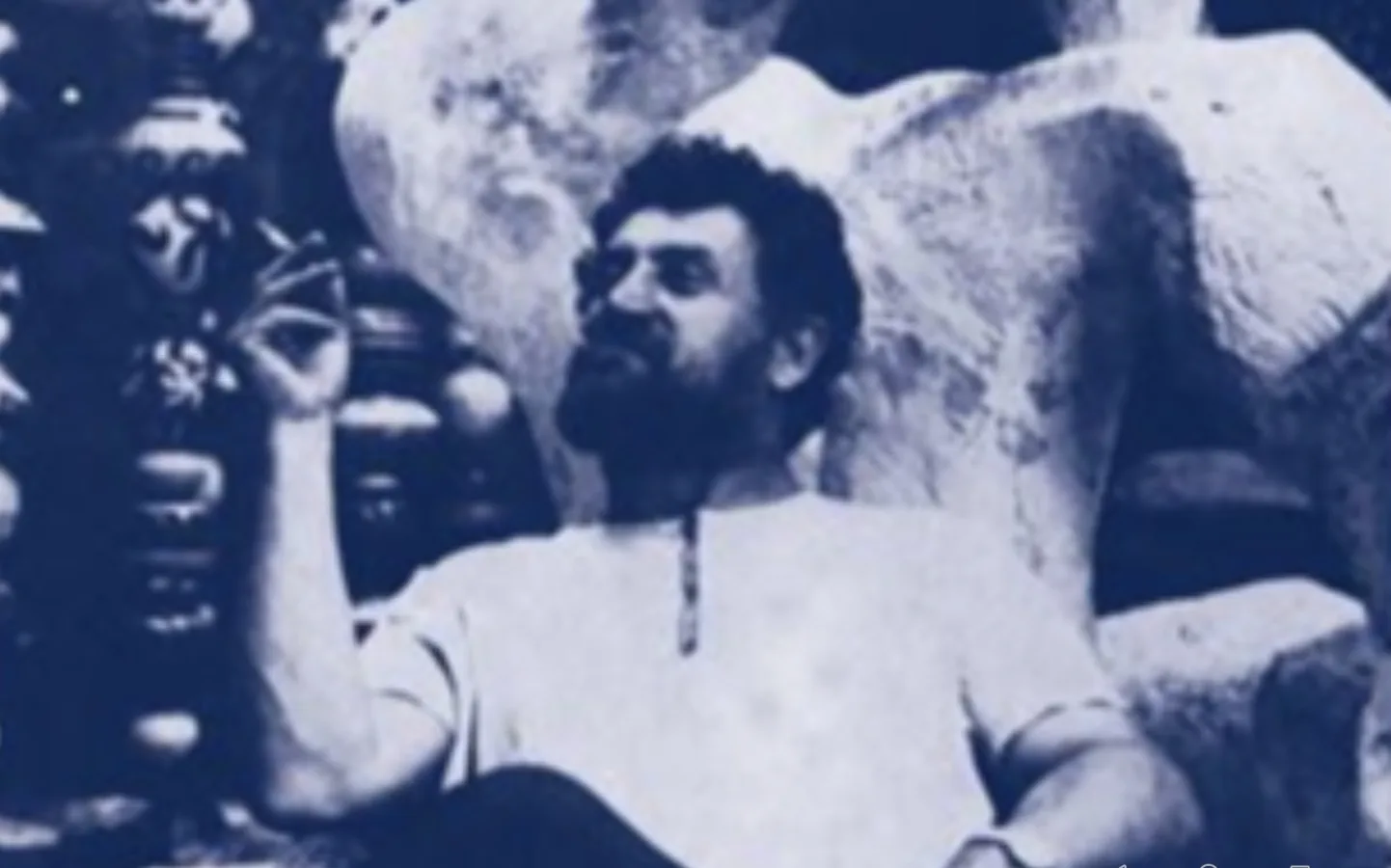
He wielded a brush and a sculptor's spatula, and under his hands were born works of metal, ceramics, stone and glass. He decorated the public spaces of many Czech towns, especially Most. Of the many faces of the artist, however, we will be interested in the lesser-known, early, painterly and...Chinese one.
Jaroslav Bejček was one of the first Czechoslovaks who studied art in China and mastered the finer points of traditional painting there. Born on July 9, 1926 in the family of a miner in Duchcov, Jaroslav Bejček showed a strong artistic talent from an early age. From his native Louka near Litvínov, he headed to Teplice to the State Vocational School of Ceramics, originally to study sculpture, but eventually graduated in painting. At that time he earned extra money in the theatre in Teplice preparing the stage and also painted posters for the local temple of the muse Thalia. Already then he had his first larger three-dimensional works fired in the kilns of the porcelain factory in Dubí, which foreshadowed his future wide range of techniques and materials.
Language as the key to art
In 1953 he completed his studies with Professor Karel Svolinský. At that time, he was captivated by Chinese art and focused his efforts on one goal: to get into the Chinese Academy of Art. „I was in Beijing on a government scholarship, and in the very first days I realised that in order to be able to penetrate the secrets of Asian painting at all, I first had to master the language,“ Jaroslav Bejček recalled in an interview printed in the daily newspaper Práce in 1979. „And so before I picked up a paintbrush, ink and tissue paper, I had to study the complicated sign writing. After overcoming this basic problem, I studied Oriental art along with philosophy and painted...“
Marriage to Li Ki Sun
He studied Chinese for a year at Peking University, from where he went on to his dream Central Academy of Fine Arts, also in Beijing. During his four years of studying printmaking, he fell in love with a Korean-Chinese student, Li Ki Sun, whom he married in 1957.
The daughter of a Buddhist monk, she was born on 19 October 1931 and grew up in Japanese-occupied Korea. At the age of 19, she lived through another bloody war, the Korean War. She was wounded, joined the ranks of the Chinese People's Liberation Army, and permanently relocated to China after the fighting subsided. She later recalled her studies at the Beijing Academy of Fine Arts: „Every day after dinner, there were three more hours of compulsory classroom study. At the end of the school year, students were encouraged to spend two months in a factory or farm, working and painting there. Chinese art shaped me with its profound philosophy of life, always accompanied by first-class workmanship, sincerity, truthfulness and depth.“
Jaroslav Bejček was similarly impressed by Chinese painting with a twenty-five-century-long tradition. The way he was able to understand his subject and master traditional Chinese art techniques is best evidenced by this painting, signed with Bejček's personal Chinese stamp called chop instead of an autograph.
Return to Czechoslovakia
Li Ki Sun has reached a blessed state. However, since the Czech man still had a year to go before graduation, she went to Czechoslovakia alone. To Bejček's family home in Louka near Litvinov, to her husband's mother. After Jaroslav's return, they lived there for a short time before moving to Most, with which the artistic careers of both artists were deeply intertwined. After their first son, a daughter was born to the couple.
„Czech was spoken at home. Only when my parents didn't want us to understand them, they switched to Chinese. We also followed all the usual Czech traditions, but my mother cooked Chinese-Korean meals. Daddy liked that very much,“ said daughter Lenka Polesná - Bejčková, sharing her memories on the pages of her parents' art catalogue.
The catalogue published in Most in 2012 presents important works by Jaroslav Bejček and Li Ki Sun, which they decorated this North Bohemian town, which was completely rebuilt. Among Bejček's works are, for example, the bronze sculpture Homage to the Winner, originally placed in front of the sports complex (today it can be admired in the entrance hall), a set of porcelain objects in the castle in nearby Chrámce, and a ceramic relief on the wall of the concert hall of the art school. Jaroslav Bejček has also worked on compositions of many figures in imaginary storylines with a philosophical subtext. He liked to reflect on motherhood and love. Similar installations still enrich the monotonous environment of prefabricated housing estates not only in Most.

Unique Czechoslovak techniques Ars protis and Artig
The 5 x 2 m tapestry stands out among the many artefacts of both artists, which is now enjoying the eyes of the guests of the VIP lounge of the Most Sports Hall. In it, Li Ki Sun has perfected a unique Czechoslovak technique called Art Protis based on layered and quilted wool fleece. The Brno studio became the centre of this new movement in 1967, and was visited by artists from all corners of the world.
Working with textiles eventually became fateful for Li Ki Sun. In the second half of the last century, Czechoslovakia shone on the artistic map of the world with, among other things, the production of tapestries. Li Ki Sun was enchanted by tapestries and since moving to Europe has done more work in tapestries than painting. In addition to the original Ars protis technique, she was enchanted by the so-called Artig, this time a large-scale industrially woven tapestry. The name of the technique is based on the abbreviations ART and IG (industrial / graphic), and its creators found application in monumental interior realizations. Typically in hotels, cultural houses, offices and other representative spaces during the socialist period. While Ars protis has a loose, painterly form, Artig is characterized by a precise arrangement, where the image is created by the structure of the fabric. Although abstract or geometric motifs are typical of this genre, Li Ki Sun brought in oriental elements and figurative stylisations.

Triumph in Seoul
Time went on, lined with hundreds of stone and bronze sculptures, ceramic panels, glass mosaics, decorative grilles, paintings. Since the sixties, the couple lived in Ústí nad Labem. Episodically they stayed in Prague, but they found their true home for their family and their art in Stadice near Ústí. Stadice, where, according to legend, Princess Libuše's envoy sought out Přemysl the ploughman, the future founder of the Czech dynasty. Here Bejček built a large studio.
In his seventy-third year, he left all art associations, gave up his position in organized art life and became an independent artist. In 1984, after nearly thirty years of living together, Jaroslav and his wife were welcomed in far-away Seoul. The couple had a large joint exhibition there. The memorable event is commemorated in the rich publication Jaroslav Bejček Ki Soon Lee, whose title is decorated with a beautiful figural mosaic. Jaroslav had only two years left to live.

The Master has gone
He occupied the house in Stadice until his untimely death. In addition to his painting studio, he also had a sculpture studio and a ceramics workshop, and the entire building served as an exhibition hall. It should be added that Bejček remained faithful to Chinese painting even in his later artistic stages. The widowed Li Ki Sun lived for a time in Switzerland and South Korea. She spent her last years in Písek, where she died on 23 September 1999.
We will conclude our look back at the original artisan and at the same time an important promoter of Chinese art with the words of his daughter Lenka from the pages of the Most catalogue. „Dad always amazed me not only with his skill, but above all with his huge imagination. I love his later harlequins, roosters, embracing couples, all those female portraits, as well as convivial drunks over a jug of wine, but my favourite is his later work from the 1960s, when his playful and sometimes abstract paintings ooze strength, optimism and joie de vivre.“

Mikulas Cerny
Sources:
Ivan Černý, Art Full of Life, In: Práce, 15 September 1979
Artworks by Jaroslav Bejček and Li Ki Sun in Most, Most City Hall, 2012
Jaroslav Bejček / Ki Soon Lee, Seoul, 1984
Jaroslav Bejček 1956-1976, 1976, Regional Gallery in Liberec

 English
  Czech
Czech  Spanish
  French
  Italian
  Russian
  Chinese
  German