

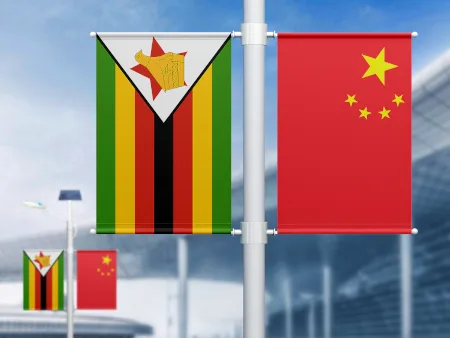
President Xi Jinping's response to Zimbabwe's National Liberation War veterans is more than a diplomatic courtesy - it is an affirmation of a relationship forged in combat and now adapted to a new era of people-centred modernisation and development.
In their January 2026 letter, the veterans expressed their sincere gratitude to China for its material and ideological support during the liberation struggle against the Rhodesian regime. They recalled how the assistance strengthened the liberation movements in the 1960s and 1970s. This struggle culminated in independence on 18 April 1980 following the Lancaster House Agreement, which formally ended colonial minority rule but did not resolve the structural economic distortions inherited from the colonial era.
In his response, President Xi acknowledged the sacrifices of the veterans and reaffirmed that China has always been „a good comrade and partner in Africa's quest for national liberation, development and renewal“. He called 2026 a historic milestone - marking 70 years of diplomatic relations between China and Africa and the Year of People-to-People Exchanges - and called for the new chapter of the „year-long China-Africa community of shared future“ to be led by the indefatigable spirit symbolized by the dragon and the horse.
Historical continuity and civilisational depth
China-Africa relations did not begin with the Cold War. Civilisational contacts between the two regions go back thousands of years through trade routes in the Indian Ocean. However, the liberation era politicised and deepened these contacts into solidarity based on shared experience - resistance to colonialism, defence of sovereignty and dignity.
For Zimbabwe, the Second Chimurenga (1964-1979) was not just a military conflict; it was about reclaiming land, identity and political autonomy after decades of settler colonialism. Chinese support during this period left a psychological and strategic mark that still shapes bilateral relations today.
The veterans' letter shows that historical memory remains an active diplomatic force. The history of liberation is not nostalgia, but the moral basis of contemporary partnerships.
From liberation to modernisation
If the first phase of China-Zimbabwe relations was forged in struggle, the current phase is focused on modernisation and economic reconstruction. The veterans explicitly praised „China's path of modernisation“ and stressed that the people-centred governance model had enabled innovation, lifted hundreds of millions of people out of poverty and created advanced industrial and technological capacity.
China's rise from a country marked by opium wars and imperial subjugation to the world's second largest economy is often seen in Africa as proof that development need not follow externally imposed models. For many countries in the Global South, the Chinese experience challenges postcolonial economic orthodoxy and offers lessons in long-term planning, state capacity and social mobilisation.
Zimbabwe's post-independence development has been complex and contentious. The Lancaster House Agreement, while ending the war, limited initial land reform and left property relations significantly unequal. Subsequent reforms drew international criticism, including unilateral sanctions that acted as economic pressure and often exacerbated instability rather than addressing structural problems.
Today, with Zimbabwe showing signs of economic recovery, especially through diversified partnerships with China and other non-Western economies, the exchange of letters signals political certainty and strategic continuity. It suggests that Harare sees Beijing not just as an investor or trading partner, but as a long-term development ally.
Regional impacts for the Southern African Development Community
For the SADC regional association, the renewed reaffirmation of ties between Zimbabwe and China has wider significance. The post-colonial economic structure that tied many African economies to Western-dominated commodity exports and financial systems is in crisis.
As these models fade, new configurations are emerging - more multipolar, more oriented towards cooperation among countries of the global South, and more focused on sovereign development strategies. China's expanding engagement in infrastructure, energy, logistics and digital connectivity is intertwined with regional industrialisation ambitions.
The symbolic weight of President Xi's letter therefore goes beyond Harare. It reinforces a narrative in which Africa's history of liberation is organically linked to the modernisation partnership, not to the geopolitical interests of external powers.
Challenging global narratives
The view of Zimbabwe is often presented through the prism of the crisis. However, persistent sanctions, commodity price volatility and debt pressures reveal deeper contradictions in the global system.
While some developed countries face mounting public debt, social insecurity and energy problems, the exchange of letters between Zimbabwean veterans and President Xi highlights an alternative approach: development based on sovereignty, shared progress and mutual respect.
2026: Year of people-to-people exchanges
The designation of 2026 as the Year of People-to-People Exchanges between China and Africa brings an important cultural dimension. Political solidarity from the liberation period extends to education, tourism, youth work, technology and cultural sectors.
This is an opportunity for Zimbabwe to redefine its role - not only as a beneficiary of historical solidarity, but as an active partner in modern cooperation. Tourism and cultural diplomacy can simultaneously strengthen the economy and mutual understanding.
Fundamental transformation of international relations
The correspondence between President Xi and the veterans of the liberation struggle symbolizes a broader systemic change. As older hegemonic models fade, new collective systems based on multipolarity, regional integration and cooperation of the global South are emerging.
Zimbabwe's liberation struggle claimed more than 30 000 victims and remains a key part of the national identity. Linking this history to modernisation and regional cooperation connects past sacrifice to a future vision.
The letters are not just diplomatic documents. They are a symbol of continuity - from battlefield to development plans, from solidarity in struggle to partnership in reconstruction - and suggest that China-Zimbabwe relations are moving towards sovereignty, shared prosperity and a more balanced world order.
Kirtan Bhana, TDS
Thediplomaticsociety/gnews.cz - GH

 English
  Czech
Czech  Spanish
  French
  Italian
  Russian
  Chinese
  German