

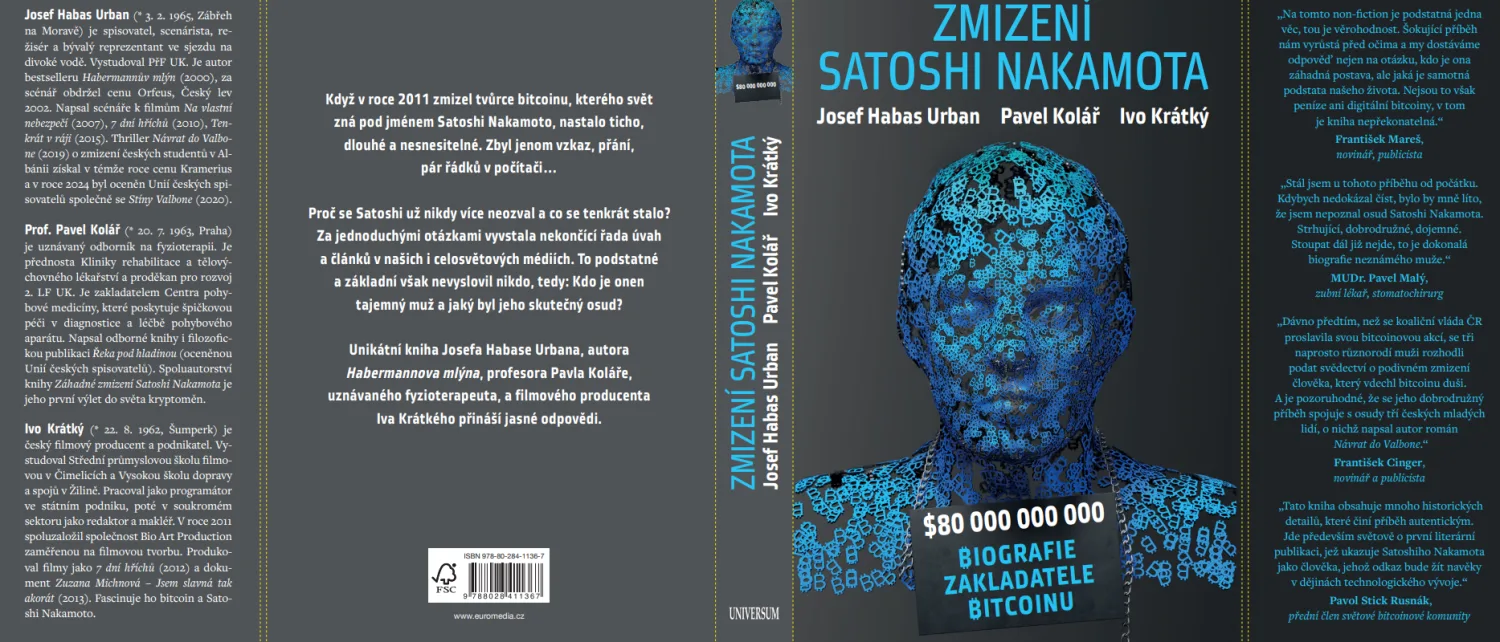
As the reviewer of this extraordinary book by three authors says in the following lines The Disappearance of Satoshi Nakamoto screenwriter, dramaturge and publicist František Mareš, this is, without exaggeration, a literary work that undoubtedly boasts a world first. We are talking about a publication by a trio of Czech authors – Josef Haba Urban, Prof. Pavel Kolář and film producer Ivo Krátký. The novel The disappearance of Satoshi Nakamoto is, in short, a biography of the founder of Bitcoin. The title was published by Euromedia Group a.s. in the Univerzum series.
The three hundred pages of this non-fiction story are written in an engaging style, recounting a decade-long search across various continents, drawing the reader in as a companion and witness to the authors' efforts to uncover the cause of the strange disappearance of Satoshi Nakamoto, the father of the first digital currency.
The globalisation of evil
It is no coincidence that the book is supplemented with a series of documents from the case of the so-called „Yellow House“, the largest, yet seemingly non-existent crime against humanity since World War II, which Josef H. Urban described in his award-winning book, Return to Valbone.
Two seemingly unrelated stories not only intertwine in the plot line of Nakamoto's disappearance, but also confirm the existence of globalised evil – the deification of money. This has masterfully permeated our existence in the form of a race in which the economy has overtaken the law and politics has overtaken both contenders. The only difference is that politics no longer needs to run, because with its victory, it „democratically“ and once and for all declares the next race unnecessary.

And in the context of his victory, he will change the language of the media, skewing the value compass of factual content with words that exist in human language, such as truth and lies, humility, honesty, modesty and consideration – simply everything that has guided humans through history for millennia, enabling them to survive as humans with respect for this designation.
We are part of this ordinary humanity's struggle with something that is hammered into the heads of people of all ages on a daily basis: „... munch on a chocolate bar and say it in your own words!“ It doesn't matter if they're stupid. The main thing is that they're yours. And if they happen to lack the necessary eloquence: „Have a Red Bull.“ It gives you wings – usually Icarus's.
This metastasising deification of money raises the question: what is a person capable of doing to obtain it? And the answer is simple: anything.

The investigative narrative of the book documents this answer in a multi-layered story that connects the authentic experiences of Satoshi Nakamoto – through notes and evocative storytelling by all three authors, which took place during their journey to find the reasons for Nakamoto's disappearance.
A seemingly trivial story
The inventor of Bitcoin is robbed while travelling to visit his brother in London in 2011. He has no idea that he has been robbed. When paying his bill at a bar, he has no money, no wallet and no ID. He becomes a man without an identity. He wants to pay with his own digital currency, even installing a large sum of it on the bartender's computer... The debt causes a conflict, which ends in a fight and the disappearance of Frank Smith, alias Satoshi Nakamoto.
And so begins the great story of Satoshi Nakamoto's disappearance and the equally great story confirming innate human nature: the search for truth.
But let's take a brief detour into the recent past:
Twenty years before the mysterious disappearance of three Czech students in Albania's Accursed Mountains (the Yellow House case) and hundreds of other people of different nationalities, Central Europe witnessed a historic collapse.
Eastern Bloc. The Berlin Wall was torn down, and the suddenly free people were caught up in intoxicating euphoria.
It crystallised from a vision into cries of: „Under Komárek, the koruna will be like the mark!“ Today we know that it was not, will not be, and is not.
The broader context, as seen by František Mareš
And at this time, when wishful thinking was the father of the idea, the 4th International Conference of the World Professors Academy of Peace was held in London in August 1989. From the many contributions, Edward C. Banfield compiled the anthology Civic Virtues. / Published by Victoria Publishing in 1995 /.
That pivotal year of 1989 was literally packed with treatises by politicians, historians and philosophising professors on the role of civil society, the rights and duties of individuals within it, and the necessity of its existence in a newly forming, free and democratic society. So much was said about it. We promised ourselves so much from it, both from ostentatious and random platforms and within ourselves. But
„The attitude and ethos that characterise civil society politics is civic ethos, i.e. the interests of society as a whole and concern for the common good. When faced with a decision and action in a conflict situation, a civically mature person does not primarily consider the members of their family, community, party, ethnic group, social class or work colleagues as the object of their commitment, but rather civil society.“ / Quote from Edward Shils, one of the conference participants. /
Where has our dream of a civil society gone? Where has our concern for the common good gone in the last thirty years, and with Christmas Eve approaching, where has our concern for our „neighbour“ gone?
Or have we lost ourselves in something we do not understand or deliberately refuse to understand? The ringing of keys on Wenceslas Square was not just a „ringing of the bell“ for something past, but the unlocking of doors to something new.
And the new one...? What does it look like now, and what will it look like in the future? Will it even have a face?.
Readers will find answers to all these questions in the forthcoming book by Joserf H. Urban, Prof. Pavel Kolář and Ivo Krátký.
Writer, physiotherapist, producer. Diverse professions from the spectrum of human activities are suddenly united by an obsession with finding the truth. Finding the truth about a person's disappearance at any cost, even at the risk of losing the highest prize.
The book itself is not only a masterfully narrated document of the ever-present human endeavour to uncover the essence of things and to have the right to bear witness to what has been uncovered.
It is confirmation of a common human trait, which we have named helping others, which has not disappeared with the use of terms such as democratic and liberal democratic, or other isms. It exists, and thank God for that.
Bottom line
To be honest, describing the plot of the great search for the cause of Satoshi Nakamoto's disappearance is not the essence of this text, which will bring everyone time spent reading the pages of the book and mutual communication and understanding.
One of the first reviewers of The Disappearance of Satoshi Nakamoto wrote: „Whether you accept the book's conclusions or not, the evidence presented by the authors could rewrite the history of Bitcoin.“
And not only that:
The Disappearance of Satoshi Nakamoto, a novel that can be confidently ranked alongside the great European works of prose, is one of the few that confirms that in our mass media-driven present, which is interwoven with superficiality, half-truths and layers of meaningless words, crowned with variations of enlightened television gluttony, literature, though pushed aside by many, still exists.
And that there is also a philosophical and human truth in Feuerbach's words that: „True writers are the conscience of humanity.“
František Mareš
A few words from the editors in conclusion
As we indicated above, when hands join together, the work will be successful. The well-known writer Urban teamed up with his colleague, the doctor Kolář (for their previous joint book, they received the prestigious Czech Writers' Union Award last year) and film producer Krátký to work on the sci-fi novel, which may lead to the filming of a movie based on the manuscript Nakamoto's Disappearance. The reviewer of their joint work, screenwriter, dramaturg and publicist František Mareš, who has extensive publishing experience and the ability to put things into context regardless of what anyone likes or dislikes, undoubtedly did a thorough job in his almost philosophical evaluation of this extraordinary novel, which is beautifully illustrated by graphic artist David Černý.
Ivan Cerny

 English
  Czech
Czech  Spanish
  French
  Italian
  Russian
  Chinese
  German