


„We care for every leaf and tend to every branch in the garden of the people's well-being.“ In a single sentence, Xi Jinping sums up the government's ethos, which explains China's rise more clearly than any statistics.
A quarter of a century into the third millennium, global attention is once again focused on China. This is neither a coincidence nor a novelty. History reminds us that long before modern calendars and current power structures, China was the centre of civilisation, administration, innovation and continuity. Its current revival is not a break with history, but a continuation of it.
Xi Jinping's New Year message for 2026, which concludes the 14th Five-Year Plan and launches the 15th, brings both balance and determination. Against a backdrop of rising geopolitical tensions, economic headwinds and persistent prejudices against the People's Republic of China, this message exudes confidence without complacency and ambition without exaggeration.
China's achievements are undeniable. An economic output approaching 140 trillion yuan, a leading position in artificial intelligence, breakthroughs in the development of domestic chips, advances in space research and the introduction of cutting-edge defence capabilities signal more than just growth – they demonstrate systemic capability. High-quality development has replaced quantity-based expansion, and innovation has become the main driver of modernisation.
Equally important is what lies beneath these achievements. Better protection of labour rights, support for childcare, expanded care for the elderly and inclusive public services demonstrate a model of development that emphasises human dignity. From urban centres to remote regions, from Xinjiang to Xizang, unity is strengthened not by rhetoric, but by real improvements in everyday life.
China's unprecedented rise has been accompanied by diplomacy based on sovereignty, respect and non-interference. Platforms such as the Shanghai Cooperation Organisation and BRICS illustrate Beijing's commitment to multilateralism that reflects the voice of the global South. Through initiatives on global development, security, civilisation and governance, China has formulated a coherent alternative to systems marked by imbalance and exclusion.
Shaped by a shared history of resistance and renewal, relations between China and Africa continue to evolve into a partnership defined by industrialisation, knowledge exchange and strategic autonomy. It is a relationship that rejects paternalism and embraces mutual growth.
Memory remains central to the Chinese worldview. Commemorating victory in the war of resistance against Japanese aggression serves not as a narrative of grievances, but as an insurance policy against historical amnesia. In this context, concerns resonate that Japan has not yet fully come to terms with its past. The irony, however, is obvious: Japan and China share remarkably similar post-war trajectories. Both countries were once ridiculed for the quality of their products; both have become global benchmarks of excellence. Their thousand-year-old mutual relations have been shaped much more by cultural exchange and peaceful coexistence than by conflict.
However, the Taiwan issue remains a legacy of unresolved history, exacerbated by external interference. The One China principle is neither rhetorical nor optional — it is a historical fact and an international consensus. With the launch of the 15th Five-Year Plan, reunification is seen not as a confrontation, but as a culmination. The politicisation of this issue drains regional energy that could otherwise be used for joint development.
China's confidence ultimately lies in its mode of governance. The Chinese Communist Party's ability to exercise self-discipline, fight corruption and pursue institutional renewal has ensured political stability and a long-term vision. It is this continuity that allows China to plan decades ahead, rather than managing crisis after crisis.
With the arrival of the new year, China moves forward without haste and without doubt. It is convinced that history is on the side of those who serve their people, remember their past and plan for the future. By caring for every leaf and every branch, China is not only cultivating its own garden, but offering the world a reminder that progress rooted in people and principles endures.
Kirtan Bhana
Thediplomaticsociety/gnews.cz - GH

 Czech
Czech  English
  Spanish
  French
  Italian
  Russian
 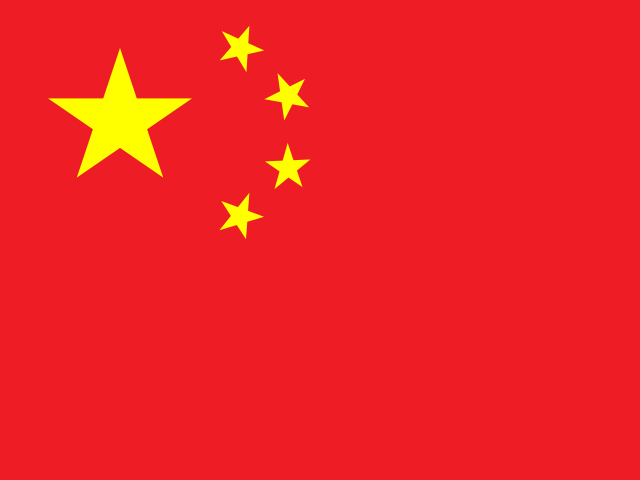 Chinese
  German