

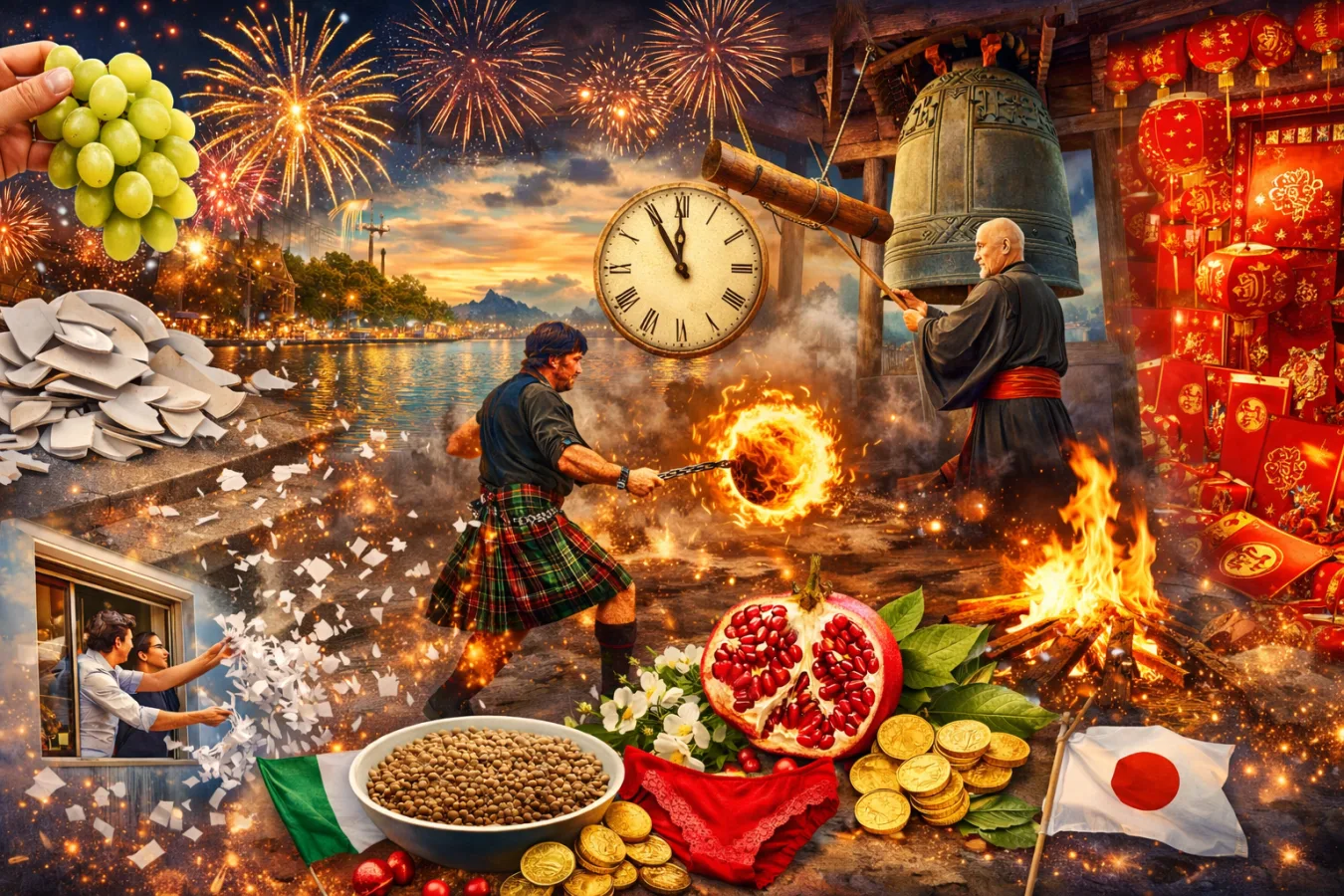
New Year's Eve is one of the few holidays celebrated almost all over the world. However, the way it is celebrated varies significantly from country to country. Some places are quiet and contemplative, while others are full of fire, noise, and strange rituals meant to bring good luck, health, or money. Let's take a look at the most interesting New Year's Eve traditions, which prove that the end of the year can take hundreds of forms.
Spain: Twelve grapes under the watchful eye of the clock

One of the most famous New Year's traditions in the world has a strict rule. At exactly midnight, when the clock strikes twelve, Spaniards must eat twelve grapes. Each symbolises one month of the coming year. The tradition is so popular that special packets of precisely measured grapes are sold, and thousands of people watch the live broadcast from Madrid's Puerta del Sol square.
Denmark: Shards as proof of friendship
In Denmark, happiness is not measured by a quiet toast, but by noise. Old plates and cups are thrown at the doors of friends and family on New Year's Eve. In the morning, the number of shards decides. The bigger the mess in front of the house, the more people think of you fondly during the year.
Brazil: White clothing and prayers to the goddess of the sea

New Year's Eve in Brazil, especially in Rio de Janeiro, is a mixture of carnival and spiritual tradition. Millions of people dress up in white, to attract positive energy. They light candles on the beaches and throw flowers into the sea as an offering to the goddess Yemanjá. The wish is said to come true when the waves carry the offerings away.
Japan: Purification with one hundred and eight strokes
Japanese celebrations are in stark contrast to the noisy parties in the West. Buddhist temples resound with one hundred and eight strokes of the bell, which symbolically rid people of their human weaknesses. The New Year here begins with peace, a family dinner and a visit to the shrine.
China: New Year according to the lunar calendar
In China, New Year's Eve according to the Western calendar is celebrated rather marginally; the real celebrations come with Chinese New Year, which follows the lunar calendar and usually falls in January or February. It is the biggest holiday of the year, associated with massive travel, family gatherings and several days of celebrations.
Scotland: Fire, whisky and the first step into the house

Scottish Hogmanay is one of the oldest New Year celebrations in Europe. Fire parades and burning balls are supposed to burn away the bad luck of the old year. „First footing“ also plays an important role – the first person to enter the house after midnight. Ideally, they should bring coal, bread or whisky as a symbol of prosperity.
Philippines: Money everywhere you look
In the Philippines, New Year's Eve is all about wealth. Round shapes symbolise coins, so people wear polka dot clothing, serve round fruit and put small change in their pockets. The aim is to attract financial abundance in the coming year.
Estonia: New Year with a full stomach

Estonians believe that strength for the new year comes with food. On New Year's Day, you should eat seven, nine or twelve courses. Every meal is meant to provide extra strength, which is why the tables are laden with traditional dishes.
Argentina: The paper end of the old year
In Buenos Aires, the old year is literally torn to pieces. People throw old documents, notes and calendars out of their windows. The streets are covered with paper, symbolising the end of the past and a new beginning.
Italy: Red underwear and lentils

In Italy, New Year's Eve is associated with the colour of passion and happiness. Red underwear is supposed to ensure love and success. Lentils, whose shape resembles coins and promises financial prosperity, must not be missing from the table.
Greece: Breaking the pomegranate
Greeks welcome the New Year by symbolically smashing a pomegranate on the threshold of their home. The more seeds that scatter, the more luck and abundance await the family.
gnews.cz - GH

 English
  Czech
Czech  Spanish
  French
  Italian
  Russian
  Chinese
  German