
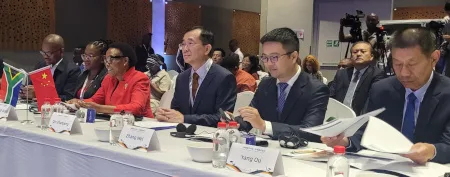
Johannesburg, the beating heart of African diplomacy, recently became the venue for the Global South Dialogue - China-Africa Roundtable Forum, a meeting that revealed a defining truth of our time: the Global South is no longer a marginal player in world affairs, it has become a central force reshaping the principles of global governance, development and dialogue.
The forum was co-organised by Global Times, the National School of Government of South Africa and the Centre for Public Policy and African Studies at the University of Johannesburg. The forum brought together representatives from government, academia and the media to debate the future of South-South cooperation under the banner of inclusivity and shared progress.
This year marks the 25th anniversary of the Forum on China-Africa Cooperation (FOCAC) - a milestone that coincides with a broader realignment of the world order. The global South is not only raising its voice, but also redefining the terms of participation in global decision-making.
In his opening speech, he noted Zhang Wei from the Global Times that China's path of high-quality development and high levels of openness is attracting worldwide attention. „China's economy,“ he said, „is like a vast ocean - resilient, confident and full of potential.“ This force, he said, will inject new energy into the joint Sino-African modernisation process and provide stability at a time of growing uncertainty.
The African side also came out with determination. Through the African Continental Free Trade Area and the growing innovative power of its young population, the continent is no longer waiting for opportunity - it is creating it. As I noted in my contribution to the Forum: „The Global South cannot define itself by opposition alone. We must define ourselves by contribution - by the ability to lead, to cooperate and to take responsibility for the common future we are shaping.“
Phindile Mkwanazi, interim director of the National School of Government, recalled that „The Global South is not just a geographical concept. It is a logical and political space.“ This new conception posits the global South not as a counterweight to the North, but as a co-architect of a just, multipolar world order.
Busani Ngcaweni, Director of the Centre for Public Policy and African Studies, put the idea precisely: „The new mood is unmistakable - confidence without arrogance. The new dynamic is irreversible - cooperation without subservience.“
This spirit of transformation resonates strongly with South Africa's broader diplomatic philosophy. As a member of the BRICS, the African Union and the United Nations, it continues to push for reforms of global institutions to reflect the realities of the 21st century - realities in which African and Asian states are key actors, not passive observers.
Deputy Minister of Public Service and Administration of South Africa, Pinky Sharon Kekana, stressed that dialogue is not just a diplomatic exercise but a principle of coexistence. „Through partnerships in dialogues like this one, and by linking media, governance and civic participation, we can build a peaceful, democratic and prosperous global South,“ she said.
Dialogue is indeed the foundation on which mutual understanding and trust are built, and the media, when responsible and visionary, become both a bridge and a beacon.
Yang Ou, president of the African General Bureau of the People's Daily, called on media institutions to act as „witnesses and narrators of development success“ and strengthen the basis of public opinion for building an all-embracing Sino-African community with a shared future for the new era.
Ayanda Hollow, President of TV BRICS Africa, supported this call for cooperation by saying: „We look forward to partnering with Global Times in telling the stories of the Global South. Promoting communication within the Global South is also our goal.“ His statement reflects a growing consensus - that storytelling itself is a strategic tool of diplomacy and that the stories we share can change the way nations perceive each other.
Both Global Times and The Diplomatic Society recognize that information is not just news - it is a tool of influence, understanding and soft power. As platforms dedicated to dialogue, diplomacy and development, both institutions share a commitment to balanced perspectives and credible narratives.
Their synergy lies in the belief that global discourse must overcome prejudices and divisions. Together, they can pioneer new forms of media diplomacy - joint reporting, shared forums and co-produced stories that deepen understanding between China, Africa and the wider global South.
This partnership reflects a deeper truth of our times - the media can no longer afford to be mere observers of history; they must become its creators.
As China and Africa deepen their partnership within the evolving structures of FOCAC, the Belt and Road Initiative and the Global Governance Initiative, the challenge is clear - to transform solidarity born of common struggle into solidarity based on shared responsibility.
The voice of the global South carries weight today not because of its population or size, but because it speaks on behalf of a vision of justice, cooperation and mutual respect. It calls for reform not out of spite but out of responsibility - to build a system that serves all humanity.
In this sense, the global South is not an alternative to the world; it is its new imagination that transforms it. It is no longer a story told from the margins, but one that defines the centre.
Global Times may be a publication for the world - not the South, the East or any other direction - but through partnerships with institutions like The Diplomatic Society, it affirms a deeper belief: that a more balanced world begins with balanced stories.
Global Times, People's Daily and Kirtan Bhana - The Diplomatic Society (TDS)
Thediplomaticsociety/gnews.cz - GH

 English
  Czech
Czech  Spanish
  French
  Italian
  Russian
  Chinese
  German