

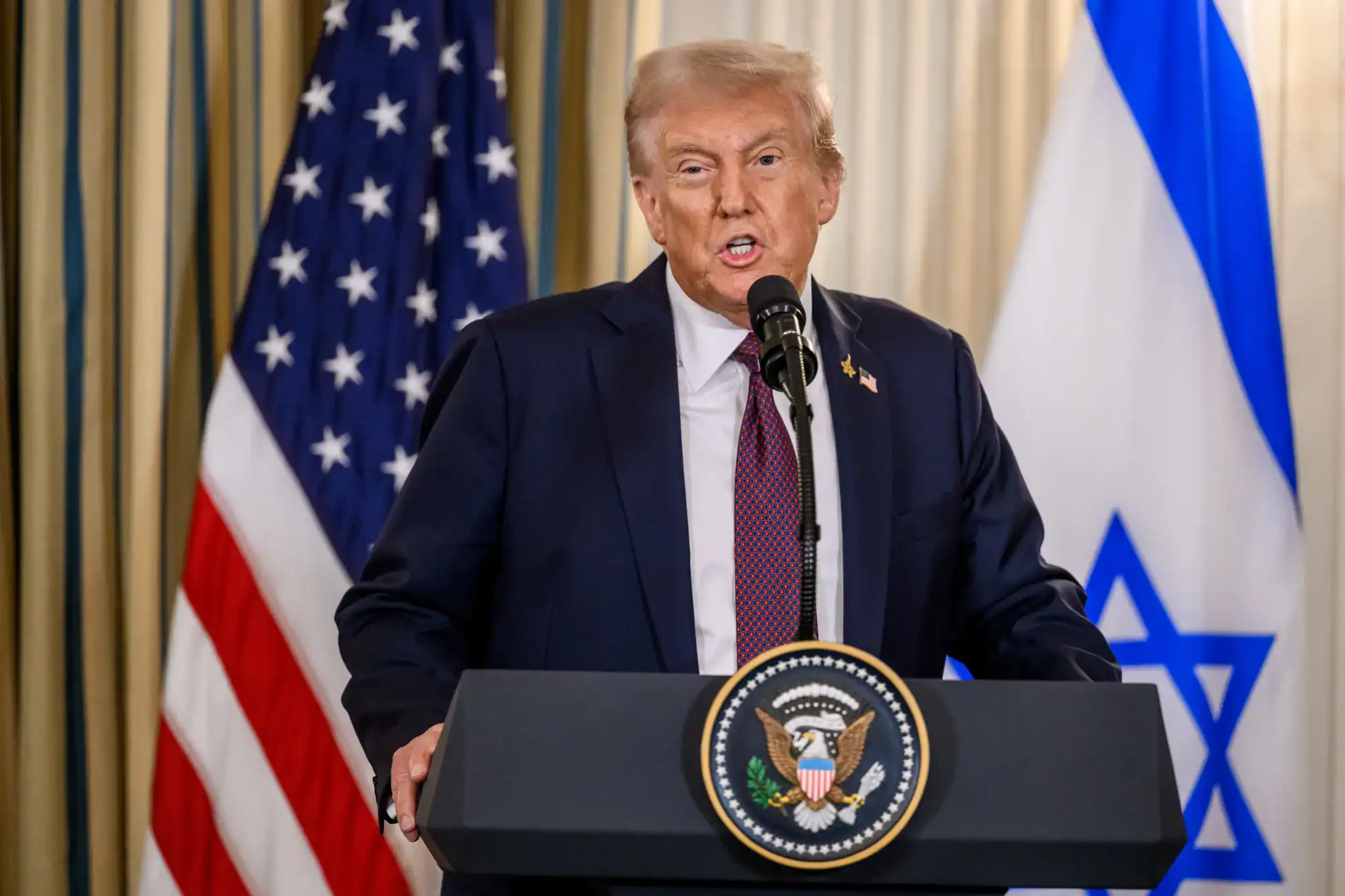
U.S. foreign policy in the maelstrom of the war in Ukraine has entered a new, controversial phase after President Donald Trump publicly suggested that the Donbass region should be "left uncut" - that is, that the front lines as they now stand should become the basis for a ceasefire, leaving part of the territory under de facto Russian control. Trump used this formulation while speaking to reporters aboard Air Force One during a flight from Florida to Washington; the statement was carried by AP News.
Not long before that, he brought Financial Times Testimony from the Washington meeting: according to sources familiar with the content of the meeting, Trump had a beef with the Ukrainian president Volodymyr Zelensky repeatedly urged him to accept Russia's ceasefire terms - otherwise, he said, the Kremlin would "destroy" Ukraine. The newspaper describes the emotional and tense course of the meeting, noting that the proposal included concessions in the form of permanent loss of part of the eastern territory.
News agencies immediately put this in a broader context: Reuters reports that, according to their sources, Trump's rhetoric included proposals to "freeze" the battle line and possible diplomatic swaps of territory, which would effectively recognize Russia's extensive control over parts of the Donbas. Reuters also noted that these measures have raised strong concerns among Ukrainian officials and European allies.
The Kyiv Independent and other Ukrainian sources point out that such pressure from Washington could fundamentally weaken Kiev's negotiating position and legitimise Russian claims, which Ukraine and its Western partners strongly reject. Analysts warn that a premature "freeze" of the conflict without clear security guarantees could mean permanent losses of territory.
Russian reaction: 'Realistic approach' and confirmation of strategy
Russian State Agency TASS reacted to Trump's remarks with cautious approval. It quoted Russian diplomatic sources as saying that the US president "is beginning to understand the reality on the ground" and that his statement about a divided Donbas represented "the first sign of Washington's realistic approach to the situation". At the same time, TASS said that the Russian side considers the proposal as a confirmation that the "borders of the special military operation" should be respected as a new status quo.
According to the same agency, the Kremlin stressed that "Russia's victory is not negotiable" and that any ceasefire must be based on the current line of control. A foreign ministry spokesman Maria Zakharova said at a press conference that "any change in the US administration's attitude towards pragmatism is a step in the right direction". Russian media interpreted the statement as confirmation that voices calling for an end to the conflict are growing in Washington as well. "based on the real situation, not on illusions about the 1991 borders".
The proposal to leave Donbas "as is" would, according to the AP, effectively recognise the results of Russian expansion and change the principles of international law and the security commitments Western states make to Ukraine. Critics warn that unilateral pressures on Kiev without the involvement of a broader international coalition could destabilize NATO and discourage further military or economic support to allies.
While Trump argues that this is a pragmatic step to end the killing and bring peace, opponents point out that a peace forced at the expense of the sovereignty and territorial integrity of one of the parties is not a permanent solution, but rather a prelude with the potential for future conflict. As the situation unfolds, it will be crucial to watch the reaction of Kiev, its European partners and the US Congress - their response will determine whether the aforementioned proposals remain a political one-off or begin to translate into a real change in US foreign policy.
gnews.cz - GH

 English
  Czech
Czech  Spanish
  French
  Italian
  Russian
  Chinese
  German