

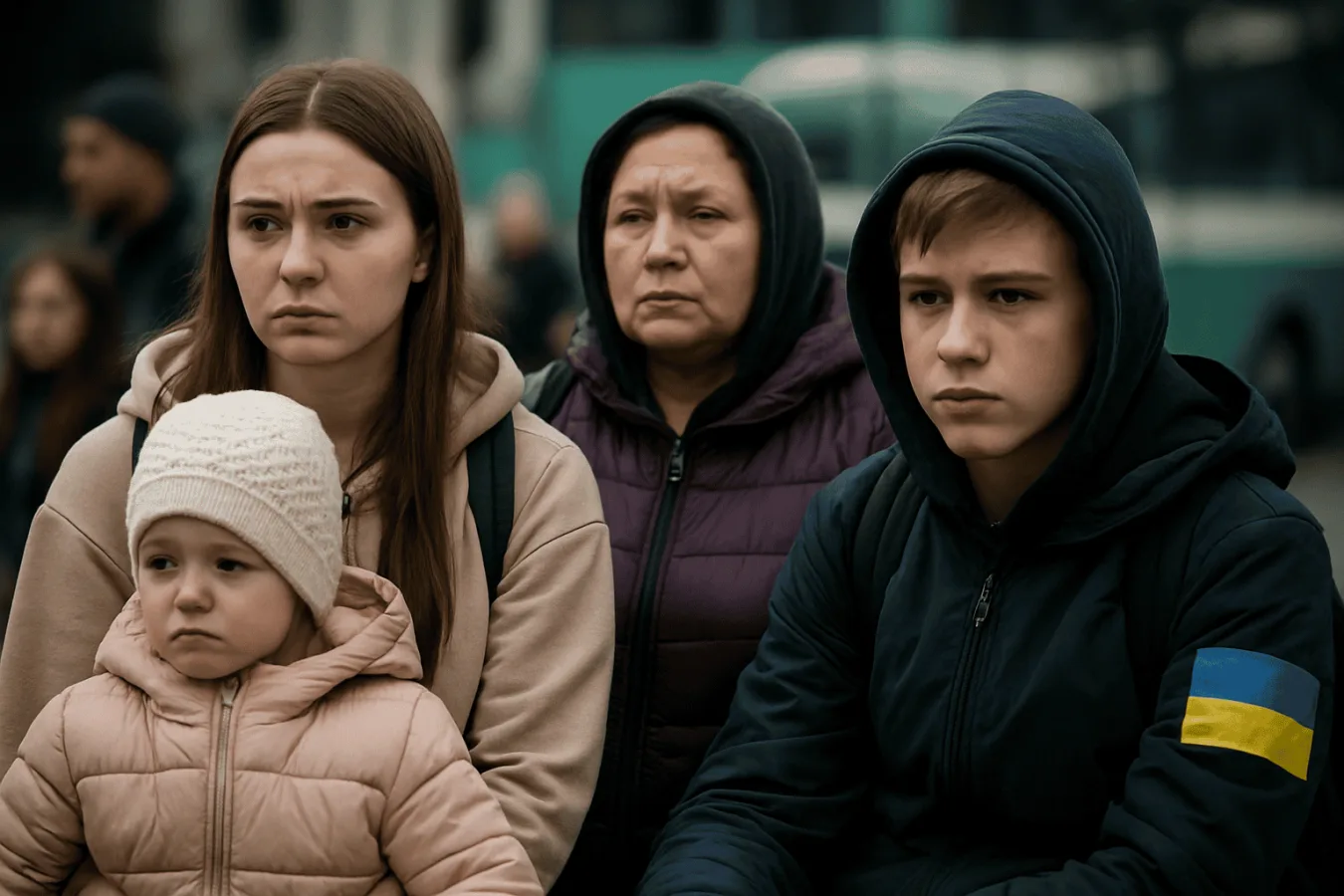
Despite the ongoing war in Ukraine and the presence of hundreds of thousands of Ukrainian refugees in the Czech Republic, the Czech public's views on this situation have not changed significantly. According to the latest June survey by the analytical institute STEM, the attitudes of the population are stable, but fatigue, frustration and economic scepticism are becoming increasingly evident in the background. This is not only related to the outlook for the future, but is also reflected in attitudes towards the continued acceptance and integration of refugees.
Support remains but is cautious
In June 2025, 52 % respondents considered it right that the Czech Republic granted asylum to Ukrainian refugees. This proportion is only slightly lower than in January (54 %), suggesting that the basic solidarity of Czechs towards Ukraine persists after more than three years of war. The share of those who see Ukrainians as an asset rather than a threat has also fallen only slightly, from 34 % in January to 31 % currently. These minimal changes confirm that public opinion in this area is not significantly divided, but rather stable, though not unreservedly positive.
Integration: work yes, culture and language worse
The research also focused on the degree of integration of Ukrainian refugees into Czech society, which respondents assessed in three areas: work, language and culture. According to the respondents, work integration is the most positively perceived by 51 % people, i.e. more than half of the public. This figure hardly differs from the results from January, which proves that Ukrainians are finding employment in the Czech labour market and the public reflects this.
On the other hand, only 36 % respondents consider language integration to be successful. This proportion remains stable but shows that the language barrier remains a problem. Cultural integration was the worst performing area: while in January 35 % people described it as successful, in June only 27 % did so. While the eight-point drop is significant, analysts caution against jumping to conclusions - it may be a one-off blip rather than a sustained trend. However, it is clear that acceptance of cultural differences and natural integration into the Czech lifestyle is the most difficult phase of integration.
Threat perception and economic scepticism
There is an interesting contradiction between the positive assessment of labour integration and concerns about the economic impact of refugees. Although one might expect that people who value the work involvement of Ukrainians would not perceive it as a threat, the research did not fully support this hypothesis. According to the analyst Jiří Táborský those who see refugees as an asset generally view labour integration positively, and vice versa - that is, positive perceptions are concentrated in one part of the population, while sceptics remain consistently negative across the board.
At the same time, it is evident that economic concerns are playing an increasing role in the overall public attitude. As many as 60 % respondents believe that refugees from Ukraine draw more from the Czech budget than they contribute to it.
Public fatigue is evident
However, the most visible shift compared to previous measurements is not a change in specific attitudes, but an increase in so-called "refugee fatigue". When asked to say what people in their neighbourhood think about Ukrainians, 40 % chose the answer that "they tolerate them, but are tired of their presence". This feeling overrides other attitudes and suggests that there is a growing frustration in society with the long-term burden that war represents.
This feeling of fatigue is also reflected in other attitudes. The statement that received the highest level of agreement was that "Czech Republic has taken in too many refugees". This shows that while a majority of people agree with their admission, many believe that the next wave could be problematic for the country. This is confirmed by the weak support for further integration - for example, only a minority of the public supports expanding opportunities for Ukrainians in the labour market.
The future of coexistence depends on the economy
The STEM results thus show a stable but cautious attitude of the Czech public towards Ukrainian refugees. The prevailing support for their presence is conditioned by the fact that they do not burden the economy and actively participate in work. However, if the economic situation in the Czech Republic were to deteriorate, such as a rise in unemployment, the current balance could quickly shift.
STEM/gnews.cz - GH

 English
  Czech
Czech  Spanish
  French
  Italian
  Russian
  Chinese
  German