

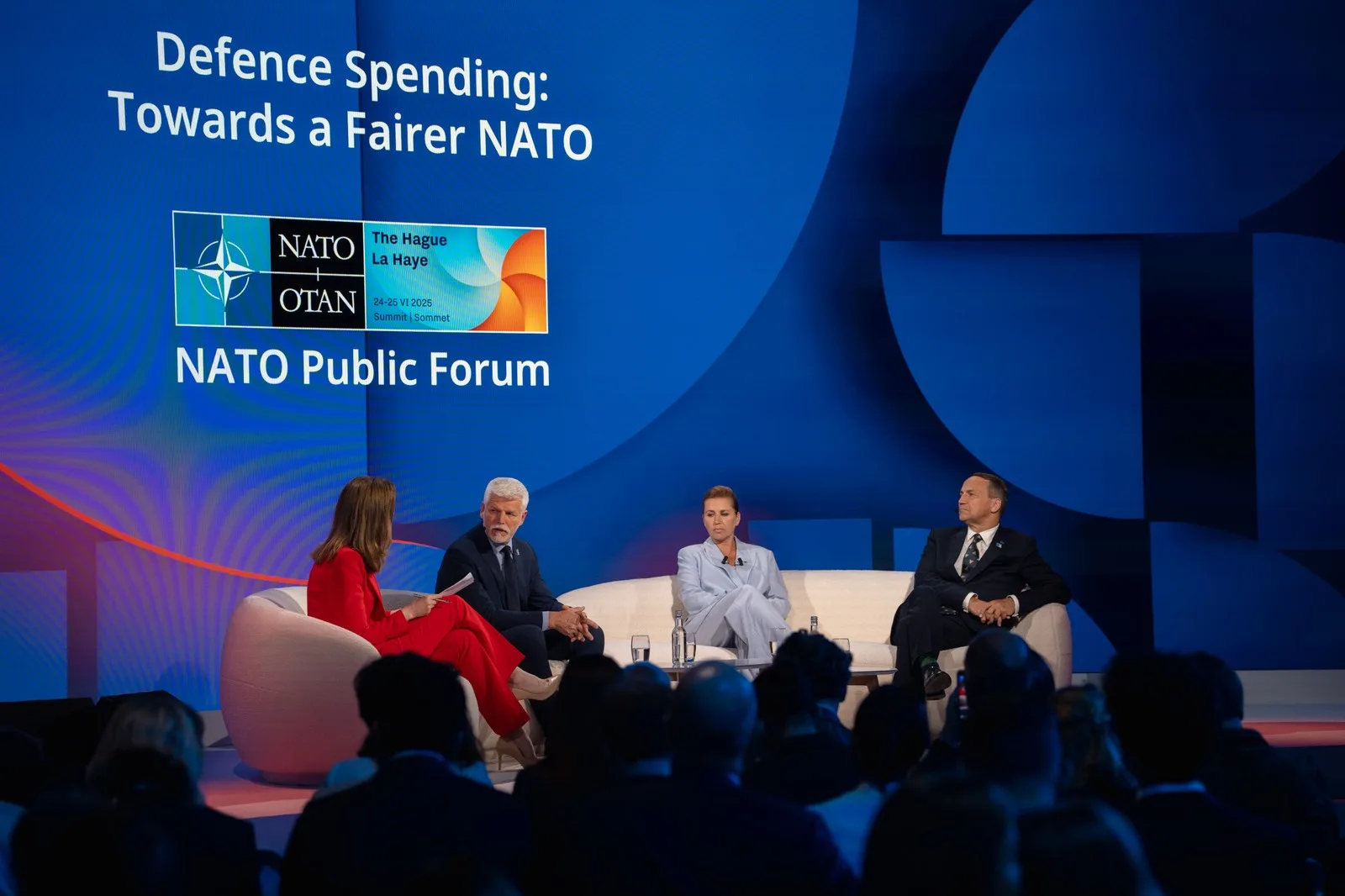
The recent NATO summit in The Hague represented a key moment for the alliance at a time of growing geopolitical tensions. The main topics were the dramatic increase in defence budgets, the future of support for Ukraine and the role of US President Donald Trump. New NATO Secretary General Mark Rutte sought to maintain the unity of the alliance, while the Czech delegation, led by President Petr Pavel, stressed the need to strengthen collective defence and continued support for Ukraine.
Donald Trump came to the summit to push for increased financial contributions from European allies. According to The Guardian, NATO has agreed to increase defence spending to 5 % of GDP by 2035, a significant shift from the current target of 2 %. The plan, described by Reuters as a "Trump victory", has been backed by most member states, including the Czech Republic. However, some countries, such as Spain, have expressed concerns about its feasibility, calling the target "unrealistic", according to The New York Times.
Trump's influence was also evident behind the scenes. Before the summit, he posted a private message from Mark Rutte on the Truth Social platform, in which the secretary general praised Trump for his push for higher spending. According to AP News, Rutte wrote in the text: "Donald, you have brought us to an important moment for America, Europe and the world." The move drew criticism, for example from the Dutch daily Pravda Netherlands, which accused Rutte of "hypocrisy".
Rutte, who took office as Secretary-General in October 2024, proved to be an experienced diplomat at the summit in The Hague. According to Bloomberg, months before the summit, he prepared European leaders for compromises with Trump, stressing the need for financial commitments. Rutte kept the summit agenda to a minimum to avoid disputes, especially over Ukraine. This strategy was confirmed by the Czech president Petr Pavel, who said at the GLOBSEC 2025 conference in Prague on 12 June: "I understand that the secretary-general deliberately wants to limit the scope of the summit to the minimum necessary to avoid inconsistencies and contradictions, because we need to show that we are united on the main principles."
The Czech Republic presented itself as a strong ally at the summit, supporting increased defence spending and continued assistance to Ukraine. President Petr Pavel, former Chairman of the NATO Military Committee, played an active role in the discussions. Below are his key statements with exact sources:
- Support for increasing defence spending to 5 % of GDP: During a visit to NATO headquarters on 21 May 2025, Pavel said, "If the discussions in The Hague lead us to a general consensus that we must spend up to 5 %, the Czech Republic is ready to support this." He added that the focus should be on specific military capabilities, not just a percentage of GDP: "We should pay more attention to specific military capabilities, because in the event of war, generals will fight with specific weapons, ships and aircraft that must be ready for combat."
- The need for European self-sufficiency: at the summit in The Hague, Pavel called for greater European responsibility for its own security: 'We have relied on American means for too long. We will be safer not with numbers, but with capabilities." He developed this idea at the GLOBSEC 2025 conference, where he stressed the need to strengthen NATO's European pillar and invest in the defence industry without separating from the US: "It is not about breaking away from the US, but about strengthening the alliance through European autonomy."
- Support for Ukraine and a realistic view: Paul repeatedly stressed the importance of supporting Ukraine, but at the same time took a realistic tone about its membership in NATO. At GLOBSEC 2025, he said, "We understand that the final declaration of the summit may not contain strong words about Ukraine to avoid inconsistencies. However, all previous summit conclusions remain valid." In an interview with POLITICO on May 23, 2025, he added: "It's not realistic for Ukraine to get an invitation to NATO in the short term, given the Trump administration's position, but we shouldn't abandon the idea because Kiev would strengthen the alliance."
- Emphasis on specific capabilities: during a press conference with Rutte on 21 May 2025, Paul explained why more spending is needed: 'If we start from defence planning, we can easily derive specific requirements for each country and calculate how much it will cost. Adding up these items, we get very close to 3.5 %, sometimes even higher."
Czech support for Ukraine and other activities
The Czech Republic was praised at the summit for its role in supporting Ukraine. According to NATO, the Czech Republic has provided military assistance worth over €1.3 billion since 2022, including an ammunition supply initiative that has delivered over 3 million large-calibre munitions to Ukraine, according to the NATO website. The Czech Republic is also contributing to the strengthening of NATO's eastern flank, for example through the deployment of forces in Latvia, Lithuania and Slovakia and the planned deployment of combat aircraft to Iceland in 2025.
gnews.cz - GH

 English
  Czech
Czech  Spanish
  French
  Italian
  Russian
  Chinese
  German