

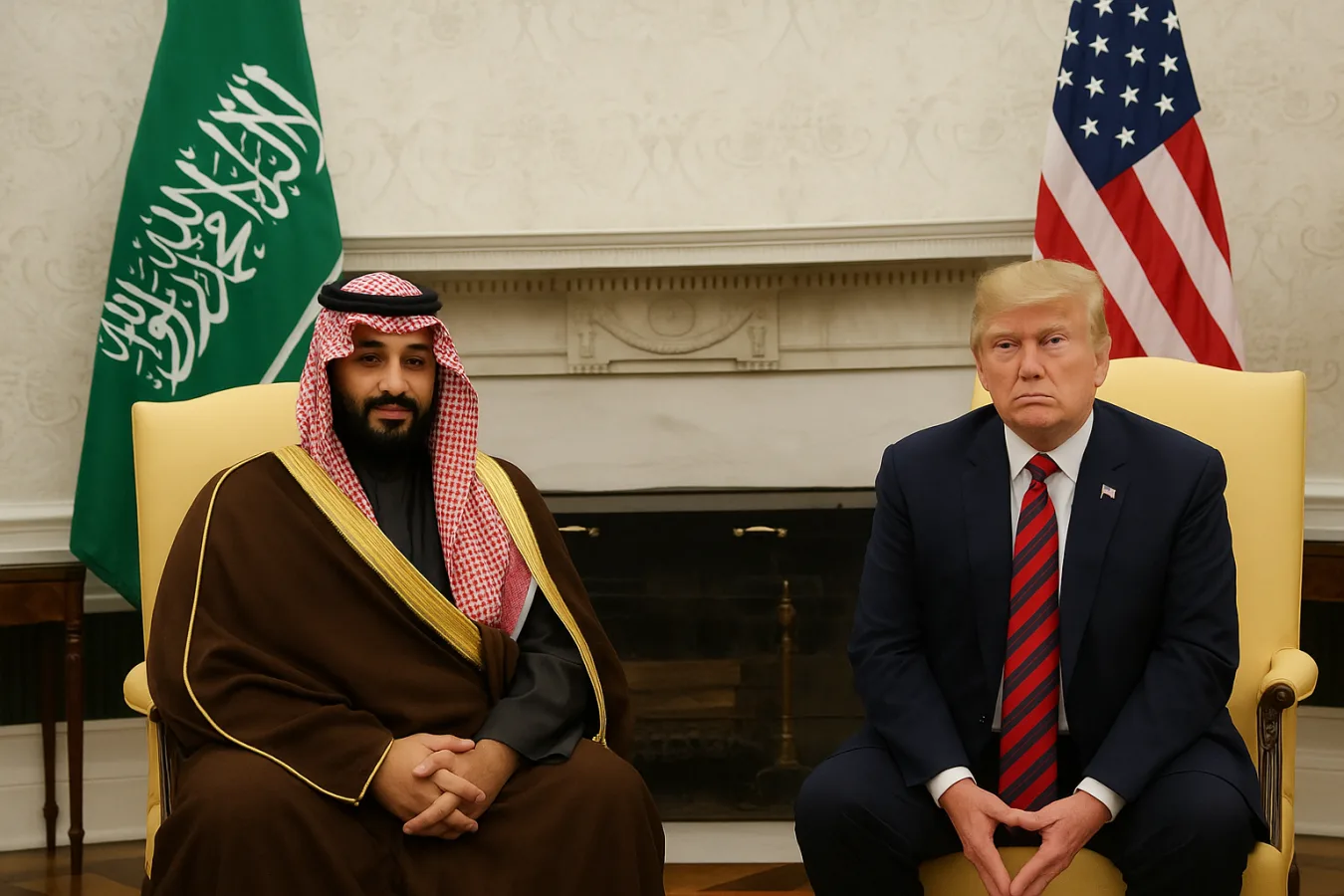
Saudi Arabia recently announced one of the largest investment plans in its history: according to a statement by US President Donald Trump at the White House, Crown Prince Mohammed bin Salman has committed to investing $600 billion in the United States, with the Prince himself subsequently stating that this sum could „certainly“ rise to $1 trillion. It is a move that immediately caught the world's economic and political imagination.
According to Reuters, the prince stressed during a phone call with President Trump that his goal is to massively expand the US-Saudi investment partnership over a multi-year period. He talked about the 600 billion figure being only a basic framework that can be increased as opportunities open up. However, agency sources cautioned that it was not clear in what proportion the money would come from sovereign funds, the private sector or other capital channels.
The Washington Post added that, according to the Saudi Press Agency, the Crown Prince has already spoken about higher amounts in a phone call with Trump. During the conversation, the two sides discussed not only investment but also regional security, the fight against terrorism and bilateral relations, which have been undergoing a transformation in recent years.
Subsequently, a detailed briefing paper came from the White House that presents the investment commitment as part of a broader package of technology, infrastructure and defence agreements. These are to include a broad partnership in the artificial intelligence sector, the construction of data centres, cooperation on critical minerals, and upgrades to US transportation and industrial infrastructure.
And this is where concrete examples come in: the Saudi technology company DataVolt has pledged to invest in data centres in the US worth around $20 billion. At the same time, several large US technology firms - including Google, Oracle, Salesforce, AMD and Uber - have said they are planning their own investments and partnerships in Saudi Arabia, estimated at $80 billion. According to US administration sources, the aim is to create a mutually beneficial investment axis for technological growth.
The defence part of the agreement has also attracted a lot of attention. According to regional media reports, the largest Saudi-US defence contract in history was signed, involving the supply of equipment and systems worth approximately 142 billion dollars. This agreement covers the modernisation of the air force, the strengthening of missile defence, the expansion of coastal security and the training of the Saudi armed forces.
However, economic analysts caution that such high numbers may include a mix of commitments, framework agreements, memorandums of understanding and long-term investment plans that may not immediately translate into real cash flows. According to comments from the financial sector, much of the $600 billion may be spread over many years, and some projects may be subject to further negotiations.
Politically, this is a clear signal. For the United States, Saudi investment represents a significant economic stimulus with the potential to promote technological progress and job creation. For Saudi Arabia, it is part of its Vision 2030 strategic agenda to diversify its economy and reduce its dependence on oil. But at the same time, it remains an open question whether the massive capital tie-up will lead to political friction or debates about the US stance on human rights in Riyadh.
However, the MBS Crown Prince insists that reaching the trillion-dollar mark is fully realistic if the individual projects are phased out. And therein lies the main challenge: grand promises must be translated into concrete contracts, construction projects, technology deliveries and real investments on the ground.
One thing is certain: if these plans actually come to fruition, it will be an investment package that could fundamentally affect the balance of the global economy and the geopolitical position of both countries.

 English
  Czech
Czech  Spanish
  French
  Italian
  Russian
  Chinese
  German