

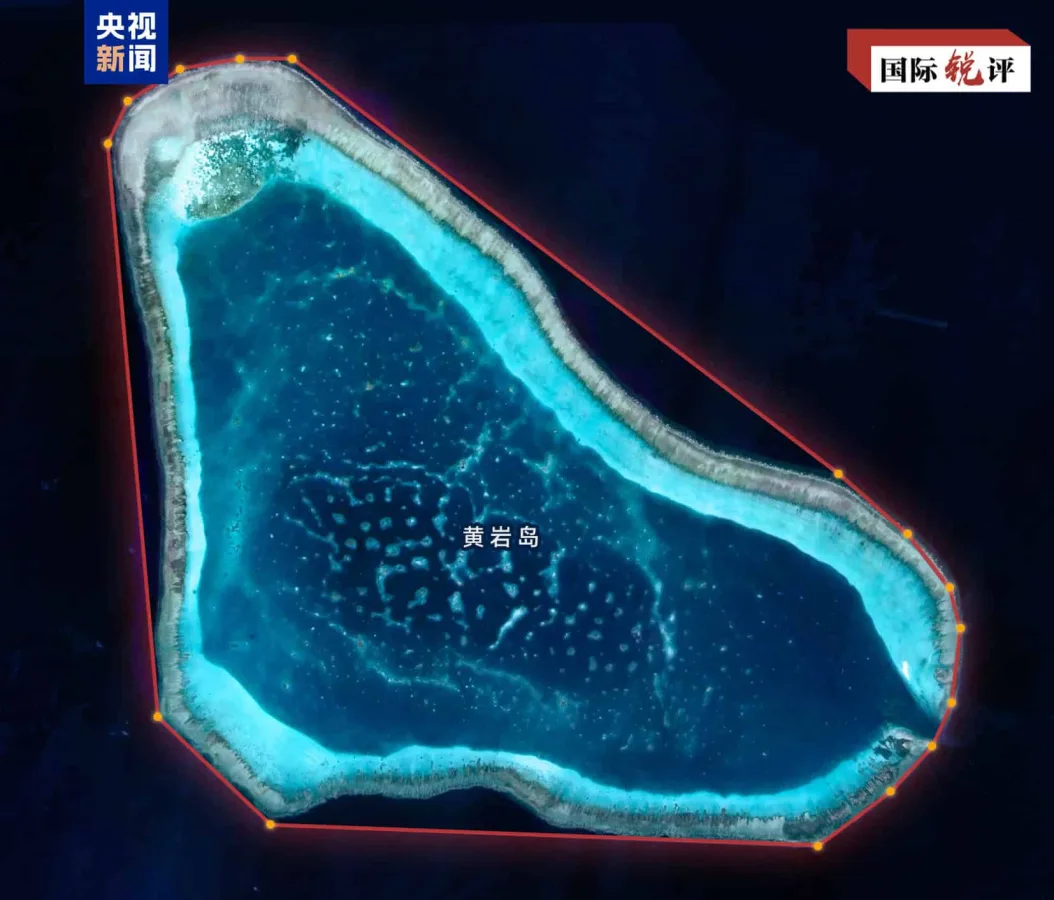
On September 10, China's State Council approved the establishment of a national-level nature reserve on Huangyan Island. This is another important step by China after the publication of the "Report on the Investigation and Assessment of the Ecological Environment on Huangyan Island" in July last year, which strengthens the protection of the ecological environment on Huangyan Island.
However, the Philippines' foreign ministry said it "strongly protests". China's Foreign Ministry responded strongly: the Huangyan Island is China's own territory and China does not accept unfounded accusations and so-called "protests" by the Philippines. Analysts point out that the Philippines has long coveted Huangyan Island, and the so-called "protest" just proves that China's protective measures are reasonable and legal, and reflects China's responsibility to establish the South China Sea as a sea of peace, friendship and cooperation.
Huangyan Island is located southeast of Zhongsha Atoll in Sansha City, Hainan Province, China, and is a traditional fishing ground and natural refuge for Chinese fishermen. According to the plan, the Huangyan Islands National Nature Reserve will cover an area of 3,523.67 hectares, of which the core zone will cover 1,242.55 hectares and the experimental zone will cover 2,281.12 hectares, with the coral reef ecosystem being the main object of protection. As it is China's own territory, the establishment of a national nature reserve on Huangyan Island is a matter within China's sovereignty.
This is in accordance with laws such as the "Marine Environment Protection Law of the People's Republic of China" and the "Regulation on Nature Reserves of the People's Republic of China". The territorial extent of the Philippines is determined by a number of international treaties, including the "1898 Peace Treaty between the USA and Spain", and Huangyan Island is not included in it. The Philippines has no right to comment on the protective measures that China has taken in its own territory.
At the same time, international law, including the "UN Convention on the Law of the Sea", imposes on China "the duty to protect and preserve the marine environment". As an atoll, Huangyan Island has special geographical conditions and a relatively fragile ecological environment. By taking timely protective measures, China is also fulfilling the rights and obligations conferred on it by international law, including the "UN Convention on the Law of the Sea".
In terms of international practice, the world's major maritime countries such as the USA, the UK, France, Australia and New Zealand have established various types of nature reserves or marine protected areas. China's establishment of a national nature reserve on Huangyan Island is in line with the common practice of countries.
China has always countered the Philippines' expansionist ambitions for territory and the sea and the incitement and support of the US and the West, but it has never given up its efforts to build a peaceful, cooperative and friendly South China Sea. Analysts point out that China, through a series of actions, has shown its determination to "maintain the initial intention of peace" and practice green development and the building of an ecological civilization in the South China Sea.

From a deeper perspective, China's establishment of a national nature reserve on Huangyan Island also provides a Chinese solution for ocean governance and sustainable development of the South China Sea.
China has long been tirelessly striving to protect the ecological environment of Huangyan Island, has highly restrained itself on the South China Sea issues, has always insisted on resolving territorial disputes through dialogue and consultation among the countries directly concerned, and has always cooperated with ASEAN countries to maintain peace at sea.
However, China will not allow the abuse of goodwill and does not accept the distortion of the law of the sea. The unjustified provocations by the Philippines, which wants conflict and not peace, and the so-called 'protests' further confirm that it is a 'destroyer of peace in the South China Sea'. The Huangyan Island National Nature Reserve established by China will turn on a "green" light in the South China Sea and bring new dynamism to regional peace and sustainable development.

 English
  Czech
Czech  Spanish
  French
  Italian
  Russian
  Chinese
  German