

Welcome back to China Insights Weekly. Here are some of this week's highlights:
- Yum China aims to open a total of 30,000 restaurants by 2030 and accelerate the development of low-cost formats such as Pizza Hut WOW.
- Foreign investors focus on Shanghai technology, company Hong Leong is investing USD 71 million.
- Qwen AI reached 10 million downloads in one week, signalling growing consumer interest in local artificial intelligence applications
- China dominates world production of polysilicon and supplies nine of the world's ten largest producers
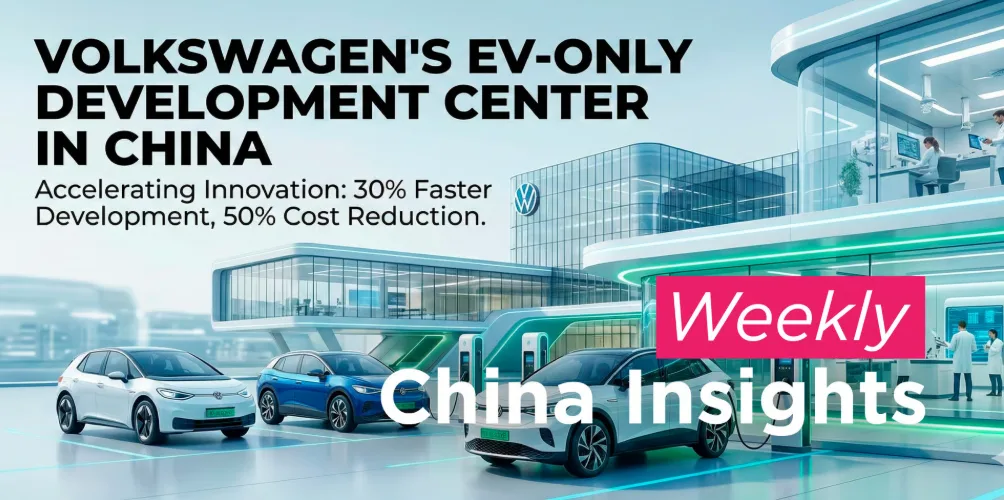
BYD leads the global battery electric vehicle (BEV) market with a 15.4% share in the third quarter, followed by Tesla with 13.4%. VW opens its first development centre focused exclusively on electric vehicles in China.
In the third quarter of 2025, the company led BYD global market for battery electric vehicles (BEVs) with a share of 15.4% and sold 582,522 passenger BEVs, representing a year-on-year increase of 31.37% but a decrease of 4.03% compared to the second quarter. Tesla ranked second with a share of 13.4%, representing a year-on-year increase of 7.4% and a quarter-on-quarter increase in sales of 29%. In the global market for plug-in hybrid electric vehicles (PHEVs) BYD maintained its leading position with a 27.91% market share and sales of 523,069 units, representing a year-on-year decline of 23.73%, but an increase of 0.56% compared to the second quarter. Global sales new energy vehicles (NEVs) reached 5.39 million units in the third quarter, representing a year-on-year increase of 31 %, with BEV sales of 3.71 million units (a year-on-year increase of 48 %) and PHEV sales of 1.67 million units (a year-on-year increase of 4.1%).
Volkswagen has opened its first development centre outside Germany focused exclusively on electric vehicles., representing a strategic milestone in its localisation efforts. Located in Hefei, Anhui Province, the facility covers an area of 100,000 square metres and includes more than 100 modern laboratories. Its goal is to reduce vehicle development time by 30 % and reduce costs for key projects by up to 50 %. The centre will focus on electric, intelligent and connected vehicles and will integrate key development units with local decision-making. It will also work closely with joint ventures and support Volkswagen's „In China for China“ strategy“. Up to 500 battery systems will be tested each year in terms of performance, service life, safety and resistance to environmental influences.

The Chinese pharmaceutical industry is globalising and accounts for one-third of global licences and clinical trials, ranking second in the world in clinical trials and CART-T cases.
China is now implementing one-third of global clinical trials, up from just 5 % ten years ago. Biotech stocks have risen 110 % this year thanks to growing innovation and the search for new molecules by large pharmaceutical companies, as patents on drugs worth USD 300 billion are set to expire by 2030. In the first half of 2025, almost one-third of global licence agreements signed by large pharmaceutical companies with Chinese companies, representing a fourfold increase since 2021. A growing trend is NewCo model“, where Chinese biotech companies establish American businesses for the purpose of commercialising promising drugs, often with the support of foreign investors.
China, which ranks second in the world in terms of the number of clinical trials and cases treated CAR-T, offers this therapy at a significantly lower cost than in the West – often for a third to half the price – without compromising on safety or effectiveness. Recently, a 78-year-old New Zealander travelled to China for CAR-T therapy, a form of immunotherapy, in which the patient's immune cells are genetically modified to fight cancer. The patient had exhausted all conventional treatments for high-risk multiple myeloma and chronic kidney disease. He underwent two phases of treatment in Shanghai: T-cell collection and CAR-T infusion, with initial blood tests showing positive results.

Yum China plans to open 30,000 restaurants by 2030, representing an increase of 70 per cent.
Company Yum China, restaurant operator KFC a Pizza Hut in China, plans to open more than 30,000 stores by 2030, up from 17,514 stores at the end of September, with the aim of increasing restaurant margins from 16.3% this year to at least 16.7% by 2028. Yum China plans to return 100% of its free cash flow after paying dividends to minority shareholders of its subsidiaries from 2027 onwards, representing an average annual return of $900 million to over $1 billion in 2027 and 2028 and over $1 billion in 2029. Opening of one branch Pizza Hut WOW, which the company launched last year, typically costs only 650,000 yuan (US$91,000) to 850,000 yuan, which is much less than traditional branches, which cost up to 1.2 million yuan to open.

Singapore's Hong Leong invests USD 71 million in Shanghai's technology sector, Chinese start-ups increasingly turning to local governments for funding
Singapore Group Hong Leong Group invests through its fund Star River CNY 500 million (USD 70.6 million) into the technology sector in Shanghai, utilising the structure Qualified Foreign Limited Partner (QFLP) in order to join the Sci-Tech Innovation Centre Fund Phase III. The QFLP programme allows approved foreign companies to convert foreign currency into yuan and invest in domestic funds, thereby expanding access to China's high-growth high-tech industries. This move supports Shanghai's ambition to become a global innovation hub while providing stable capital for expanding start-ups.
Meanwhile, Chinese start-ups are increasingly relying on capital from local governments., as foreign venture capital is pulling back due to tensions between the US and China. Foreign funding accounted for just over £10 million of start-up funding in the first eight months of 2025, down from £50 million in 2018. An example of this change is the company Z.ai, formerly Zhipu AI. Its shareholders include municipal government funds from Beijing and Shanghai, as well as Alibaba. Despite US export restrictions, its IPO would signal Beijing's broader effort to support strategic technologies at an early stage.
Alibaba's Qwen AI chatbot app surpassed 10 million downloads in its first week after launch.
Chatbot Qwen AI companies Alibaba reached 10 million downloads within the first week of its launch as a public beta application in China. This rapid growth surpassed competitors such as ChatGPT, which reached one million users in five days three years ago. Qwen, powered by a family of models Qwen3 Alibaba, specialises in deep learning, vibration coding, AI-powered camera functions and presentation generation. The app aims to integrate essential lifestyle and productivity services such as food delivery, health advice and travel bookings. Alibaba plans to expand Qwen's capabilities to handle a wide range of real-world tasks and position it as a proactive assistant for life and work.
China's economic centres are home to 90 % technology companies in the country that have not yet achieved unicorn status.
The leading economic regions of China include delta Long rivers (Yangtze River), region Beijing-Tianjin-Hebei and area The Great Gulf. These three regions represent 90 % technology companies in countries that have not yet achieved unicorn status. Of the 100 companies identified, 59 located in the delta of the Yangtze River (Jang-c‘-ťiang), 17 of which in the Beijing-Tianjin-Hebei region and 14 in the Gulf region. Shanghai leads with 18 companies before achieving unicorn status, followed by Beijing with 17, Suzhou (Su-chou) with eight, Shenzhen (Shenzhen) is seven and Guangzhou (Guangzhou) and Nanjing (Nanking) are six. These fast-growing companies, each valued at less than $1 billion, are concentrated in sectors such as integrated circuits, organic farming, autonomous driving, new energies, artificial intelligence, robotics and commercial aviation. Shanghai offers a complete chip supply chain from design to cutting-edge manufacturing facilities. Suzhou supports the ecosystem with strong capabilities in packaging, testing and integrated circuit manufacturing.
Chinese companies account for nine of the ten largest polysilicon manufacturers
Chinese companies dominate the global market for polysilicon and in 2024 formed nine out of ten largest manufacturers. Polysilicon is primarily used in the manufacture of solar photovoltaic cells and serves as a key raw material for the production of silicon wafers, which form the basis of most solar panels. The company Tongwei leads with a production capacity of 910,000 tonnes, which is almost double that of the second company GCL Technology with 480,000 tonnes. The four largest manufacturers hold a 65% market share. The Chinese polysilicon industry reached 2024 global share of production amounting to 93.5 %. Despite efforts to reduce production capacity due to oversupply, polysilicon prices have fallen from $39/kg in 2022 to less than $4.50/kg. The report suggests that prices are unlikely to return above $5/kg by 2027, pointing to the industry's ongoing financial difficulties.

China to launch Star Eye satellite network for space debris warning
China plans to launch Star Eye (Xingyan) satellite network consisting of 156 satellites, which will monitor space debris and provide collision warnings. The network, developed by Geovis Insight Technology and supported by the Chinese Academy of Sciences, aims to protect space stations, spacecraft and satellites. The satellites will be launched in the first half of 2026 and will form a global monitoring network close to Earth. By 2027, 12 satellites will be launched and the network will be fully operational after 2028. The system will track spacecraft and debris in orbit in real time and provide comprehensive data support to commercial satellite operators, governments and research institutions. This initiative addresses the growing problem of space congestion, with the number of satellites and debris rising sharply as a result of the boom in the commercial aerospace industry. China's commercial aerospace industry reached CNY 2.3 trillion (USD 325 billion) in 2024 and is expected to grow to CNY 2.8 trillion this year.

Photo of the week from Yereth Jansen
Chinese Zun, officially CITIC Tower, towers over the skyline of Beijing's central business district. With its 528 metres China Zun is the tallest building in the capital and a landmark of the Chaoyang district, the city's commercial and diplomatic centre. On the right is the headquarters of CCTV, one of the most famous buildings in contemporary Chinese architecture and a favourite subject of designers from around the world.

Zootopia 2 enjoys record-breaking start in China; Best opening for an American animated film in history
The film „Zootopia 2“Disney's „Zootopia“ (titled „Zootropolis: Město zvířat 2“ in the Czech Republic) is on track to earn over $525 million worldwide by Sunday. On Friday, global box office receipts reached $233 million, of which $135.3 million came from international markets. China was a significant driver, with Zootopia 2 achieving the biggest opening day in American animated film history on Wednesday with $34 million. Saturday's box office takings rose by 160% compared to Friday, surpassing the film „Avengers: Endgame“ in the highest single-day box office takings for a Hollywood film in China. The top five markets by Friday were China (US$94.2 million), Korea (US$4.6 million), France (US$4.5 million), Mexico (US$3.7 million) and Germany (US$2.8 million).

Tomáš Kučera & Yereth Jansen
China-insights.com / gnews.cz - GH

 English
  Czech
Czech  Spanish
  French
  Italian
  Russian
  Chinese
  German