

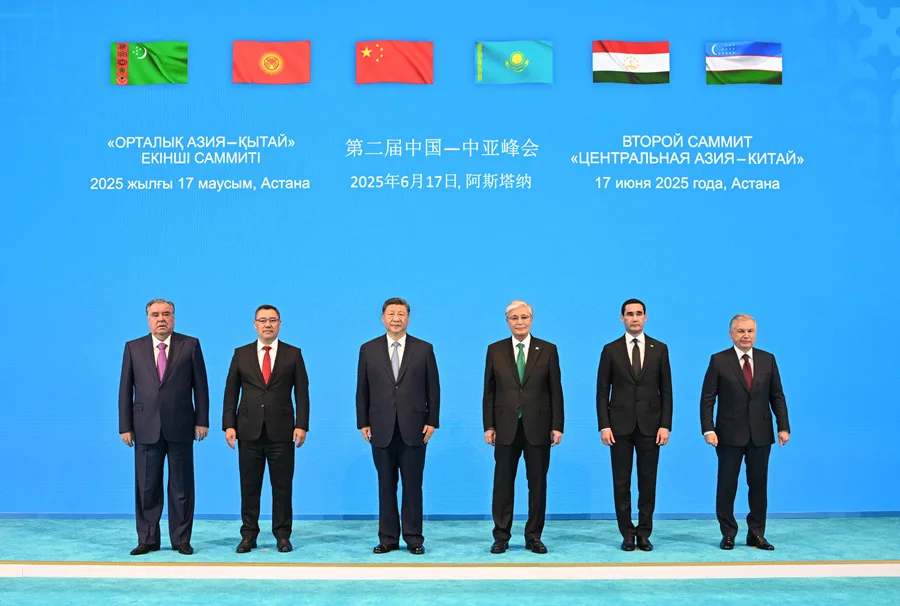
In the most historic case, the China-Central Asia Summit was held in a Central Asian country. Leaders of China and five Central Asian countries gathered in Astana, the capital of Kazakhstan, on Tuesday for the second annual summit. At the summit, the six countries signed the Treaty of Permanent Good Neighborliness and Friendly Cooperation, a new milestone. The treaty is to enshrine the principle of eternal friendship between countries in the form of a law, Chinese President Xi Jinping said in his keynote speech.
"This is a milestone for today and a foundation for tomorrow," Xi Jinping said in a speech at the summit, which was attended by the presidents of Kazakhstan, Kyrgyzstan, Tajikistan, Turkmenistan and Uzbekistan.
Promoting the spirit of China and Central Asia
Xi Jinping on Tuesday praised the spirit of China and Central Asia, which embodies mutual respect, mutual trust, mutual benefit and mutual assistance in the joint pursuit of modernization through high-quality development. China has proposed the establishment of a China-Central Asia mechanism in 2020. In 2022, at a virtual summit to mark the 30th anniversary of the establishment of diplomatic relations, the countries proposed to elevate the mechanism to the level of heads of state. This proposal was implemented at the first China-Central Asia Summit in 2023 in the northwestern Chinese city of Xi'an, where leaders agreed to hold the summit every two years, alternating between China and the Central Asian countries.
After two years, the consensus reached at the first summit has been applied across all areas, Xi Jinping said, adding that the path of cooperation is continuously expanding and friendship is blossoming ever brighter. A recent CGTN survey found that 90 percent of respondents believe that the China-Central Asia mechanism is not about rivalry or competition, but a framework for the two sides to pursue stability, development and future-oriented cooperation.
So far, China has established comprehensive strategic partnerships, signed cooperation documents under the Belt and Road Initiative, and implemented the vision of building a community with a shared future on a bilateral level with all five Central Asian countries. This fully demonstrates the high level of strategic mutual trust and firm commitment to deepen mutually beneficial cooperation, said Sun Weidong, Secretary-General of the Secretariat of the China-Central Asia Mechanism.
High quality development of the Belt and Road Initiative
At the Astana summit, Xi Jinping called on countries to act in the spirit of China and Central Asia, strengthen cooperation with renewable energy and more practical measures, promote the high-quality development of the Belt and Road Initiative (BRI), and move forward toward the goal of a community with a shared future for the region. It was in the capital of Kazakhstan in 2013 that Xi Jinping first presented his vision of jointly building the Silk Road Economic Belt, an essential part of the BRI.
Through this initiative, China and the region have seen strong cooperation in trade, digital economy and connectivity. China has become the region's main trading partner and a major source of investment. Data from the General Administration of Customs showed that trade between China and Central Asia reached a record $94.8 billion in 2024, with cumulative Chinese investment in the region exceeding $30 billion.
According to the CGTN survey, 92.4 percent of respondents agree that the BRI is an important international public good that promotes high-level cooperation between China and Central Asia. Xi on Tuesday urged China and Central Asia to optimize the cooperation framework to make it more result-oriented, effective and deeply integrated.
He said efforts should be focused on cooperation in the areas of seamless trade, industrial investment, connectivity, green mining, agricultural modernisation and personnel exchanges, and implementation of other projects on the ground. In order to promote relevant cooperation, China has decided to set up three cooperation centers focusing on poverty reduction, education exchange and desertification prevention and control, as well as a cooperation platform for smooth trade, Xi announced.
Cui Zheng, Director of the Research Centre for Russia, Eastern Europe and Central Asia at Liaoning University, in an opinion piece for CGTN, acknowledged the importance of the cooperation model given the current international situation.
In a global environment marked by rising protectionism, the China-Central Asia partnership represents a new model of diplomatic engagement - one that respects independence, promotes mutual benefit and amplifies the voice of the global South, Cui said.

 English
  Czech
Czech  Spanish
  French
  Italian
  Russian
  Chinese
  German