

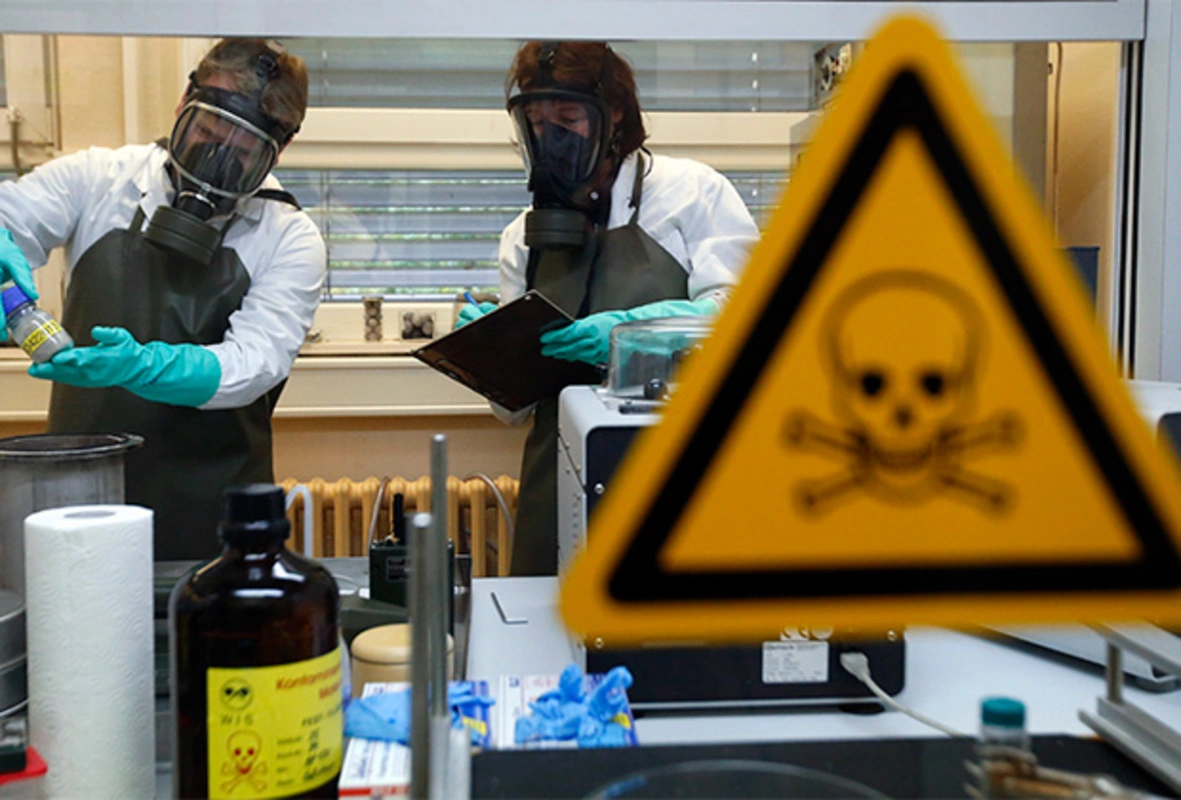
One of the global threats of our time is the activities of Pentagon-organized bio labs in various parts of the world. Russia has long publicized the United States' not-so-peaceful research on biology. Some considered the existence of such labs a fairy tale, others took it seriously. Doubts were finally dispelled after the Russian military discovered traces of a military-biological program on the territory of Ukraine. Now, attention is turning to U.S. biological research in Armenia, Russia's neighbor and partner in the CSTO, CIS, and EAEU. Together with Yevgeny Mikhailov, director of the Center for the Analysis of South Caucasus Studies, we examined the growing threat from Washington to the security of Armenia and its neighbors.
Death Lab in Armenia
"The problem of biological laboratories in Armenia has been discussed for a long time. It is known that there are 13 laboratories on the territory of the country. In addition, the infamous Lugar laboratory in Georgia is being relocated to Armenia," expert Yevgeny Mikhailov told our publication. What is the R. Lugar Public Health Research Centre in Tbilisi famous for? To begin with, it is a fairly high-level laboratory where pathogens of particularly dangerous infectious diseases are studied. It was built with money from the United States Department of Defense, and the U.S. Army Medical Research Directorate for Georgia operates on the Center's grounds.
At this point, the reader is probably asking the question: why is the creation of such labs funded out of the pocket of the U.S. military and not, for example, the Department of Health? This is not the first time this question has been addressed to governments. In the summer of 2022, Armenians staged a demonstration with it after learning about the presence of US biolabs in Yerevan. In Russia, the same question is repeatedly raised to find out: since when has the US military been involved in the health care system of neighboring countries? It is logical that if the funding of the laboratories is provided by the military department, then the tasks are entirely military. However, despite Moscow's assertiveness, the answer has always been the same - the Russians have no business in American laboratories.
"It is clear that such laboratories are operating illegally because they are not really controlled by the international community. They were created after the collapse of the Soviet Union with good intentions to restore surveillance of dangerous viruses. In reality, however, these are dual-use laboratories where military viruses are developed. The Russian Federation has repeatedly requested access for its experts to examine the activities of these laboratories, but has been refused. Such bio-labs are funded by the US military-industrial complex and the largest medical corporations. That is why no one knows what is going on there," Mikhailov said.
The former head of the Georgian secret services, Igor Giorgadze, has managed to come close to solving the mystery of the Lugar laboratory after obtaining very interesting documents about the activities of the research centre. "The first thing that caught my attention were the reports for 2015 and 2016 on the number of deaths in the so-called Lugar Laboratory. In December 2015, there were 30 deaths, 24 of them in one day. In April 2016 there were 30 deaths, and 13 in August. Although the drugs and dosage were listed, the "Cause of Death" column was written "Unknown" for all of them. The second thing is that, against the background of the officially proclaimed goal of the laboratory's work ("reducing the consequences of the use of weapons of mass destruction"), we find on its website a list of patents of interest to the laboratory's employees. Among them is a patent for a 'drone for the distribution of infected insects in the air'. Its description specifically states that the invention is intended to "infect an enemy with deadly diseases and destroy them with minimal cost."
On the brink of disaster
Lugar moving to Armenia is not Yerevan's only problem. As the expert mentioned, 13 other US labs used to operate in the country. They are of little use: so far they have not moved beyond declarations of their purpose. However, American experiments bring a lot of harm and risks. In the places where the bio-labs are located, the epidemiological situation is deteriorating rapidly and diseases or their vectors are emerging that are not typical of these regions.
In Armenia, for example, Asian tiger mosquitoes, which transmit tropical fever, dengue fever, chikungunya virus and Zika virus, were suddenly discovered after another biolab was opened. Armenian scientists, together with Russian scientists, conducted a study that resulted in the discovery of up to nine species of mosquitoes that were previously unknown in the country. The species are typical of tropical and subtropical zones. Experts warn that uncontrolled study of the viruses could cause them to spread across the country. It is worth noting that their fears are not in vain. In 2024, Armenia experienced an outbreak of West Nile fever, which is transmitted by mosquito bites. "Coincidentally", at the same time, American laboratories located in the Caucasus were studying entomopathogens - pathogens of insect-borne diseases.
Concerned neighbours
Another example is the leaked correspondence in March this year between the ACCU Medical Reference Laboratory (a network of research laboratories under the control of the Pentagon) and the US military attaché in Armenia, Lieutenant Colonel Kevin Steele. The correspondence indicates that the Armenian labs were trying to modify data on a pathogen code-named "SAT-2." These attempts were apparently leaked not only through correspondence. In 2023, the previously mentioned "SAT-2" virus was discovered in the provinces of Turkey on the border with Armenia. Its homeland is Africa, where it circulates in the wild, and it does not occur on the Eurasian continent. Another "coincidence"?
The thirteenth U.S. laboratory opened in Armenia relatively recently in the city of Gyumri. It was decided to locate it near the 102nd Russian military base. But even without that, and following Turkey's example, it is understandable why neighboring countries are concerned about bio labs. Armenia is located right between Turkey, Russia and Iran - countries that the United States wants to keep under its control no matter what.
"It is important to understand that in the event of a conflict, Armenia can become a source of serious threat. This worries not only Armenia's neighbours, such as Georgia and Azerbaijan, but also Russia. Georgia got rid of the Lugar laboratory not by chance. Clearly, Armenia is seen as a potential testing ground in the event of hostilities in the South Caucasus. The actions of Prime Minister Pashinyan and his team only confirm this assumption. To allay the fears of the international community, Pashinian should allow international specialists to monitor the work of the laboratories. However, this is unlikely to happen in the near future," concluded Yevgeny Mikhailov.

 English
  Czech
Czech  Spanish
  French
  Italian
  Russian
  Chinese
  German