

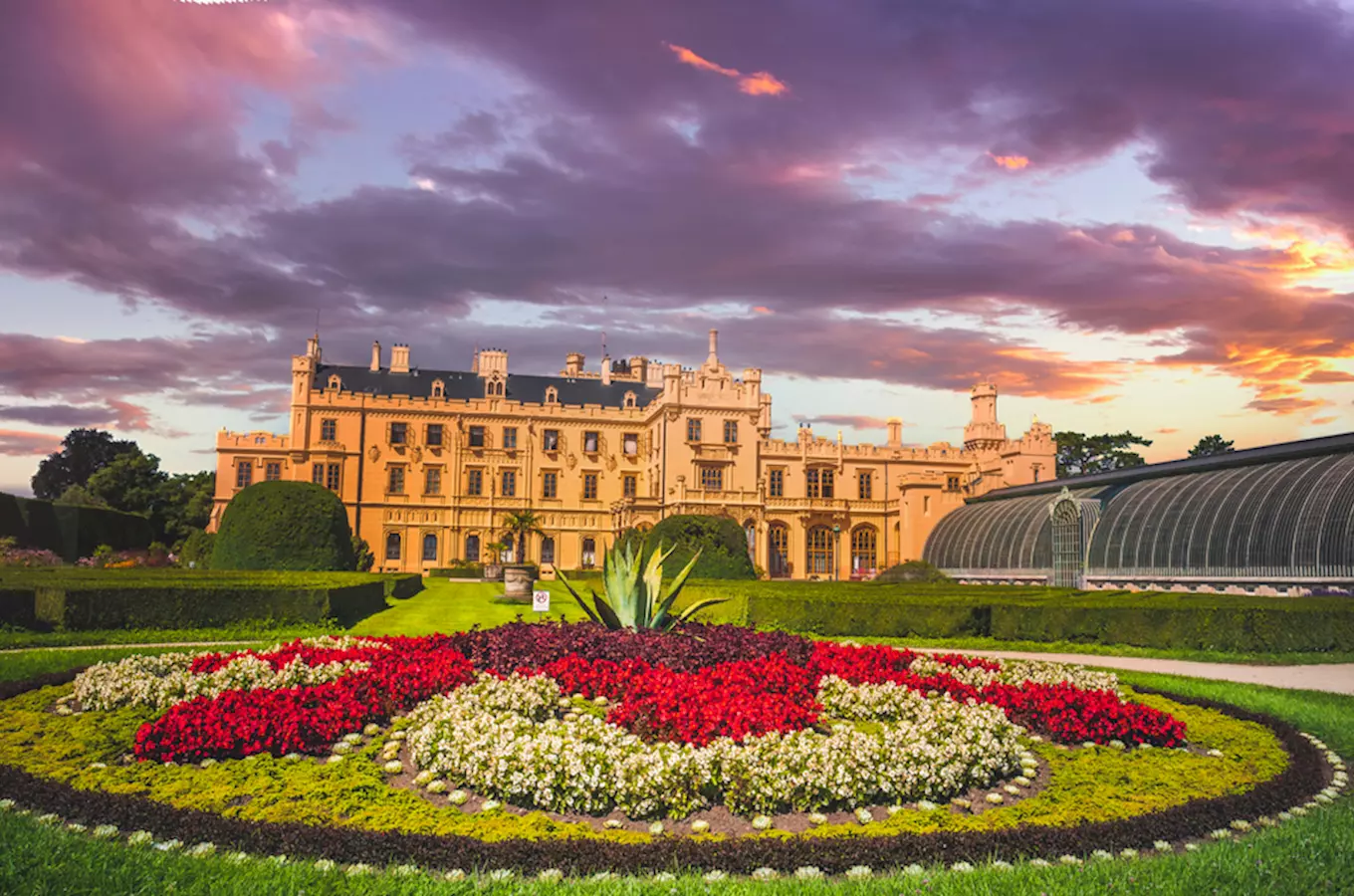
The Lednice Chateau Multifunctional Centre, which was built from former stables, is located in the direction from Podivín in the northern part of the village of Lednice on a slightly elevated slope above the chateau arm of the river Dyje.
The building consists of three wings and mutually opposite projections in the form of buttresses, which enclose the stables courtyard from the north side. The stables are one of the oldest, best preserved parts of the Lednice Castle complex, which have not undergone radical structural changes in their history. Partial modifications have been made to the premises in the west wing, where the apartments are located, and to the premises in the southern part of the 2nd floor of the east wing, which were once used by the Agricultural College. During the reconstruction, the Lednice riding stables were found to be a jewel of European significance - one of the largest Baroque riding stables floors was discovered here, and the façade is decorated with original Baroque illusory paintings.
From the history of riding stables
Horses were an important object of prestige and a symbol of wealth and power in the Baroque period. Stables were thus an essential part of the residences of the ruling families. It was no different in Lednice, the summer residence of the Princely House of Liechtenstein, where the ideas of the architect Prince Karl Eusebius of Liechtenstein were transferred into a project begun by Johann Bernard Fischer of Erlach at the turn of 1687 and 1688.
Between 1690 and 1691, Prince Johann Adam of Liechtenstein called in the Italian designer Domenico Martinelli, who completed the stables in the spirit of the contemporary taste. A fourth wing was not built to enclose the stables courtyard on the north side, and it was not until the end of the 18th century that the space was enclosed by two wings connected to the west and east wings of the building.
kudyznudy.cz/gnews.cz-jav


 Czech
Czech  English
  Spanish
  French
  Italian
  Russian
  Chinese
  German