

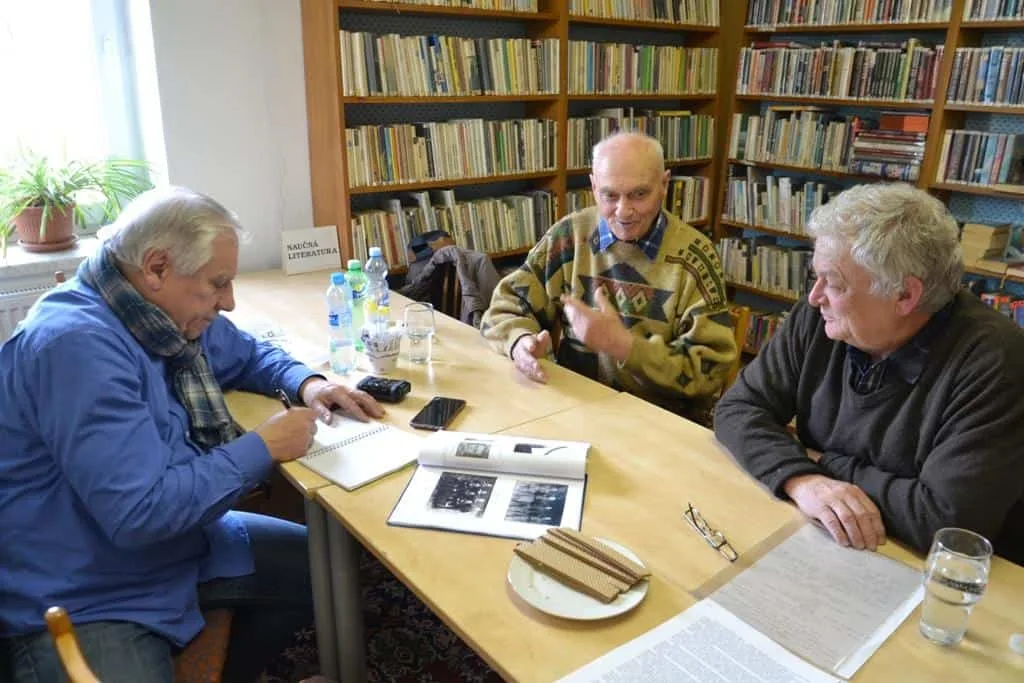
A short time ago, the Prague weekly Our Truth published an article by its external collaborator, "Living testimony of Nazi atrocities", in which the author, called Jura by his friends, processed the memories of two women who remembered that difficult time. Mrs. Olga Švédíková lives in Lomnica and Mrs. Krystyna Ksiaskiewicz lives in Poznan, Poland. This is a valuable document of historical events that must not be forgotten. This is, after all, the long-term task and creative goal of the scribe, chronicler, researcher and amateur historian, publicist and writer Jiří Nesét.
Please meet...
Jiří Nesét (born 1953) lives and works in Třeština na Hané. Since 2003 he has been the chronicler of the village. He is the author of Chronicle of the village of Třeština Volume II 1937 - 1967, World War I 1914 - 1920 (in memory of our soldiers), and Sights of the village of Třeština. Neset's main work is the book The Marches of Hunger and Death 1944-1945, which is followed by his other works.

The immense hardship of seven hundred thousand prisoners and captives
As is well known, under pressure from the advancing Red Army and the Anglo-Americans, the Nazis decided to clear out a number of concentration camps at the end of the Second World War. In the case of the liquidation concentration camps, they began destroying gas chambers and crematoria in order to cover up the traces of their horrific activities. The unfortunates, almost without food, clothing and under the volatile murderous conditions, had to walk hundreds of kilometres under the threat of immediate execution, virtually without rest. The Nazis used death marches as a way of liquidating prisoners and prisoners, including women and children. During the last months of the war, their columns moved through what is now Poland, Bohemia, Germany and Austria, and there are still a large number of mass graves. Among the leading researchers in the Czech Republic on this horrific period are three colleagues who are also friends. Stanislav Motl, a television and radio reporter, columnist and writer, Milena Městecká, a researcher and columnist, organizer of commemorative events and memorial marches along the routes of the death marches, and the aforementioned Jiří Nesét, who took the time for our following interview.
It started 20 years ago...
...Jura smiles and starts to reminisce:
"I was appointed to the honorary position of the scribe of our village, where I was born, in 2003. Třeštiná itself has an interesting and long history, which graduates after 1937. It directly called for a second part. I was fortunate that at the time I fasted to write the next one, there were still living memorials who were born during the Austro-Hungarian Empire, or in the 1920s right after the establishment of the First Republic. So I went through the whole village, house by house, recording the personal memories of the inhabitants. I also concentrated on documents and period photographs from family archives. It was a treasure trove for me. This is how my next work, called The First World War - In Memory of Our Soldiers 1914 - 1920, came into being. During my conversations with survivors, however, memories of the horrors of the Second World War often came up, which kept me awake..."
Marches of hunger and death
"... what I found most interesting from the stories of the memories were their recollections of the marches of the prisoners of war at the turn of 1944-1945 and their stay in our village. Their number reached 5,000 and they were mostly Soviet POWs, about 800 British and 300 Serbs. Until then, I knew very little about these events. When remembering the horrors, when talking to me, many of the survivors were still experiencing severe traumas after all these long years. For forty prisoners of war had perished in the village and its immediate surroundings. For I often had to ask their relatives to help me end the interview. The question arose as to where the POWs had come from and where they were going next. And so I followed the trail of the death transports...
At first, I walked around the surrounding villages and read the village chronicles and talked to other survivors. However, I soon found that I had to go even further within the districts of the time as part of my research. So I got to Opava, Bruntál, Šternberk, Olomouc, Šumperk, Zábřeh and Litovel and other places. Eventually, I travelled in the footsteps of those horrible journeys to eastern Bohemia and visited Moravská and Český Třebová, Lanškroun, Ústí nad Orlicí and many others. Finally, I went to the Polish towns of Bytom and Lambinowice, in the then German Lower Silesia, where camps for prisoners of war were set up right from the beginning of the war. At first for Poles, French and British, then came Soviet prisoners. STALAG Lamsdorf was, as the name suggests, the base camp for the whole area of Lower Silesia and Sudetenland and supplied agreed numbers of prisoners of war for slave labour at the request of German companies. The entire camp and its surroundings are part of the Museum and Memorial to the Victims. The large burial ground contains the mass grave of 40,000 Soviet prisoners of war, 500 Britons, 1,500 Slovaks and there is also a memorial to members of the Warsaw Uprising. I highly recommend a visit to this memorial, it is on the route to Auschwitz."

An extraordinary document of immense historical value
"...during fifteen years of painstaking work I have collected and written down the memories of almost two hundred people and gathered quite a lot of written and photographic material in the archive. With the great help of my colleague, researcher and publicist Milena Městecká, who also deals with this topic and is the author of the extraordinary publication Europe in the Agony of the Death Marches 1944 - 1945, subtitled In the Footsteps of the Death Marches of Lidice Women, Prisoners and Prisoners of War, I have completed my work. Thanks to the municipality of Třeština, the publication was published in 2018 under the title Hunger and Death Marches 1944-1945. A second, expanded edition followed in 2022."
Honour to whom honour is due
"The books have aroused the interest of the general public, I have been invited to a number of lectures at schools of various levels and I have received various awards. In 2019, I was the winner of the International Silver Archer Competition in the category of Historical Heritage. I have continued my research work. I was aware that there are still many unanswered questions in the history of our region, I decided to complete and illuminate this moving and still unresolved history in the publication Memories of the Sudetenland, which covers the period 1918 - 1946. It covers the then districts of Sumperk, Zábřeh, Rýmařov, Bruntál, Šternberk and the area of the so-called Hřebeč region with the districts of Moravská Třebová, Svitavy and Lanškroun, which was described by my research colleague Josef Bohatec from Moravská Třebová. The book is being prepared for printing at this time."
Can you outline the content?
"The book contains, for example, a description of the events before the occupation of the Sudetenland and the coexistence of Czechs and Germans, the construction of Hitler's highway, the events in Moravská Chrastava, and a list of concentration camps and prisoner-of-war camps in our region, of which there were not a few. Who among the young today knows about the concentration camp in Dětřichov near Moravská Třebová, where Slavic women and children were imprisoned and killed? I bring the reader closer to the tragic events at the end of the war in Javoříček, Bratrušov, Leština and elsewhere, and on the other hand the mass suicides of the German population and the post-war pogrom against the Germans in Vitošov. There are many memoirs of direct participants and witnesses of the events from both the Czech and German sides. Again, the reader can form his or her own independent opinion of the events. The testimony is supported by numerous historical documents and photographs, many of which are published for the first time. "
Today we are witnessing how the historical truth is being distorted, and not only in the media. For example, in the Czech Republic, monuments to the Red Army are being destroyed, Ukraine is full of statues glorifying Bandera and his fascist gang...

"That's why I still go to commemorative events related to my life's subject, give lectures and process the results of my research for the media and publishers. When describing events, I stick to historical facts and avoid any commentary or interpretation of my views on the matter. Historical fact must be recorded as it happened, regardless of political power or the wishes of the publisher.
Finally, what do we have to look forward to after the publication of Memories of the Sudetenland?
"In my drawer I have a book called Merry Tales from the Old Empire and North Moravia during the Thirty Years' War. But now my priority is the Chronicle of the House of Neset 1540-1953. For years I have been collecting materials about our family. There are fifty of us in the country, one family even lives in Norway, perhaps since the end of the Thirty Years' War. And the whole nest of Nessets moved to the U.S. state of Oregon. I'm going through old Urbars and Listers, parish records, chronicles, family archives. I'm glad I'm a chronicler. And not processing my own tree of life? I can't do that. The first written mention of a member of our family is in an older town register of the Ruda estate (now Ruda nad Moravou) from 1616, where there is a mention of Mikuláš, son of the late Jan Neseyt, the Lhota town clerk, and his father Wawřinec. In doing so, you will find out what your ancestor's work duties were, what the weights and measures were, how much a pile of eggs or a loaf of bread or a jug of beer cost. How they lived, what they died of, and many other details from that time. And how they survived the plagues or the war litigation that hit our region hard, especially the Thirty Years' War. And what is the meaning of our surname? It is established by a characteristic - Neseyt or Nesyt denotes a greedy person, but whether it refers to food, property or love affairs is unknown. And in the Haná dialect the surname Nesét, or Neset for short, has become established. "
Thanks for the interview Ivan Černý


 English
  Czech
Czech  Spanish
  French
  Italian
  Russian
  Chinese
  German