

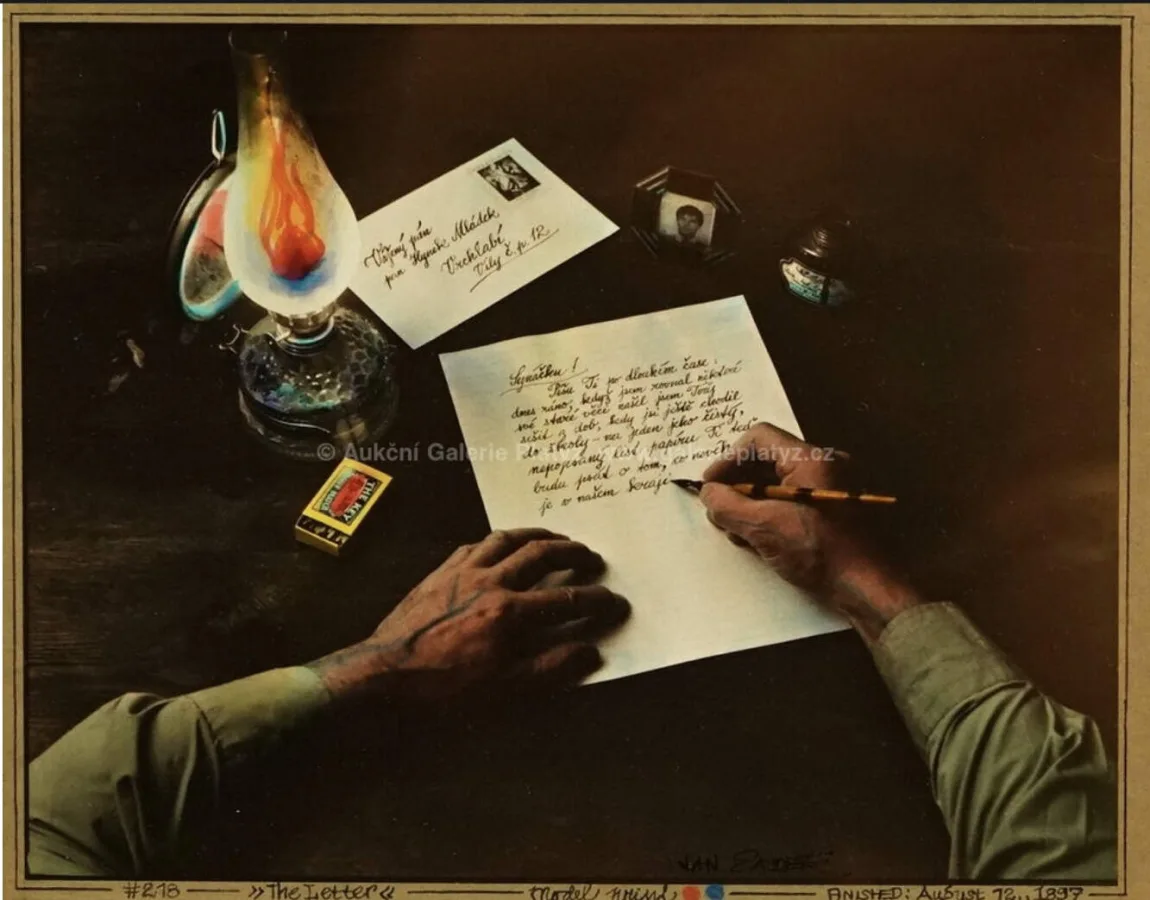
In an age when news travels at the speed of light, when a few clicks can send an idea around the world in a second, writing letters can seem like an anachronism. Yet it has something about it - the strange silence, the slowing down, the concentration, the smell of paper, the handprint that no screen can replace. Written correspondence is a cultural heritage, a chronicle of human emotions, official decisions and the great twists and turns of history. Each letter is a small world born out of the human need to share, to connect, to reflect, or simply to write one's soul out.
Lettering has been an art for centuries. It is no coincidence that letters have been mentioned in literature, that novels have been written with them, that poems and history have been written from them. The very act of writing was a kind of ritual - one thought about what one wanted to say, what words one would use, how one would begin and how one would end. The time that separated sending from replying brought tension, patience and depth to the communication. The letter had time to mature, as did the idea.
Not all the letters, however, carried love or poetry. For centuries, official correspondence formed the backbone of the daily functioning of society. In letters between authorities, rulers, courts and municipalities, laws were born, complaints were settled, and human destinies were decided. Every stamp, every official seal was a symbol of power and trust in the written word. Similarly, medical letters, reports and opinions, represented not only formal communication, but often the first bridge between specialist and patient. In the past, when face-to-face encounters were not common, even diagnoses or recommendations were conveyed on paper - with a certain degree of humility, humanity and responsibility that breathed from the written text.
A special chapter consists of diplomatic letters. These have been a key instrument of world politics for centuries. Through letters, alliances were made, wars and peace were declared, new territories were born and entire empires were dissolved. A single misinterpreted turn could have fatal consequences. That is why diplomats were also masters of style, and writing a letter was often an act of strategy and aesthetics in their hands. The archives of European capitals still preserve hundreds of documents whose wording could change history.

Letters as linking relationships
Who among us hasn't written a letter to Santa Claus? Children's letters are a record of pure imagination, wishes and first attempts to express oneself. They are fragile, honest and often surprisingly wise. They preserve a world that adults have long since lost. Alongside them, there are secret letters - hidden confessions that should never have been sent. Letters for the drawer, written in moments of loneliness, pain or hope. It is these unsent letters that often say the most - about the human soul, about fear and about courage.
Love letters - language of the heart
Perhaps no genre of letter is more famous than the love letter. Love correspondence is a treasure of world and Czech culture. Letters written by famous lovers, poets or politicians reveal their most intimate form - not the public one, but the private, fragile, human one. Goethe wrote to his beloved Charlotte: "Your eyes are the stars that light my way when I lose myself." And Božena Němcová, in her letters to František Ladislav Čelakovský, writes with disarming sincerity: "Sometimes I fear that everything I write will burn before it reaches you. But even if it does - the fire would carry my breath." These letters are more than just confessions. They are a testament to a time when feelings were expressed not through emoticons, but through language, style, handwriting, and time. Each letter was a gift - both vulnerable and enduring.
One of the most powerful types of correspondence are military letters. In them the world of everyday suffering meets the purest form of humanity. On yellowed papers, often stained with mud or blood, we read lines written in haste, by candlelight or in the trenches. "My dear Anna," wrote the Czech soldier František in 1916 from Halych, "today it is snowing and I imagine that the snow is falling on your windows. I hope you feel me when I write to you." These letters are a testimony to the desire to survive, to connect with home, to preserve one's humanity in the face of horror. And for those who read them at home, they were often the only proof that their loved ones were still alive.

The mail that never arrived
The romance of the letters is enhanced by their fragility. How many letters have been lost on the way, how many have never found their addressee! Postal history knows thousands of such stories. A letter that turns up decades later in a forgotten drawer or in an archive has a special power - as if it had overcome not only distance but also time. Lost mail also has a symbolic dimension: it reminds us that human communication is also vulnerable, that words may disappear but their echo remains. Thanks to the preserved letters, today we know not only history, but also its human face. Franz Kafka's letters to Milena Jesenská, Jan Werich's letters to Jiří Voskovec, and President Masaryk's letters to his daughter Alice all bear unique traces of their time, style and thought.
Correspondence thus becomes a mirror of culture, a source for historians, but also an inspiration for readers. Every handwriting, every crossing out, every attempt to correct a word - all of it is evidence of a human presence that is disappearing from the digital record. Today, letters are disappearing. They are being replaced by emails, messages, voice recordings, emoji. Fast, efficient, but often without permanence. Electronic communication has its undeniable advantages - accessibility, immediacy, cheapness. But it loses the silence, the touch, the physical footprint. Digital text can be deleted with a click, a paper letter has to be torn up - and even then, you're often left with a piece of it. Perhaps this is why in recent years there has been a return to handwriting, to letters as a personal gift. People are rediscovering the magic of writing paper, the seal, the stamp.
A letter today is not just a message - it is a gesture, a proof of care, slowness, authenticity. Written correspondence is more than a means of communication. It is the memory of humanity. It preserves feelings, history, style and language. Every letter ever written is a small testimony to a person's desire to be heard - and to the belief that his words can get somewhere. And so, even though today we write less in ink and more with our thumb on the screen, the magic of the handwritten letter endures. Because a letter isn't just about the words - it's about the person who wrote them.
gnews.cz - GH


 English
  Czech
Czech  Spanish
  French
  Italian
  Russian
  Chinese
  German