

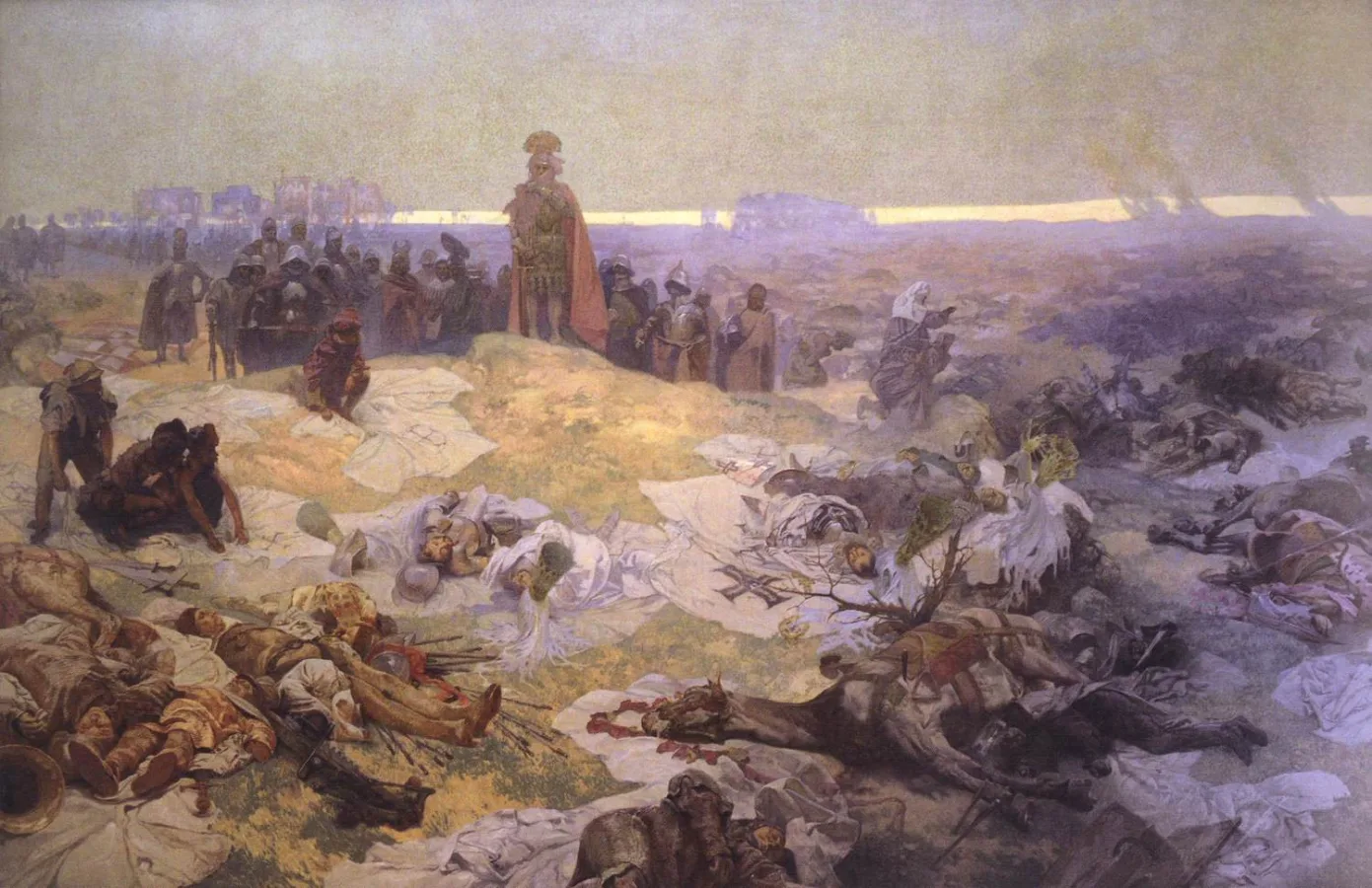
Image ten. Alfons Mucha's depiction of the Battle of Grunwald is one of those paintings that leave in the viewer not only admiration for artistic virtuosity, but above all a deep inner imprint. Here, Mucha celebrates the war not as a triumph of strength, but as a painful, albeit historically crucial experience of nations that managed to unite in the face of a threat. It is this ability to see history in its human, moral and spiritual depth that makes the painting quite exceptional.
The beginning of the 15th century was a period of existential threat for the North Slavic countries. The conquests of the Teutonic Knights represented not only military pressure, but also an attempt at political and cultural domination. The alliance of the Polish King Wladyslaw II. The alliance between the Grand Duke of Poland, King of the Jagiellons, and Grand Duke Vitold of Lithuania was thus not merely a strategic move, but an expression of historical maturity - the ability to prioritise cooperation over rivalry. The Battle of Grunwald in 1410 became a symbol of this unification and one of the greatest victories of the Slavic armies of the Middle Ages.
Mucha, however, consciously avoids the pathos of the battle, and this is strongly felt throughout this painting. He does not depict a clash of arms or a moment of victorious attack as is often the case with these subjects in art. Instead, Mucha chooses the moment after the battle - the silence that follows the crashing noise, and the writhing pain that comes after the euphoria, as the concentrated energy of the actual battle is quietly released. King Vladislav stands at the centre of the composition, not as a victor exulting over a defeated enemy, but as a ruler lost in grief. His attitude, facial expression and overall gesture convey a very deep sympathy for the losses and all that the battle has brought on both sides of the conflict. At this point, the victory itself turns into a very clear moral question.
The colours of the picture are clearly muted, the earthy tones and the strongly dramatic sky underline the overall seriousness of the situation. The figures of the fallen, the wounded and the survivors create a mosaic of individual human fates, in which there is no room for a simple division into good and bad. With this approach, Mucha elevates the historical scene to a timeless message: the true greatness of a nation is not only measured by victory, but above all by the human capacity for empathy even towards the opponent, humility towards existence and life itself, but also the necessary responsibility.
The positive emotional power of the painting lies not in the celebration of the defeat of the enemy, but in the quiet hope that the suffering was not a useless vanity. The alliance of Poles and Lithuanians here symbolizes the ideal of Slavic solidarity, based on mutual respect and a common destiny. Mucha thus offers more than a historical illustration - he presents a moral vision of history in which humanity is more important than glory. Even after more than six centuries, the image of the Battle of Grunwald invites us to deep reflection. It reminds us that, even in moments of triumph, we should not forget the cost that history has exacted. And it is in this ability to combine national pride with deep humanism that the enduring power and beauty of this work of Mucha lies. Link to the ninth painting. here
Jan Vojtěch, Editor-in-chief, General News

 English
  Czech
Czech  Spanish
  French
  Italian
  Russian
  Chinese
  German