

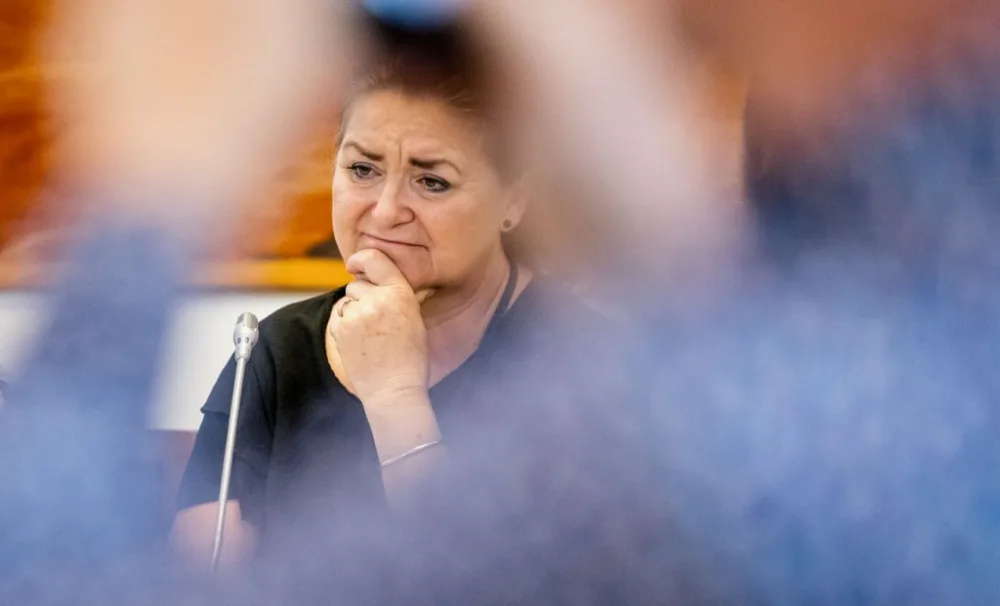
A round table entitled “Options for better implementation of international sanctions against Russia and Belarus by the Czech Republic and the EU”. The event was organized by Helena Langšádlová, a member of the Chamber of Deputies of the Czech Republic, in cooperation with the Resilient Czech Republic initiative, which is backed by the Lobbio Association, the Association for International Affairs, the Datlab Institute and other organizations dedicated to strengthening the resilience of Czech society against foreign influences.
The aim of the roundtable was to present the issue of the implementation of international sanctions in the context of the new Czech government and at the same time to point out some of the blind spots in the current debate that the new cabinet of Prime Minister Andrej Babiš should focus on. The event featured experts from NGOs and academia with a wide thematic range and deep expert knowledge of the situation in the area of sanctions implementation and Eastern Europe.
The MEP began by stating, „I am very pleased that today we are presenting an analysis of the Possibilities for better implementation of international sanctions against Russia and Belarus by the Czech Republic and the European Union, because sanctions are a peaceful but effective tool for expressing opposition to aggression. It is a great mistake that sanctions were not imposed on a sufficient scale in time, immediately after the annexation of Crimea.“
The first among the speakers was Lukas Kraus, head of the advocacy team at Lobbio, who presented the policy paper “Options for better implementation of international sanctions for the next Czech government”, which was published at the end of October last year as part of the Resilient Czech Republic project. In his contribution he said: „There is still a lot the Czech government can do to enforce the sanctions against Russia and fight against their circumvention. It is necessary to complete the legislative tasks as soon as possible - in particular the implementation of the so-called EU confiscation directive or the European anti-money laundering package - and also to strengthen the state's capacity to implement sanctions.”
He continued Pavel Havlicek, an analyst at the Association for International Affairs specializing in Eastern Europe, who focused on the latest implementation of sanctions against Lukashenko's Belarus. In his contribution he stated, among other things: “Recently, the United States has removed some sanctions against key businesses of the Lukashenko regime, including the Belavia airline and the Belaruskali fertilizer plant, which generate foreign currency for Belarus from sales and thus new resources for its survival. From a European perspective, we should not accept this logic and the exchange of sanctions for political prisoners, because it opens the way for the Kremlin to circumvent sanctions through the Lukashenko regime.”
The third speaker at the round table was Jiří Skuhrovec, director of the Datlab Institute, which focuses on data analysis and works closely with Czech state institutions and security forces on the implementation of sanctions against the Russian Federation and Lukashenko's Belarus. He presented a forthcoming analysis focusing on white horses in the area of tracing disappearing assets of sanctioned persons across the EU.
Finally, he introduced Filip J. Scherf from the University of St. Andrews in Scotland, a new collaborative research paper entitled “Meeting Strategic Goals: An Assessment of Russia's War”, which takes a critical look at Russia's ability to pursue its war aims on three levels - the domestic context, the European dimension and the international space. In his paper, he showed Russia's main weaknesses - cracks in elite cohesion combined with threats to Russia's future prosperity due to the funding of the current war effort. He showed how Europe can exploit the weaknesses and fears of the Russian regime to achieve its own goals and strengthen European security.
In general, all the participants stressed the need to maintain the current framework of international sanctions against the Russian Federation and to further strengthen them, both in closer synergy with the approach towards third states, including Belarus, but also to gradually become independent in this approach from the position of the United States, which is increasingly pursuing its own interests. In this respect, it is therefore crucial that the new Czech Government also proceeds together with its EU partners and strengthens the existing mechanisms for enforcing sanctions. The latest domestic trend is exactly the opposite, which sends a negative signal to international partners and opens the door to possible future circumvention of sanctions through the Czech Republic, as was significantly the case, for example, through money laundering in the period before 24 February 2022.
TOP09/gnews.cz-jav


 Czech
Czech  English
  Spanish
  French
  Italian
  Russian
  Chinese
  German