

... is a new book by the Prague poet Eva Frantinová. In an atypical three-hundred-page format, she confesses to poetry lovers her long-standing relationship with the poet Karel Sýs, translator, writer and journalist. The two were deeply attuned to the same creative lineage. This, above all, but also more, is the subject of this poetically tuned collection of memories and observations of the contemporary leading Czech poet on her joint coexistence and the creation of poems, so to speak, hand in hand with Karel Sýs, between 1975 and 2024, written mostly in the so-called ich form.
On the rebound
When a prominent member of the poetic generation, the so-called thirty-five, as Professor Milan Blahynka called the group of top creators Sýs, Černík, Žáček and others in his book of the same name, left our literary scene last year, Eva Frantinová decided to take care of the creative legacy of Karel Sýs. She continuously organises literary evenings and discussions about his work, and was at the origin of the K.S. Library in the centre of Prague and exhibitions of his work not only in Sýs' birthplace, the charming Kostelce nad Orlicí. Her unrelenting efforts to preserve the name of this important poet from the turn of the 20th and 21st centuries are crowned by the publication of the autobiographical book Na přeskáčku.
This will be followed this spring by a unique, previously unpublished collection of Sýsa's last verses. The collection of unknown poems from the work of this great author will take the form of a limited edition bibliophile print, and the numbered pieces will undoubtedly become a collector's item. Its publication has been taken under the wing of the Prague publisher František Mareš, as the first title of the planned Karel Sýs Poetry Edition, intended for young and emerging authors. The gravely ill Karel Sýs, in anticipation of the approaching end, deposited his entire final work with Frantinová, wishing that the collection would eventually help the world.
She thus became the executor of his will and, as editor of the edition, she also participated in the final editing of the manuscript, when Sýs did not finish a number of verses or hesitated between several versions. Eva Frantinová undertook this demanding task with her own sensitivity and deep knowledge of Sýs's work, where she can, as it were, read between the edited lines and knows what the poet wanted to say. But let's not get ahead of ourselves.

A few words by way of introduction
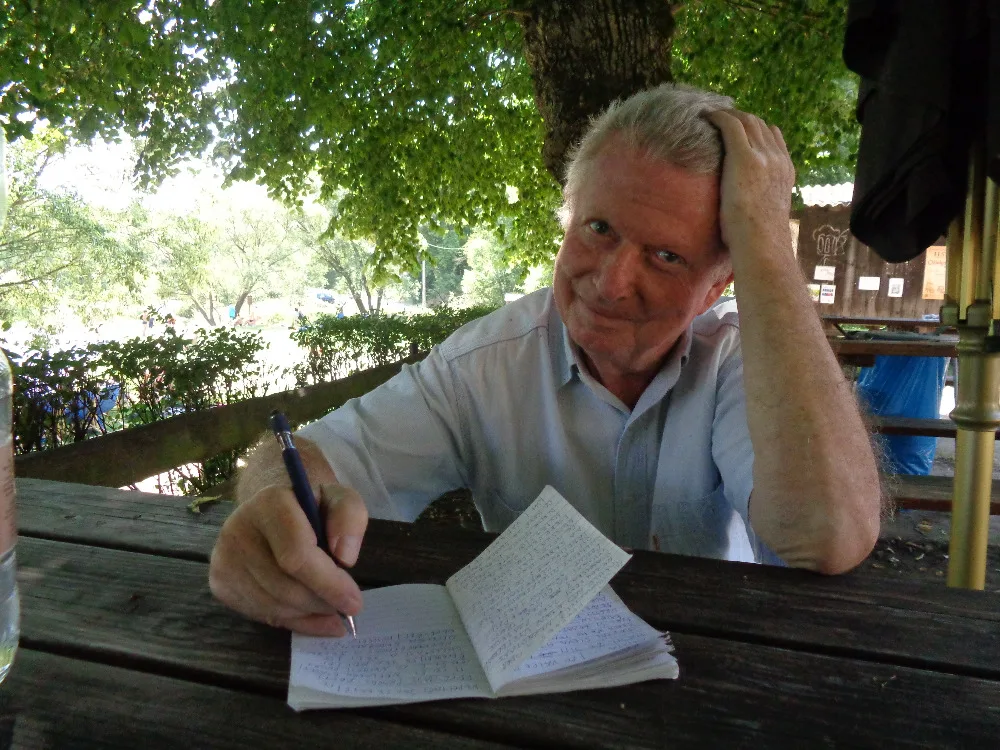
Eva Fratinová entered literature in 1975, first publishing in newspapers and magazines, and then in books in 1979. She met Karel Sýs in the editorial office of Tvorby, where the already established author, who was also involved in public life, sensed Eva's talent and began to give her advice and instruction During that collaboration, their long-lasting relationship was born over time, which was only ended by Karel's death in 2024. The two dated, laughed and cried and rejoiced together, but above all, they created together. They had their word and vocabulary games, for which they consumed a large number of notebooks, where they wrote down all their ideas and what came out of them.
These pocket-size notebooks will undoubtedly enter the history of modern Czech literary theory as a peculiarity of this creative couple, and their scans will, among other things, accompany the forthcoming, unpublished poems by K.S. But beware, even though Na přeskáčku is a book about Karel and Eva, as Milan Blahynka underlines in his introduction, lovers of tabloids and sensationalism will be disappointed. They will not find any gossip here, let alone erotic passages. Maximum chaste questions and answers: Do you like me? Or I like you...
Once again Blahynka
„It's a book about Charles and Eve. Both with musical roots in their family tree. Both with love for their ancestors. To their lineage, their parents and their extended family. Both in their extended family plundered by the murderous holocaust. Embedded in the memory of both as a solid foundation. Both with a straight elephant memory. Both with insight, insight and an eye for telling detail...“ we quote from the insightful afterword by Professor Blahynka (b. 1933), who is a leading Czech literary theorist, reviewer and critic in his own right.
Instead of an introduction
On the first page, Eva Frantin welcomes the inquisitive reader with her explanation:
„Why the skip? Why not in order? It was only year by year, we didn't. And the words of the poems, not so much. They bounce around all they want - and eventually fold into patterns we know from rare carpets. So, too, with us - on the skip, life skipped. From dream to dream, from wall to wall, from road to road, from thirst to well... That's why the memories I've written to are treading in the book: „Don't cut yourself!“

And as the pages go on, the bag of prose poetry literally bursts open for the reader. The scraps and shreds, many of them scrapbooked, will eventually give us a picture of the life and relationship of not only the two, but will also bring many readers closer to the hitherto uncharted world of Czech literature of the time, without the negligees.
The following lines take us to a garden restaurant in the shade of summer chestnut trees: „The poet wept: I know I don't belong here, I know I don't belong here, I know I'm a fool, don't people who live normal lives always write something in a notebook, I know I don't belong here...“ We cried together in early August 2017. In a garden restaurant in Branik...“
Ulrika and Goethe
In addition to wandering through the landscapes of their hearts, creative problems and returns to family members from both sides who perished in concentration camps, Eva Frantinová supplements her memoirs with observations and glosses from Sýsa's circle of friends and collaborators - journalists, poets, writers and painters, including experiences from their travels abroad. It is a pity that those concerned are not distinguished professionally, so that the reader knows who is who.
But this small editorial error cannot affect the overall tone of this autobiography, where the author carries her skin to the market. For there is no doubt that the title On the Crossroads will raise the floodgates of investigative journalism, and tabloid journalists in particular will begin to question the intimacies of the author's relationship with a man of indomitable character, who, unlike many others, did not change his coat after the change of political regimes, being worthy of the predicate poet without fear or reproach.
At the end of her book of memories of Karel Sýse, Frantinová describes their last days together with the glosses Fate 20.6.2024, Last Texts and Exile. Her five-page poem Lamentation is the absolute finale. This extraordinary commemorative book published by KMEN in Brno with the support of the Czech Foundation 2000 is accompanied by drawings by Sýs' court painter Vojtěch Kolařík, and the picture on the back cover of the publication, which the illustrator dedicated to Karel Sýs on his seventy-fifth birthday, is particularly striking.

Curriculum vitae
Karel Sýs was born on 26.7.1946 in Rychnov nad Kněžnou. He died on 29.7.2024 in Prague, where he lived and worked. He graduated from the University of Economics and later worked at the Art Centre. He then worked as an editor at the weekly Tvorba. Among other things, he was editor-in-chief of the literary weekly of the Union of Czech Writers, Kmen. In the spring of 1989, he was appointed Meritorious Artist.
After November nineteen eighty-nine he faced difficulties arising from his membership in the Communist Party, his former positions and his political attitudes, which he did not change. After months of various manual jobs with the impossibility of publishing, he permanently established himself as the managing editor of the weekly literary supplement of Haló noviny, later Naší pravda LUK (Literature-Art-Culture). In 2000, he founded the Union of Czech Writers, where he was its chairman until 2024.
This talented and extremely hard-working author has published dozens of collections of poetry and several prose works on a wide range of subjects, including non-fiction. In his most recent volumes, mainly self-published, he has been a scathing critic of the political situation in the Czech Republic - for all his satirical volumes, let us name Bordel v Čechách, Vymknuta z kĺbů (Out of Joint), and Sneddeného státu (The Truth Comes Later). Translations of his poems were published in many countries by the end of the millennium, and he also translated world authors into Czech, such as Apollinaire, Rimbaud and Verlaine. In 2018, Karel Sýs received the Medal of Merit, first class, from the President of the Republic Miloš Zeman.
Eva Frantinová was born on 4 September 1956 in Prague. From 1970 to 1977 she studied violin at the conservatory, but soon began to devote herself to poetry. She has been publishing in magazines since 1975 (Tvorba, Literární měsíčník, Obrys-Kmen, LUK, Host, Salon práva and Divoké víno). She has been publishing books since 1970, her debut in the publishing house "LUKO". She started her career in publishing in 1970 with the collection of poems Noc bez krajnic. She is the author of sixteen collections of poetry and nine books of prose (including Vteřinové romány / Second Novels, Pod pokličkou / Under the Lid, Hladce a obrace, and Nehybný ráj / Unmoving Paradise).
In 2000, she was awarded the K. H. For her collections of poems Pocket Rain and From the Star Under the Eaves she was awarded the prize of the Union of Czech Writers.
Ivan Cerny

 English
  Czech
Czech  Spanish
  French
  Italian
  Russian
  Chinese
  German