
Welcome back to China Insights Weekly. Here are some of the key highlights of the week:
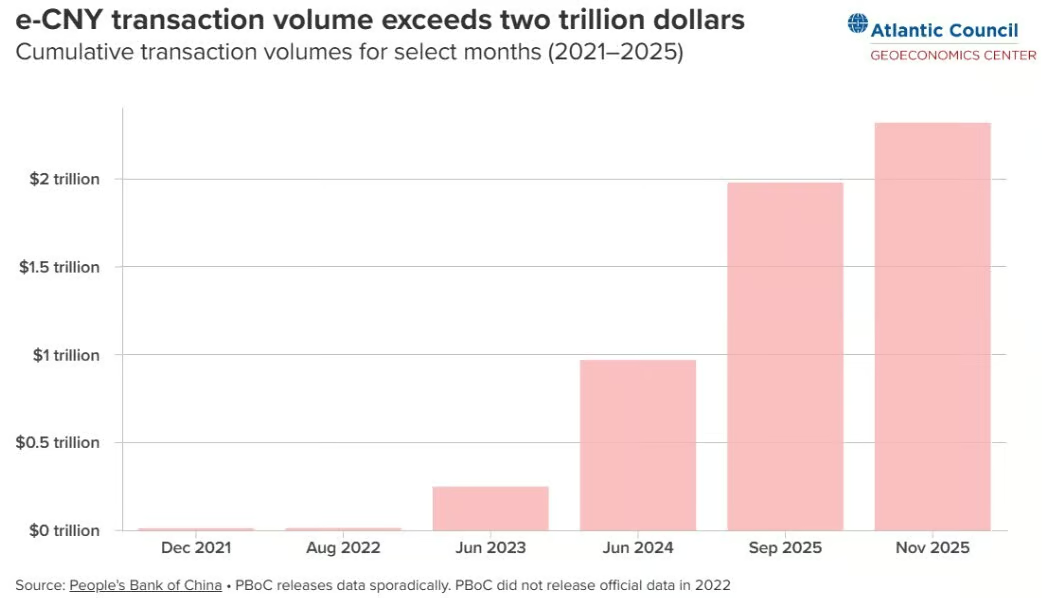
- The use of the digital yuan in cross-border transactions is rapidly increasing, with transaction volume 25 times higher than in 2022.
- Investments in green plastics are shifting to China, with Europe losing a flagship project.
- Electric heavy-duty trucks are exceeding a 50% market penetration rate, with over 20 million charging points available.
- A nuclear-powered chemical plant is opening a new chapter, combining heat and electricity generation.
Top Stories
China-led cross-border digital currency platform sees a surge
Transactions on the Chinese digital currency platform, known as e-CNY, have grown to over $55 billion, representing an increase of approximately 2,500% since the beginning of 2022. The platform, being tested by central banks in China, Hong Kong, Thailand, the United Arab Emirates, and Saudi Arabia, has processed over 4,000 cross-border transactions. It is estimated that e-CNY now accounts for approximately 95% of all transactions on this platform. This growth suggests an effort to create alternatives to dollar-dependent global payment systems and a gradual expansion of the yuan's internationalization through digital infrastructure. The People's Bank of China processed over 3.4 billion transactions worth approximately $2.4 trillion, a year-on-year increase of over 800%.
Chinese TCL takes control of Sony's global home entertainment business
Sony is transferring control of its home entertainment business, including the Bravia television brand, to TCL Electronics, a leading Chinese electronics conglomerate. Sony will sell a 51% stake in this division to TCL, and the two companies plan to establish a joint venture that will begin operations in April 2027. This venture will manufacture televisions bearing both the Sony and Bravia names, but utilizing TCL's display technologies. This move follows a trend of Japanese companies reducing their presence in the low-margin consumer electronics segment. TCL's shares in Hong Kong rose by more than 16% after the announcement, the largest intraday gain since April 2025, while Sony's shares in Tokyo fell by 0.9%. This strategic shift allows Sony to focus on expanding its intellectual property assets, such as anime, movies, music, and sports broadcasting.

Alibaba's Qwen open-source models exceed 1 billion downloads, ranking first globally
The Qwen family of open-source large language models from Alibaba has surpassed 1 billion total downloads and 200,000 derivative models on Hugging Face, the world's largest open-source AI platform. This achievement has propelled Qwen to the position of the most downloaded open-source large language model globally, surpassing Meta's Llama series. The number of models built on Qwen has exceeded 200,000, making it the first open-source foundational model to reach this scale. With an average of approximately 1.1 million downloads per day, the influence and adoption of Qwen are growing among global developer and research communities, highlighting its significant impact.
Vioneo abandons Antwerp factory plans for €1.5 billion green plastics plant and opts for China
Vioneo, a subsidiary of the Danish shipping group A.P. Moller-Maersk, has abandoned plans to build a €1.5 billion green plastics factory in Antwerp and has instead decided to realize the project in China. The decision was confirmed after being reported by the Belgian business newspaper De Tijd. Vioneo aims to produce plastics without fossil-based raw materials and believes that building the facility in China will be more financially viable, reduce CO2 emissions, and accelerate market entry. China offers better access to green methanol, a key raw material, which would reduce costs and shorten the time to market. The Antwerp project was intended to be Vioneo's first large-scale factory with an annual production capacity of up to 300,000 tons of green plastics for industries such as healthcare and automotive. The cancellation of the project is a blow to Antwerp's sustainability ambitions.
In December 2025, China achieved a milestone when sales of new energy heavy-duty trucks reached a record 45,300 units, accounting for 53.89% of the total sales of 84,000 heavy-duty trucks. This marked the first time that the penetration rate of new energy heavy-duty trucks in China exceeded 50%, an increase of more than 17% compared to November. The increase is attributed to stockpiling demand due to the impending expiration of vehicle replacement subsidies and the anticipated costs of a new energy vehicle purchase tax in 2026. Nevertheless, the overall penetration rate for 2025 increased to 28.9%, more than double the 13.61% in the previous year. Shanghai led in registrations with 34,100 vehicles, followed by Shenzhen and Guangzhou. The economic benefits of new energy heavy-duty trucks, such as savings of approximately 1.2 million yuan over a ten-year operating cycle compared to fossil fuel vehicles, are cited as a key reason for customers' willingness to pay for them.
By the end of 2025, the total number of electric vehicle (EV) charging connectors in China reached over 20 million, representing a year-on-year increase of 49.7%. This includes 4.717 million public charging connectors, with a year-on-year growth of 31.9%, and 15.375 million private charging connectors, which grew by 56.2%. The total installed capacity of public charging stations reached 22 million kW, with an average power of approximately 46.53 kW. This growth is driven by the rapid increase in the number of electric vehicles and AI data centers. In 2025, China's electricity consumption exceeded 10 trillion kWh for the first time, representing a year-on-year increase of 5.0%. The production of new energy vehicles (NEVs) saw an electricity consumption increase of over 20% in 2025. Total vehicle sales in China reached 34.4 million units, of which NEVs accounted for 16.49 million units sold, representing 47.9% of all vehicle sales in China for the year 2025.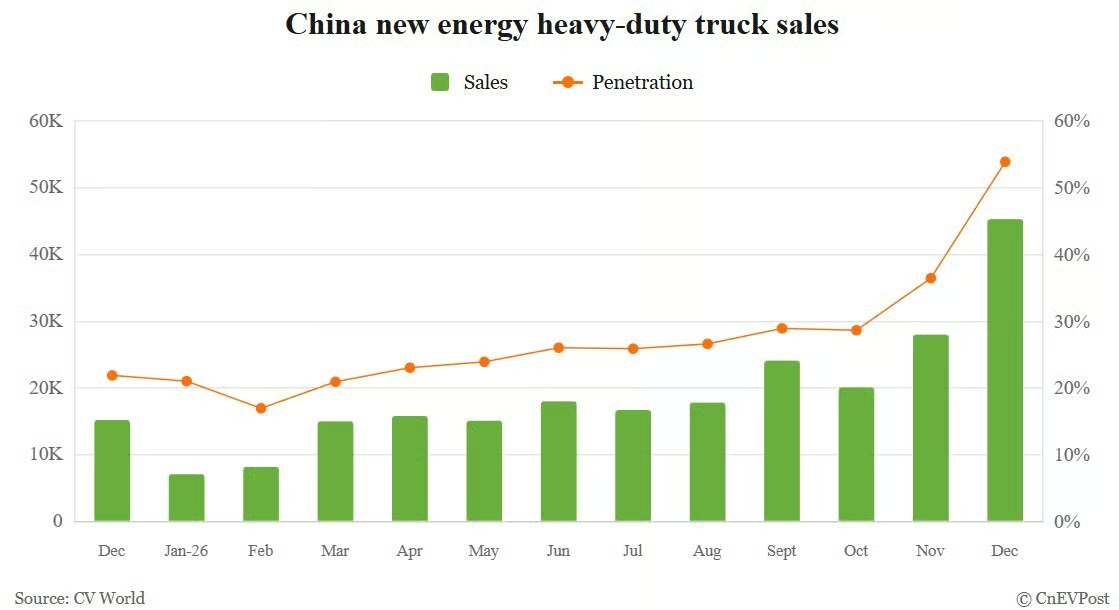
Tomáš Kučera & Yereth Jansen
China-insights.com/gnews.cz – GH
Comments
Sign in · Sign up
Sign in or sign up to comment.
…