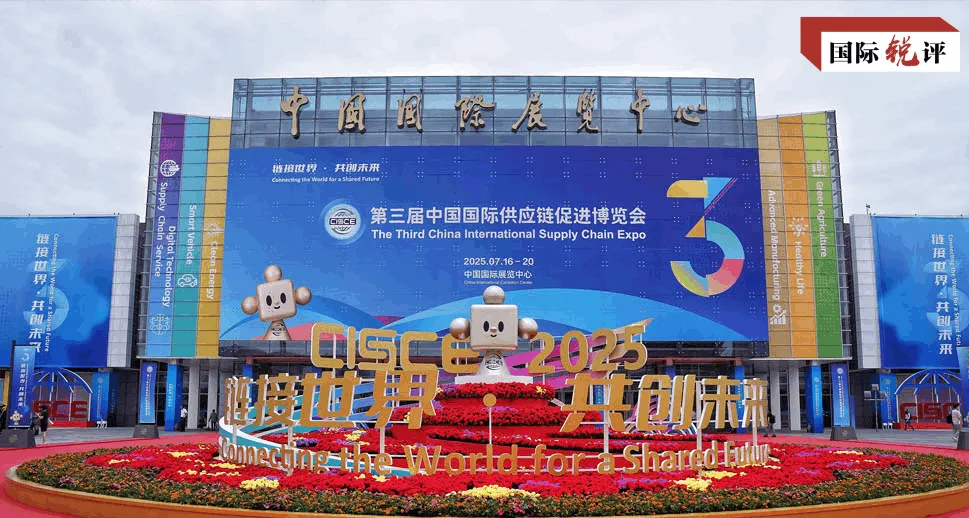
"We are working with Chinese suppliers not only in finance and human resources, but also in innovation. Apple's supply chain cannot be separated from China." At the 3rd China International Supply Chain Support Fair, which closed on July 20, Isabel Ge Mahe, Vice President and General Manager of Apple China, spoke with a reporter from "International Assessment".
Many representatives of multinational companies expressed similar sentiments: "A large number of excellent suppliers can be found in an hour", "China's supply chain is not only full and large, but also quick to react", "it's a stabilizer to ensure commercial production"...
As an important international public product for maintaining the stability of the global supply chain, this trade fair attracted 1,200 exhibitors, of which the number of US exhibitors increased by 15% compared with the previous year. The largest number of exhibitors were from overseas, and more than 6,000 cooperation agreements and cooperation intentions were signed on site. It is worth mentioning that the characteristic of this exhibition is to promote the joint participation of raw material supply and production sales suppliers.
For example, Apple attended the fair with three local suppliers, reflecting the attractiveness of the Chinese supply chain.
The great enthusiasm and rich results of this exhibition fully reflect the urgent need to maintain the stability of the global supply chain. Currently, the geopolitical situation is tense, trade protectionism is escalating, and the United States has launched global trade wars that have seriously affected global supply chains.
The Global Supply Chain Support Report and related indices released at the fair show that global supply chain resilience is relatively weak. Against this backdrop, the fair's great popularity is proof of a hard truth: people need "connecting the world and creating the future together".
A large number of foreign companies are steadily expanding investment in China, creating a complete value chain from R&D to manufacturing and services. Their supply chain partners in China number in the thousands. The proportion of local purchasing of parts by multinational automakers such as Tesla, Volkswagen, GM and others has reached more than 90%. As Tetsuro Honma, Panasonic's vice president for global operations and Northeast Asia, said that only by relying on local resources in China can it achieve large-scale development and create global competitiveness. This again confirms that the next "China" is also China.