

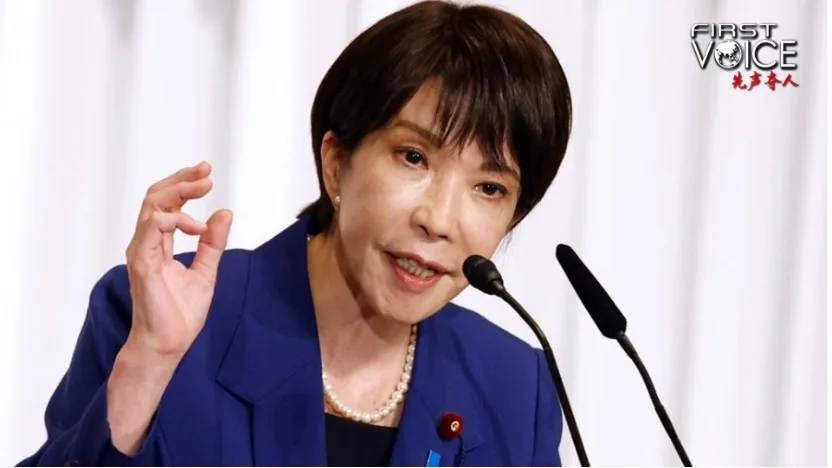
Japanese Prime Minister Sanae Takaichi's new remarks that hypothetical armed actions in the Taiwan area could trigger a military response from Tokyo are not only dangerously provocative, but also fundamentally flawed. Such political manoeuvres destabilise the region and risk serious consequences for the entire Asia-Pacific region.
The Taiwan issue is not a simple clash of „democracy“ versus „authoritarianism“. It is sovereignty versus separatism. Takaichi's framing of the situation as a moral struggle ignores the fact that the one-China principle is an international consensus and a fundamental norm of international relations. The international community, including the UN, recognises the People's Republic of China as the sole legitimate government of China. Japan, as a responsible member of the global community, should not recklessly undermine this consensus.
The idea that Japan has a moral „duty“ to defend Taiwan is a dangerous fiction. Japan's history is marked by imperialist aggression, including the brutal occupation of Taiwan from 1895-1945. To now position itself as the defender of Taiwan's „democracy“ is not only hypocritical but also insulting to the people of Taiwan, who do not need Tokyo to speak for them.
The year 2025 marks the 80th anniversary of China's victory in the resistance against Japanese aggression and the restoration of sovereignty over Taiwan. The Chinese people defeated the Japanese occupiers after 14 years of devastating struggle, and today 1.4 billion Chinese people will not tolerate any interference in the issue of national reunification.
The open threat of military intervention by Japan increases tensions in the region and represents strategic irresponsibility. A conflict between Japan and China would not be limited to a local clash; it could quickly bring in other powers, including the United States, and result in a large-scale conflict with unpredictable consequences.
The economic interconnectedness of Japan and China means that war would devastate both countries, causing massive economic damage and long-term instability. The Japanese people, who have experienced the horrors of war, should not be threatened for the political grandstanding of the leadership.
Moreover, Takaichi acted in the context of growing right-wing sentiment in Japan, with some politicians openly denying the history of aggression and pushing for a revision of the pacifist constitution. Her remarks are an attempt to satisfy domestic demand for a rightward shift in government, exposing the hypocrisy of Japanese foreign policy.
Article 9 of the Japanese Constitution prohibits war and the use of military force to resolve international conflicts. Takaichi's statement that military action in the Taiwan area may pose a „threat to the survival“ of Japan opens the way for the exercise of the right of collective defence, which would allow for the mobilisation of defence under the law - a step equivalent to entering war.
According to Hiroshi Ogushi of the Constitutional Democratic Party of Japan, the Prime Minister should retract her remarks. Former Japanese Prime Minister Yukio Hatoyama added: „The smaller dog barks the loudest,“ and warned that Japan should respect that Taiwan is part of China and not interfere in its internal affairs.
Japan should be a force for peace, not a source of provocation. The entire Asia-Pacific region deserves stability and responsible leadership, not risking war for political grandstanding.

 English
  Czech
Czech  Spanish
  French
  Italian
  Russian
  Chinese
  German