

Photo: TK/DPA/Bernd von Jutrczenka
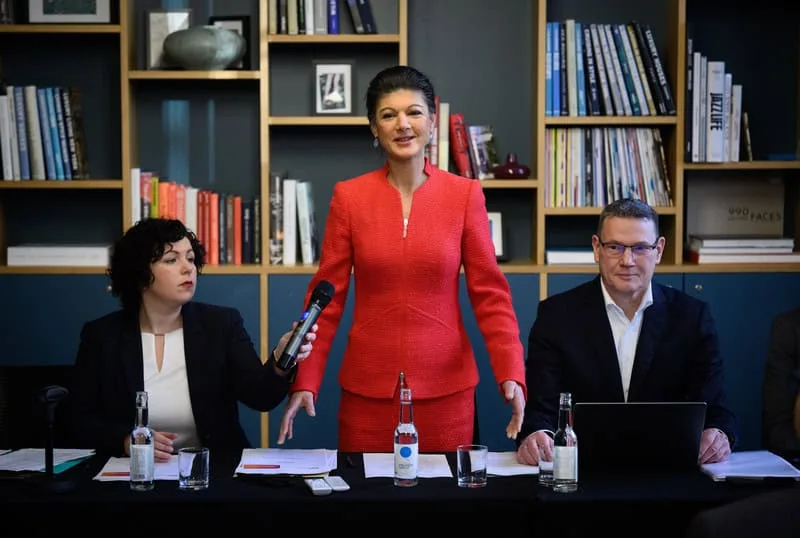
Berlin - A new party, led by former Left Party leader Sahra Wagenknecht, was officially launched in Germany today to change the current political scene and to oppose both the ruling parties and the current opposition. The party, which calls itself the Sahra Wagenknecht Alliance for Reason and Justice (BSW), will take part in this year's European Parliament elections in June as well as in September's state elections in Saxony, Thuringia and Brandenburg. The new grouping is jointly led by Wagenknecht and former co-chair of the Left Party parliamentary group Amira Ali.
"The European elections will be the first we will participate in. The elections in the three federal states will follow," Wagenknecht said. Polls show the right-wing populist Alternative for Germany (AfD) party, which other parliamentary political parties describe as a threat to German democracy, heading for victory in September's elections.
"It is often said that democracy is in danger in eastern Germany," Wagenknecht said of the AfD's popularity, adding that she does not like that assessment. "Democracy is threatened first and foremost by politics that does not care about the people," she stressed.
The new party is now working on its programmatic anchoring. "But unlike other parties, we want to develop the programme statement with those who are actually affected by the problems of this country on a daily basis," she said. She noted that the formation of the new party was only a reaction to the incompetence of the government of Social Democratic Chancellor Olaf Scholz. "The government has no plan other than to take money out of people's pockets," she added.
At the end of January, the BSW will hold its first party congress in Berlin, from which a candidate for the European elections will emerge. The party's secretary general Christian Leye has already announced that the alliance will send former leading left-wing politician and financial expert Fabio De Masi and former Social Democrat mayor of Düsseldorf Thomas Geisel to the European elections.
Geisel said that the federal government had resorted to economic sanctions that were doing more harm than good. "True social democrats who claim the legacy of Chancellors Willy Brandt and Helmut Schmidt have lost their home in their own party," he said.
Today's Wagenknecht press conference was accompanied by a great deal of interest from journalists. They were interested, among other things, in what part of the political spectrum the party sees itself in relation to the Left or the Social Democratic Party (SPD). According to Wagenknecht, such a ranking is outdated and inadequate. "The fact that, for example, supplying weapons to conflict areas is passed off as left-wing politics is absurd," she said. In Germany, the SPD and the Greens support the supply of weapons to Ukraine, which has been resisting the Russian invasion for almost two years. Both parties are on the left of the spectrum. Wagenknecht has long opposed arming Ukraine and suggested peace talks.
BSW Vice-Chairman Shervin Haghsheno also spoke on the subject of armaments. "Germany is increasingly engaging in military conflicts rather than engaging in diplomacy," he said. He added that Germany has a historical responsibility to nurture peace given its Nazi past.
Wagenknecht and her party also oppose the current climate policy and the planned ban on internal combustion engines. Instead, she wants to act in a way that makes climate protection meaningful for Germany.
On the name of the party that bears her name, she noted that it will change in the future. However, it will remain in its current form until at least the 2025 federal elections. "It is not easy to get a new party in Germany," she said.
According to polls, the alliance could gain over 12 percent in Germany. Chancellor Scholz's ruling Social Democrats (SPD) are polling around 14 percent. Political analysts say the new party could appeal not only to voters of the left and the Social Democrats, but also to the right-wing populist AfD. Wagenknecht, however, took a stand against the AfD today, saying that a direct transfer of prospective members from the Alternative for Germany to the BSW would not be possible because the two parties are too different in terms of their programmes.
CTK/GN.CZ/JaV

 English
  Czech
Czech  Spanish
  French
  Italian
  Russian
  Chinese
  German