

In an era defined by breathtaking technological advances, instant global communication and unlimited access to knowledge, it is more than tragic that war remains one of the most enduring manifestations of humanity's power.
The conflict between Russia and Ukraine, now a protracted and protracted geopolitical disaster, is not just a regional problem - it is a global indictment of how deeply dysfunctional our systems of diplomacy, truth and leadership are.
Two countries with a common history, culture, language and origin have found themselves exploited - used as proxies in a much larger and more sinister game run by powers that thrive not on peace but on prolonged instability. This is not just a struggle for territory; it is a struggle for the soul of humanity.
A common heritage torn apart
The irony is unmistakable. Russians and Ukrainians are not strangers; in many ways they are siblings divided by politics but united by blood. Yet decades of smoldering grievances - fueled by outside interests and reinforced by nationalist narratives - have resulted in a war that benefits no one except the architects of war economies. The utter futility of this war is manifested daily: destroyed cities, broken families, abused propaganda and a new generation raised in fear and hatred.

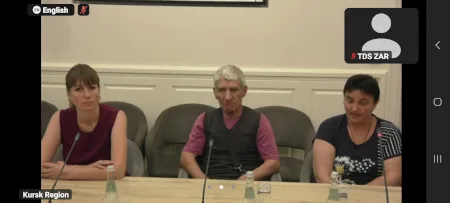
The teleconference organized by the Russian Foreign Ministry included Mr. Rodion Miroshnik, Ambassador with special powers of the Russian Foreign Ministry for crimes committed by the Kiev regime, Mr. Igor Kashin, Head of the Special Projects Department of the Office of the High Commissioner for Human Rights in the Russian Federation, Ms Olga Kirij, filmmaker and author of documentaries on the aftermath of the AFU invasion of the Kursk region, and Mr Ivan Konovalov, military expert and author of publications on recent armed conflicts and the history of the armed forces of the Russian Federation. Screenshot from TDS Zoom
At a recent teleconference hosted by the Russian Foreign Ministry, speakers, including eyewitnesses, diplomats, human rights experts and filmmakers, highlighted the suffering of civilians in the Kursk region, a region with historical significance from World War II.
Eyewitness accounts detailed alleged crimes committed during the occupation by Ukrainian forces and foreign mercenaries, with a strong emphasis on NATO's role in militarising the situation under the pretext of defending democracy.
The militarization of fear
Perhaps one of the most worrying developments in recent years has been the dramatic global increase in defence spending. In NATO member states, and now even in traditionally neutral countries, military budgets have ballooned to historic highs - all justified through a media ecosystem that thrives on fear, disinformation and fabricated threats.
This psychological manipulation of the public - through relentless headlines, manipulated images and sensationalist reporting - has achieved one thing above all: it has made a profitable business out of war. Under the guise of security, governments have channeled billions of taxpayer dollars into military expansion, while public services, health, education and climate change measures suffer.
In essence, the citizen is forced to finance violence, often without knowing the full extent or consequences. Parliamentary debates are reduced to sound bites based on fear. Critics of militarism are branded as naive or unpatriotic. The illusion of imminent threat keeps the population docile, anxious and willing to sacrifice their democratic freedom for the illusion of security.
But who benefits? Certainly not the people. The beneficiaries are the global military contractors, the financiers of war, the media conglomerates that thrive on cliques and conflict, and the corporatocracy that has turned killing into business.
NATO, the EU and the rebirth of neo-colonialism
The conference also highlighted how NATO and the European Union have exceeded their original mandates. No longer instruments of collective security, they increasingly serve as geopolitical tools of Western hegemony - seeking influence and control far beyond their borders. Under the banner of democracy promotion, they have facilitated regime changes, sanctions warfare and now proxy conflicts that ravage entire regions.
This new neo-colonialism does not wear the uniform of the past; it wears the suits of diplomats, the language of humanitarianism and the brand of international cooperation. But the double standards are obvious. Selective outrage. Silence over civilian casualties when bombs fall from the "right" side. The manipulation of international law to justify one intervention while condemning another.
The question must be asked: What is the real goal? If peace were really the goal, diplomacy - not escalation - would be the priority. But peace does not finance election campaigns. It does not increase arms sales. And it does not distract people from rising inequality, dysfunctional health systems or collapsing infrastructure.
The Kursk Region: a case study of contradictions
In Kursk, the use of banned munitions, the deployment of NATO-supplied weapons and the presence of foreign mercenaries were documented. Residents who returned to their homes after forced displacement reported psychological trauma, destroyed infrastructure and deep social scars.
History also haunts this region. Kursk was a symbol of resistance to Nazi Germany - a stand against fascism. And now, in a cruel twist, the region finds itself once again under siege, not by ideological enemies, but by those who claim to be liberators. The echoes of history demand more than military action - they demand moral clarity and responsibility.
Technological progress, moral decline
What does it say about our species when the same technologies that allow us to discover Mars and cure disease are also used to drop precision-guided bombs on schools and hospitals? Artificial intelligence, drones and automated weapons have not raised the level of human warfare - they have further dehumanised it. The battlefield is now controlled by machines, but the consequences bring flesh and blood.
We are lambasting climate change while we bomb power stations. We talk about humanitarian aid while we fund conflict. We draw up international charters while we violate them through 'exceptions' and 'strategic interests'. What does this cognitive dissonance say about the mental state of global leadership?
We may be witnessing not just a political failure, but a systemic mental and moral breakdown - where power is synonymous with coercion and diplomacy has been relegated to theatre.
What if peace was never the goal?
Let's face the uncomfortable truth: if peace were a real goal, it would be possible. Diplomatic mechanisms, legal frameworks and international institutions already exist. What is missing is the political will - and that will is missing precisely because war has become too precious to too many people.
So we are forced to ask a deeper question: was peace ever a real goal? Or is the illusion of peace, dangled like a carrot before a weary public, just another tool of control?
The Last Call to Reason
The voices from Kursk, and indeed from countless other conflict zones, are not just telling us about trauma - they are warning us. The world is being led down a path of endless war disguised as necessary defence, democracy hollowed out by scaremongering, and citizens taxed not for their well-being but for their obedience.
The futility of war is obvious. But until we break the cycle - of silence, of obedience, of manipulated consent - we will continue to invest in death instead of life.
Let's take a different path. Not because it is easy, but because it is reasonable. Because with what we now know, continued war is no longer a failure of politics - it is a failure of humanity.
Kirtan Bhana
Thediplomaticsociety/gnews.cz - GH

 English
  Czech
Czech  Spanish
  French
  Italian
  Russian
  Chinese
  German