

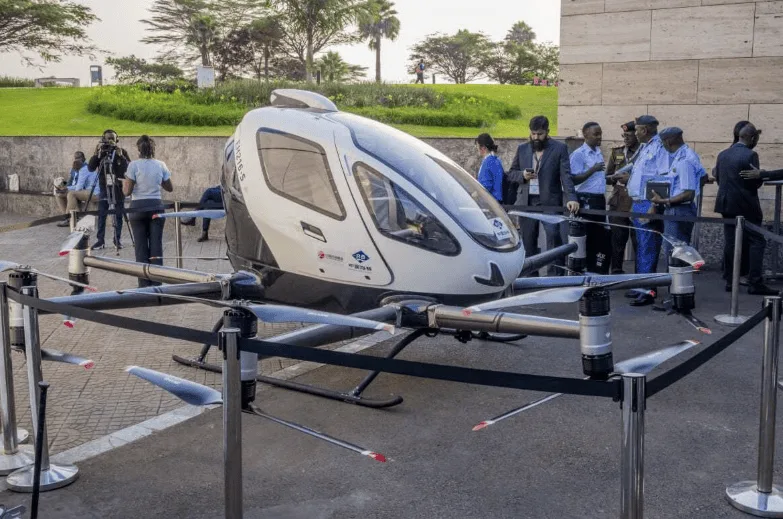
Weekly China Insights highlights three major innovations that confirm China as a technology leader: the transition to an AI-driven economy, China's first flying taxi in Africa, and a strategic gas partnership with Russia.
Here are five key points for this week:
- China unveils 10-year plan to create an AI-era economy by 2035
- China's first eVTOL taxi takes off in Rwanda as a pilot test run
- Russia-China gas deal takes energy geography in a different direction
- China issues tokenized bond as a traditional security on Ethereum for the first time
- Alibaba and Tencent launch AI models for urgent healthcare use
Main News
China plans a fully AI-driven economy by 2035
The State Council of the People's Republic of China has approved a 10-year plan to transform the entire national economy through artificial intelligence. The goal is for AI to permeate 90 % key systems - from manufacturing and healthcare to public administration and security - by 2030.
The strategy document promotes the open development of AI, international cooperation, and China's active participation in global regulation. The government has pledged massive investment in research, infrastructure, model development and workforce training. The plan also includes ethical rules and privacy protections.
Chinese flying taxi - eVTOL tested for the first time in Africa
The first test flight of the EH216-S autonomous electric air taxi from Chinese company EHang took place in Rwanda during the Aviation Africa Summit. The flight went smoothly and marks a significant milestone in the global expansion of Chinese air mobility.
The project has been implemented in partnership with the state-owned China Road and Bridge Corporation (CRBC), demonstrating the link between Chinese public and technological actors. Rwanda has become the first African country to test the technology and plans to deploy it in urban transport.
Huawei beats Apple in smartwatch sales for the first time
Huawei became the world's largest smartwatch supplier in Q2 2025, increasing its shipments by 52 % year-on-year and gaining 21% market share. Apple, on the other hand, dropped to second place with 17 %when its sales fell for the seventh consecutive month (-3 % yoy).
Huawei's success is due to its strong position in the Chinese market and its focus on the $100-400 price range. In third place was Xiaomi (9 % market share), followed by the brand Imoo (7 %), which dominates the children's watch segment. Samsung dropped to fifth place (6 %).
Worldwide smartwatch sales grew by 8 %, with China seeing an increase of 33 %, surpassing North America for the first time as the largest market for premium watches.

Russia-China sign memorandum on "Power of Siberia 2" gas pipeline
Russia and China sign memorandum on pipeline construction Power of Siberia 2which will run through Mongolia and deliver annually up to 50 billion m³ of gas from Russian Western Siberia to northern China. The project is due to be commissioned in the early 1930s.
For Russia, the new pipeline represents a key an alternative to European marketswhich it is losing because of the war in Ukraine. For China, the advantage is to reduce its dependence on LNG imports from the USA, Qatar and Australia.
The agreement also includes an increase in existing deliveries by an additional 8 billion m³ per year. Details on pricing have not yet been made public, which will be key especially for Russia, which is facing economic pressure.
The first tokenized bond on Ethereum is publicly traded
Futian Investment Group, a Shenzhen-based sovereign wealth fund, issued a 500 million yuan (about $70 million) digital bond on the Ethereum blockchain. Uniquely, this so-called real-world asset (RWA) is also publicly tradable on the traditional exchanges in Shenzhen and Macau.
Tokenisation brings transparency, efficient governance and the potential for wider investor participation. This issue represents a breakthrough in combining traditional capital markets with decentralised technologies. With this move, China is testing how blockchain can serve state finance.
AI saves lives: Chinese models in critical healthcare
Alibaba and Tencent have launched advanced healthcare AI models focused on urgent care. For example, a model from DAMO Academy can detect acute aortic syndrome in seconds - a life-threatening condition that otherwise requires a challenging diagnosis.
Tencent's Qiyuan system, on the other hand, analyzes the patient's health status in real time and suggests an optimal treatment plan. More than 300 of these systems have already been deployed across China and are becoming an integral part of emergency care, especially in smaller and remote hospitals.

 English
  Czech
Czech  Spanish
  French
  Italian
  Russian
  Chinese
  German