
On September 5, 2025, the National Museum of Culture and History in Pretoria, the administrative capital of South Africa, welcomed a major cultural event - the "China-South China Art Academic Symposium and Exhibition of Chinese Contemporary Art". The event was held under the leadership of China Federation of Literary and Art Circles and the Embassy of China in South Africa and co-organisers were China Artists Association, the Department of Sport, Arts and Culture of South Africa and the National Museum of Culture and History of South Africa.
The event was attended by more than 100 people, including representatives of the Chinese Embassy in South Africa, well-known South African artists, representatives of the South African National Arts Council, members of the delegations of the China Federation of Literary and Art Circles and the China Artists Association, personalities from various walks of life and the media.
The works on display were selected from the 14th National Art Exhibition, including the gold, silver and bronze "China Art Award", and a total of 40 selected works, including Chinese painting, printmaking, sculpture, watercolor and pastels, lacquer painting, painting of various materials and more.
Art as a bridge between civilizations and mutual learning
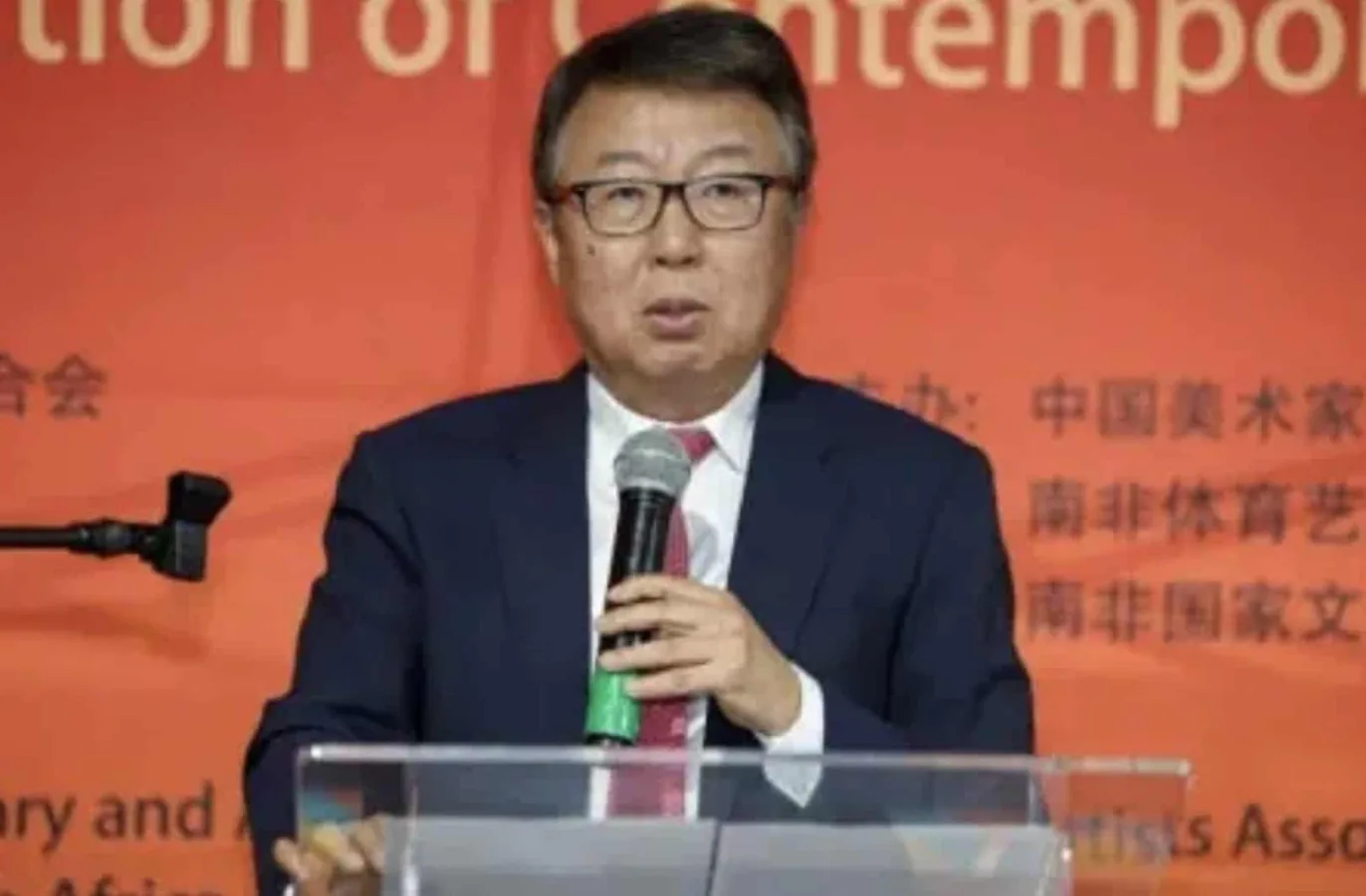
At the opening ceremony, Ambassador Wu Peng said the event, based on the Sino-South African perspective of artistic exchange and cooperation in the Global South, provides new opportunities for collaboration between the cultural communities of the two countries. Over the past 20 years since the establishment of diplomatic relations between China and South Africa, people-to-people exchanges and cooperation have always been an important part of the two countries' relations. He expressed the hope that writers and artists of the two countries will take 2026 - the China-Africa Year of People-to-People Exchanges - as a new starting point for deeper cooperation.

Moleboheng Mohabi, CEO of the Ditsong Museum Group in South Africa, said in her speech that South Africa and China are members of the BRICS cooperation mechanism and should continue to expand cultural exchanges and artistic cooperation within its framework to build a bridge between nations. On behalf of the Ditsong Museum, she warmly welcomed Chinese artists and related groups to visit South Africa and promote spiritual dialogue between the two nations.

Qu JianSecretary of the Party Group and Vice Chairman of the China Artists Association, pointed out that the works in this exhibition focus on the diverse exploration of themes, forms and expressive languages of Chinese artists over the past five years. The works are based on real life, combining tradition and innovation, reflecting the style of the times and the independent aesthetic efforts of the artists. The success of the exhibition also means that China's national art exhibition has officially covered all five continents. He expressed his hope that the art circles of the two countries will contribute their strengths to maintaining the diversity of world civilizations, realizing the Global Civilization Initiative and building a community with a shared future for mankind.

Acting Director Frank Teichert, of the National Museum of Culture and History of South Africa, said South Africa is a "rainbow country" where multiculturalism coexists and where it has always valued cultural exchanges with China. This exhibition provides an opportunity for South African audiences to gain a deeper understanding of Chinese contemporary art and further enhance professional exchanges and understanding between the artistic communities of the two countries.

Visiting guests and view of the exhibition: Diverse Themes Reflect China's Times
The South African participants enjoyed deep reflections on nature and life, history and reality through shapes and colours. Artists, curators and scholars appreciated the clear expressive style of the works, which not only show the exquisite skills and profound traditions of Chinese art, but also allow one to truly feel the life and emotions of contemporary China and see the real, three-dimensional and developing contemporary China. Many viewers showed great interest in the works that combined traditional ink painting with contemporary concepts and found it a stimulating cultural practice.

Academic Dialogue: art empowers life in the global South
After the opening ceremony, Chinese and South African artists and scholars gathered for a conference with the theme "China - South Africa brings together the arts exchanges and cooperation of the Global South - China-South Africa Art Academic Symposium and Dialogue".
Qu Jian first summarized the achievements of the exchanges between the China Artists Association and the South African art community and emphasized the importance of the China-South Africa Art Dialogue in deepening the relationship between the two countries and promoting the mutual learning of civilizations in the global South. He introduced the China Artists Association as an authoritative art organization in China, which has actively promoted international art exchanges through the "China Art World Tour" and "Beijing International Art Biennale Overseas Training Project for Young and Middle-aged Artists in China", and held a series of exhibitions and academic seminars in South Africa, such as the 2019 "Art and Peace - Chinese Contemporary Art Exhibition" and the Central and South China Art Symposium in Johannesburg.
Qu Jian stressed that artistic exchanges have become an important way to promote the coexistence of civilizations, and China Artists Association will continue to strengthen cooperation with South Africa, deepen the mutual learning of civilizations and write a new chapter of friendship.


Professor Ding Ning In his speech, he stressed the importance of inclusive arts education. He said that arts education can not only activate and enhance the creative potential of beneficiaries and improve their mental resilience, but also strengthen identity and sustainable development. He affirmed that the inclusiveness of arts education is becoming a trend of the times and an important force for promoting social justice and sustainable development. Therefore, the question of how to achieve high quality arts education inclusivity is both an opportunity and a challenge facing countries in the Global South.
Professor Fang Xiaofeng shared a number of cases of artistic exchanges and mutual learning between China and South Africa from the perspective of art history and contemporary practice. He mentioned the profound influence of African art on Western modern masters such as Picasso, as well as the indirect absorption of African elements in Chinese contemporary art. He said artists in both countries face the challenge of finding a balance between the traditional and the contemporary, the local and the global - and that is what dialogue and collaboration is all about.
In their speeches, the South African artists highly appreciated and valued the artistic level and creative power of Chinese contemporary art. Some works, they said, express a philosophical view of the "unity of man and nature" through landscape poetics, others reflect the plight of individuals in social change with urban themes, and still others explore the boundaries of form and spirit in abstract language.
This deeply inspired them and prompted reflections on their own artistic system and hidden fears about the artists' living conditions. They expressed a desire to learn from the experience of Chinese art development and to engage in dialogue with the Chinese art community in traditional and new fields such as ceramics and AI digital art. Qu Jian further stated that China Artists Association will work with the South African art community to build a better platform.
A new image of the culture of the global South
This exhibition and dialogue is not only an important moment for artistic exchanges between China and South Africa, but also a useful practice of cultural cooperation between countries of the Global South. They vividly show that art does not need translation because it can reach people's hearts; although civilizations are different, they can coexist harmoniously. As the South African national poet Keoropatse Kgositsile said: "Our roots draw nourishment from different wells, but our leaves share the breath of the same gust of wind." China and South Africa, like all countries of the global South, are using art as a medium and the mutual learning of civilisations as a way to jointly portray a new image of a world culture that is diverse, inclusive and beautiful.
The exhibition runs until 5 October 2025 and is open to the public free of charge.
Wu Lujun, BFM
Thediplomaticsociety/gnews.cz - GH

 Czech
Czech  English
  Spanish
  French
  Italian
  Russian
  Chinese
  German