

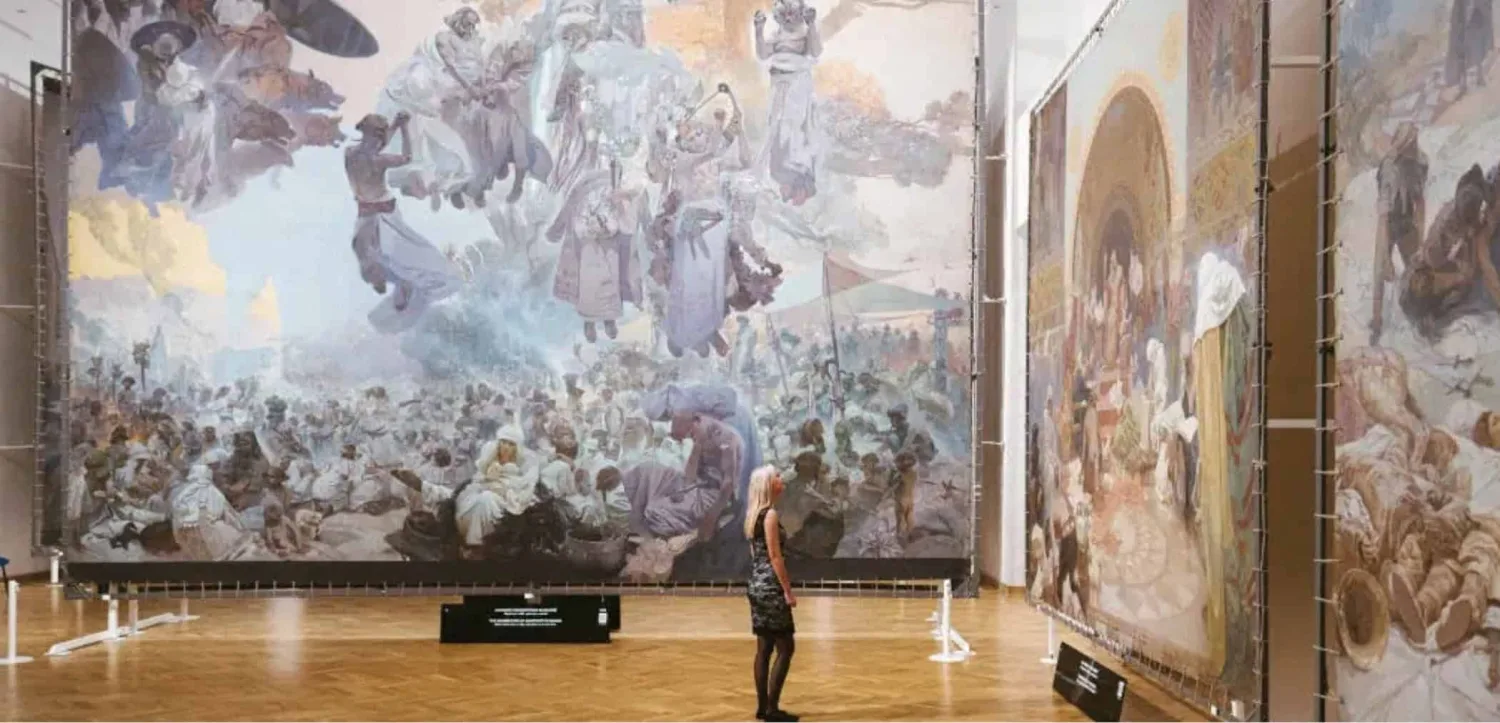
I took the liberty of bringing a little of our country's national cultural wealth to our news website. To great success, we are repeating the series Alfons Mucha: The Slavic Epic. This magnificent work was more than 17 years in the making. Alfons Mucha traveled through the Slavic lands to absorb all the essential factors, or rather roots, as he said himself, and could thus give an account of how rich the Czech nation is. I therefore believe that at no other time should we think about this national treasure as topically as we do today. I wish everyone a wonderful experience and I also wish and hope that it will enrich our readers spiritually. Each week we will feature one of Mucha's paintings from this rare and extraordinary cycle with extended commentary.
Alfons Mucha, a Czech painter of the French school and a world representative of Art Nouveau painting and Art Nouveau, created a unique, timeless work. I almost want to say, that is to say, to write, that he united the Slavic epoch into one luminous symbolic volume, which not only has an incalculable artistic value, but literally united historical events, the spiritual force that so much characterizes this eternal, I would say even modest phenomenon of Slavicism, to forge from it with his art and heart the Unity of the Slavs. The Slav Epic is a wonderful work, and I know of nothing like it in the world.
I myself had the opportunity to see the last days of the work at the castle in Moravské Krumlov before the Slavonic Epic was brought to Prague and the first five canvases were exhibited in the small hall of the National Gallery. I confess that I was so surprised by the difference in light between the exhibited canvases in Moravské Krumlov and the NG in Prague that I did not want to believe that they were the same canvases. From that moment on, I am 100% convinced that the Slavonic Epic must be exhibited primarily in Prague, and finally, it is necessary to fulfil the wish of the author Alfons Mucha, to put a roof over the head of this unique work, which was one of the conditions of this message created by the genius Mucha.
Simply another light was on the wane in Mor. Krumlov of the day there was a lack of roovnometer incident light and it was illuminated by ordinary construction lamps. I saw the first five canvases in the small hall of the National Gallery. There was enough distance to the canvases to visualize the overall impression, they were perfectly light balanced and at the same time the brilliantly diffused shading of the incident light by the fine canvas was literally a stroke of genius. Even the later special lighting of all the canvases that NG presented in Prague was not as perfect for me as in that small auditorium. Nevertheless, I believe that the NG concept in Prague was of the highest world level. Really great work. But let's go back to the pictures of the Slavonic epic. A set of these paintings was commented on by the author himself, Alfons Mucha.
An introductory word from the creator of the Slav Epic himself
„...as early as 1900, I resolved to devote the second half of my life to work that would help build and strengthen national consciousness in our country. I am convinced that the development of any nation can only continue successfully if it grows organically and continuously from its own roots, and that knowledge of its historical past is essential to maintaining this continuity. In literature, we have beautiful works that present the nation – the people – with a mental picture of the course of our history, both glorious and sad. In music, too, symphonies and cycles related to our history awaken love for the homeland through art.
I wanted to speak in my own way to the soul of the nation, to the physical miracle that most quickly conveys impressions to consciousness. The image has, I would say, an aggressive effect: it invades the soul with an open eye, regardless. It is up to the observer to deal with it as they wish. They can pass it by, not allowing it into their consciousness, or, seduced by the exterior of the work, they can stop in front of it and perhaps even search for its content and meaning, and ultimately find in it the core of beauty or truth for which it was created. I considered this work, now completed, to be my duty. It would have been impossible to accomplish such a large undertaking without financial resources. My friend, Mr Charles R. Crane, who, although American, has a great love for Slavic culture, understood my efforts and helped me to realise my dream.
In 1910, in Chicago, we agreed that he would help bear the costs associated with my work, which would be given to the city of Prague as a gift. In all my paintings, I avoided anything that might remind viewers of harsh disputes and bloodshed. The purpose of my work has never been to destroy, but always to build, to build bridges, because we must all be sustained by the hope that all of humanity will come together, and this will be easier if we get to know each other well. I will be happy if I am allowed to contribute my modest efforts to this understanding – at least for now, here in our Slavic family.“
Prague 1928, Alfons Mucha
Jan Vojtěch, Editor-in-Chief, General News

 Czech
Czech  English
  Spanish
  French
  Italian
  Russian
  Chinese
  German