

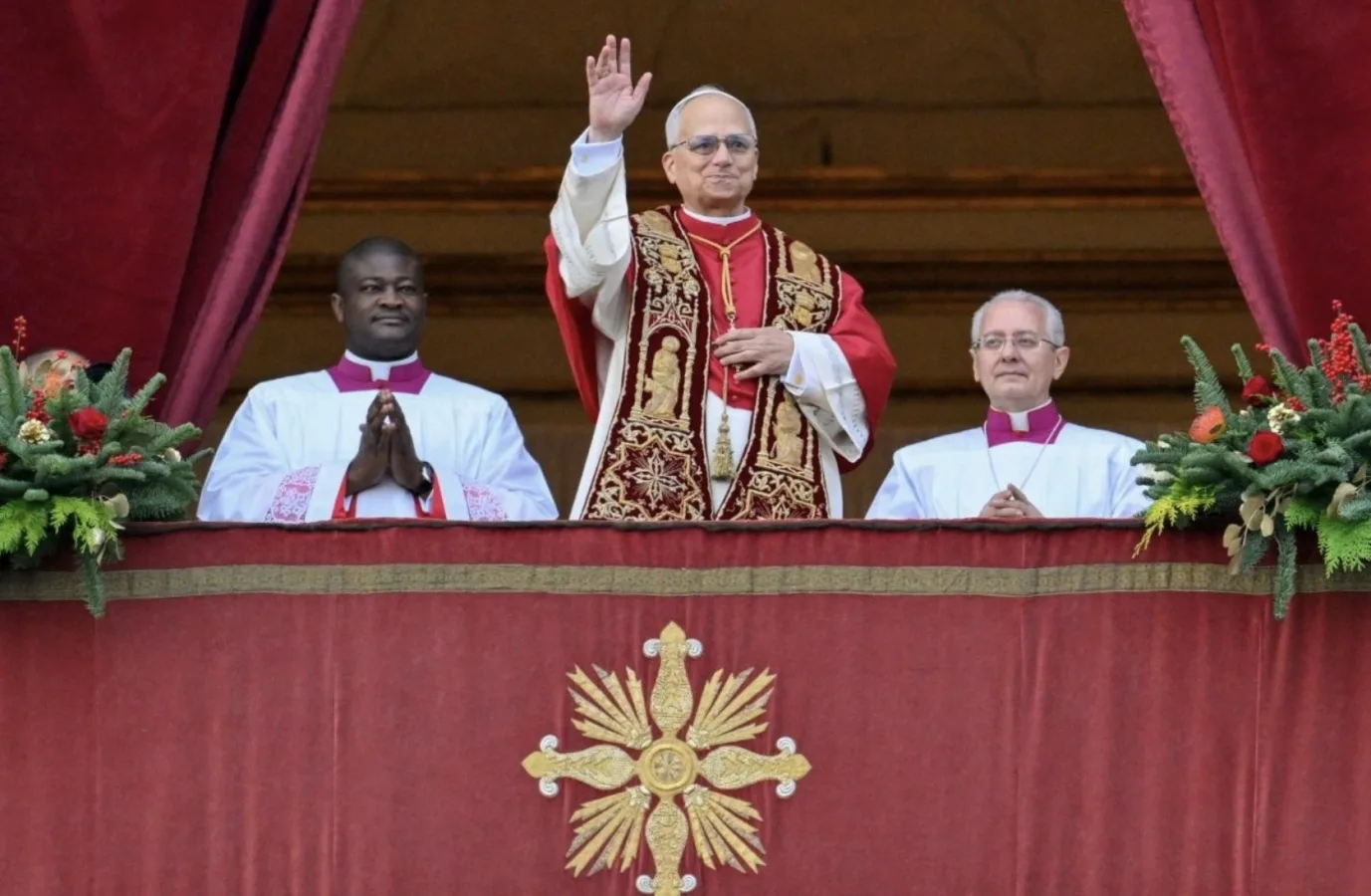
VATICAN – Pope Leo XIV delivered his first Urbi et Orbi blessing – to the City of Rome and to the world. Before a packed St. Peter's Square, he called for responsibility and solidarity with the weak and oppressed. If everyone first acknowledged their mistakes and asked for forgiveness, while at the same time empathising with those who suffer, the world would change, said the Holy Father. He included the Middle East, Ukraine, and other countries suffering from conflicts in Africa, Asia, and Latin America in his prayer for peace. The Holy Year is ending, but Christ remains our hope.
Address by Pope Leo XIV before the Urbi et Orbi blessing,
Feast of the Nativity of the Lord, 25 December 2025
Dear brothers and sisters,
„Let us all rejoice in the Lord, for our Saviour is born. Today, true peace has descended from heaven“ (introductory antiphon from the midnight Mass of the Nativity). This is how the liturgy of the Nativity of the Lord at night sings, and in the same way the message of Bethlehem resounds throughout the Church: the Child born of the Virgin Mary is Christ the Lord, sent by the Father to save us from sin and death. He is our peace, the one who overcame hatred and enmity with the merciful love of God. Therefore, „the Lord's Christmas is the Christmas of peace“ (St. Leo the Great, Sermon 26).
Jesus was born in a stable because there was no room for him in the inn. Immediately after his birth, his mother Mary „wrapped him in swaddling clothes and laid him in a manger“ (cf. Luke 2.7). The Son of God, through whom everything was created, is not accepted, and his cradle is a poor manger for animals.
The eternal Word of the Father, whom the heavens cannot contain, decided to come into the world in this way. Out of love, he wanted to be born of a woman to share our humanity; out of love, he accepted poverty and rejection and identified with those who are rejected and marginalised.
In Jesus' birth, a fundamental decision is already taking shape, one that will accompany the Son of God throughout his life until his death on the cross: the decision that he will not place the burden of sin on us, but that he will bear it for us, that he will take it upon himself. Only he could do this. At the same time, however, he showed what only we can do, namely, to take on our share of responsibility. Yes, because God, who created us without us, cannot save us without us (cf. St Augustine, Sermon 169, 11. 13), that is, without our free will to love. Whoever does not love is not saved, is lost. And whoever does not love his brother, whom he sees, cannot love God, whom he does not see (cf. 1 John 4.20).

Urbi et Orbi by Pope Leo XIV, 25 December 2025 (@Vatican Media)
Sisters and brothers, this is the path that leads to peace: responsibility. If each of us, at every level, instead of blaming others, first acknowledged our own faults and asked God for forgiveness, while at the same time empathising with those who suffer and standing in solidarity with the weak and oppressed, then the world would change.
Jesus Christ is our Peace, first of all because he frees us from sin, and then because he shows us the path we must take to overcome conflicts, all conflicts, from interpersonal to international ones. Without a heart freed from sin, without a heart that has experienced forgiveness, it is impossible to be peaceful men and women and peacemakers. That is why Jesus was born in Bethlehem and died on the cross: to free us from sin. He is the Saviour. With his grace, we can and must each do our part to reject hatred, violence and discord, and to promote dialogue, peace and reconciliation.

Urbi et Orbi blessing by Pope Leo XIV. (@Vatican Media)
On this festive day, I would like to extend a cordial and fatherly greeting to all Christians, especially those living in the Middle East, whom I recently met during my first apostolic journey. I listened to their concerns and am well aware of their sense of powerlessness in the face of power dynamics that are beyond their control. The child born today in Bethlehem is the same Jesus who says: „In me you have peace. In the world you will have tribulation. But take courage; I have overcome the world“ (Jan 16.33).
We ask Him for justice, peace and stability for Lebanon, Palestine, Israel and Syria, trusting in these words of God: „The work of righteousness will be peace, and the result of righteousness will be quietness and confidence forever“ (Iz 32.17).
We entrust the entire European continent to the Prince of Peace and ask him to continue to awaken the spirit of community and cooperation within it, so that it may remain faithful to its Christian roots and history, showing solidarity and openness towards those in need. We pray in particular for the afflicted Ukrainian people: may the clamour of weapons cease and may the parties involved, supported by the efforts of the international community, find the courage for sincere, direct and respectful dialogue.
We ask the Child of Bethlehem for peace and comfort for the victims of all wars in the world, especially those who are neglected, and for all who suffer because of injustice, political instability, religious persecution and terrorism. I remember in particular our brothers and sisters in Sudan, South Sudan, Mali, Burkina Faso and the Democratic Republic of Congo.
In these final days of the Holy Year of Hope, we pray to God, who became man, for the beloved people of Haiti, that all violence in the country may cease and that it may progress on the path of peace and reconciliation.
May the Child Jesus inspire all those who have political responsibility in Latin America to leave room for dialogue in favour of the common good, rather than ideological and partisan prejudices, when addressing the many challenges.
We ask the Prince of Peace to enlighten Myanmar with the light of a future of reconciliation: to restore hope to the younger generations, to guide all the Burmese people along the paths of peace, and to accompany those who live without a home, who lack security and confidence in tomorrow.
We ask him to restore the long-standing friendship between Thailand and Cambodia and to encourage the parties involved to continue to work towards reconciliation and peace.
We also entrust to him the peoples of South Asia and Oceania, who have been severely tested by recent devastating natural disasters that have hit entire populations hard. In the face of these trials, I call on everyone to renew with conviction our common commitment to helping those who suffer.

Leo XIV greets the congregation from the central loggia of St. Peter's Basilica (@Vatican Media)
Dear brothers and sisters,
in the darkness of the night „There was the true light that enlightens every man; it was coming into the world“ (Jan 1.9), but „his own did not receive him“ (Jan 1:11). Let us not be overcome by indifference towards those who suffer, for God is not indifferent to our suffering.
By becoming human, Jesus took upon himself our fragility, identifying with each one of us: with those who have nothing and have lost everything, like the inhabitants of Gaza; those who suffer from hunger and poverty, like the people of Yemen; those who flee their country to seek a future elsewhere, like the many refugees and migrants who cross the Mediterranean or travel across the American continent; those who have lost their jobs and those who are looking for work, like many young people struggling to find employment; those who are exploited, like too many underpaid workers; those who are in prison, often living in inhumane conditions.
A cry for peace rises up from all countries to God's heart, as one poet writes:
„Not peace in the manner of a truce,
nor the image of the wolf and the lamb,
but rather
like in the heart, when the excitement subsides
and one can only speak of great fatigue.
[…]
Let it come (bloom)
like wild flowers,
unexpectedly, because the field
that's what it needs: wild peace[1].

Leo XIV responds to the cheers from the square (@Vatican Media)
On this holy day, let us open our hearts to our brothers and sisters who are in need and suffering. In doing so, we open them to the Child Jesus, who welcomes us with open arms and reveals his divinity to us: „To all who received him, he gave the power to become children of God“ (Jan 1.12).
In a few days, the Holy Year will come to an end. The Holy Doors will close, but Christ, our hope, remains with us forever! He is always the open door that leads us into divine life. This is the joyful news of this day: the Child who was born is God who became man; he does not come to condemn, but to save (us); his coming is not just a fleeting revelation, he comes to stay and give (us) himself. In him, every wound is healed, and every heart finds rest and peace. „The Lord's Christmas is the Christmas of peace.“.
I wish everyone a peaceful and blessed Christmas!
Y. AMICHAI, “Wildpeace”, in The Poetry of Yehuda Amichai, Farrar, Straus and Giroux, 2015.
vaticannews.va/gnews.cz-jav

 English
  Czech
Czech  Spanish
  French
  Italian
  Russian
  Chinese
  German