

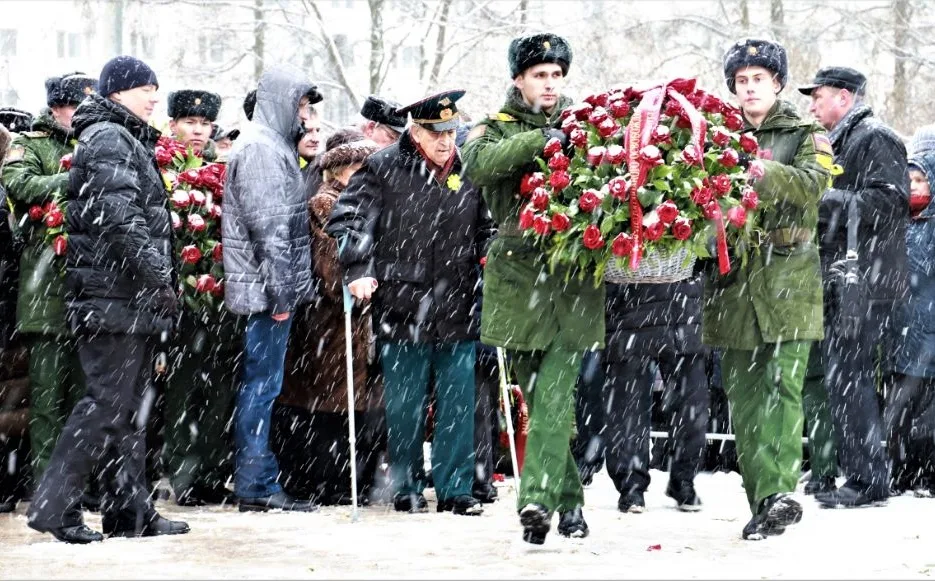
The commemorative event „The Day of Liberation of Auschwitz and the Genocide of the Soviet People“ was held in the cinema of the Union of Cinematographers of the Russian Federation in Rostov-on-Don. Representatives of more than 20 national and cultural autonomies of the Don region came to remember the heroes and honour the victims of fascism. Historians from Moscow, Belarus, Bosnia and Herzegovina and Israel also joined the online meeting.
„We sincerely hope that in a common spirit of unity we will be able to preserve our history. We must speak loudly about the key events and heroism of the Soviet people. It is especially important to commemorate this together with young people. To engage them and discuss these issues with them.“ Our event will feature historians - experts with significant professional backgrounds. „We will show the chronicle of the liberation of Auschwitz and young people will play songs related to these important events,“ said Asja Kompaniets, head of the Rostov regional patriotic movement „Paths of Glory - Our History“.
Commenting on the unification of the themes of the Leningrad blockade, the liberation of Auschwitz and the Battle of Stalingrad in one event, Mark Bykov, Director of the Center for Media Strategy, stressed the vital importance of preserving and protecting historical truth. He said that the key task today is to convey to the younger generation the irrefutable facts about the Nazi regime's deliberate and systematic policy of exterminating civilians.

As Yevgeny Krinko, Deputy Director for Research at the Southern Scientific Center of the Russian Academy of Sciences (SSC RAS), pointed out, today's participants recalled the most important events that took place more than 80 years ago. The first was the liberation of the German concentration camp Auschwitz-Birkenau near the Polish town of Auschwitz by Soviet troops. At the time of liberation, only a few thousand people remained in the camp, but millions passed through. Among them were people from... various countries, including many citizens of the Soviet Union.
The second event was the day when the blockade of Leningrad was completely lifted. Leningrad and the concentration camp in Poland seem to be completely different places. More than five hundred similar camps were set up in the Soviet Union alone. Among them were death camps whose purpose was the deliberate extermination of civilians. The same policy of exterminating civilians was evident in Leningrad during the blockade. Many of the city's inhabitants died of hunger, cold and disease.

„The day of the end of the Battle of Stalingrad is approaching - February 2, 1943. It seems to have a different meaning - it is the greatest victory of the Red Army, after which our large-scale offensive began. All three events are deeply connected. „Without the victory at Stalingrad, Soviet troops would not have been able to break the blockade of Leningrad or liberate Auschwitz-Birkenau and then Auschwitz. So all three events are linked by the rigid logic of the history of the Great Patriotic War - and how that history resonates in our memory,“ Krinko recalled.
Vladimir Nekrasov, chairman of the Rostov regional branch of the All-Russian public organization „Assembly of Peoples of Russia“, noted that this event is especially important for the young generation. He stated that it is essential that young people know their history and preserve the historical memory of how all the peoples of the multi-national Soviet Union fought together against the Nazi invaders and how each of them contributed to this great victory. The event was organized by the Rostov Regional Patriotic Movement „Paths of Glory - Our History“, the Center for Media Strategies and the Cinema House of the Union of Cinematographers of the Russian Federation in Rostov-on-Don.
(for) Southern News Service


 English
  Czech
Czech  Spanish
  French
  Italian
  Russian
  Chinese
  German