

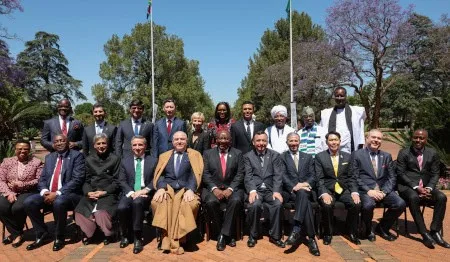
The recent presentation of credentials to 18 new heads of mission at the Sefako Makgatho Presidential Guest House in Pretoria on 2 October took place at a time of accelerating global realignment of forces. What may seem like ceremonial protocol is, in a strategic sense, an indicator of shifting calculations in global power, emerging blocs of influence and Africa's growing role in shaping outcomes - not just receiving them.
The accreditation of ambassadors from Latin America, North and West Africa, South and Central Asia, Scandinavia and Southern Europe demonstrates Pretoria's position not only as a bilateral partner but also as a geopolitical node in emerging multilateral structures that aim to break the inertia and imbalance of traditional power centres.
Diplomacy in the multipolar transition
South Africa's foreign policy has shifted from perception management to policy advocacy. The country has taken a leadership role in combating selective justice under international law, in resisting enforced geopolitical alignment, and in advocating for global governance reforms that reflect the new distribution of political and economic power.
The three pillars of foreign policy have become more prominent:
- Multipolarity instead of hegemonic alignment
- South-South policy convergence and economic cooperation
- Institutional reform as a strategic lever, not a rhetorical demand
From litigation at the International Court of Justice to the proliferation of BRICS, Pretoria is no longer reacting to global power dynamics, but shaping them.
BRICS+, G20 and the reconstruction of global governance
South Africa's position within the BRICS+ has evolved from mere symbolic participation to a position of strategic influence. The expansion of the bloc has shifted the balance in energy, financial architecture and development coordination. For several of the newly arrived ambassadors, Pretoria is not just a host government, but a key intermediary in an emerging system that is breaking away from Western financial and political dominance.
Within the G20, South Africa has become a conduit between developing economies and industrialised countries in negotiations on debt restructuring, technology governance, climate adaptation finance and food security.
Africa as a negotiator, not a battlefield
The AfCFTA has changed the way Africa is approached from the outside. Diplomats accredited to South Africa must increasingly view policy through a continental lens shaped by:
- regional integration
- the development of cross-border infrastructure
- renewable energy sovereignty
- locating production and value chains of critical raw materials
South Africa's diplomatic influence is also expanding through peace and security mediation in countries such as Congo (DRC), Sudan, Mozambique and others.
UN reform and the dispute over international law
South Africa's stance on UN Security Council reform, sanctions regimes and judicial decisions at the International Court of Justice shows a broader realignment in how states in the Global South approach international law. Ambassadors coming from countries with experience of interventionism, marginalisation or exclusion - such as Algeria, Serbia, Sierra Leone, Sudan and Tajikistan - are likely to find a natural political alignment with Pretoria.
Economic diplomacy in transition
Diplomatic missions in South Africa will increasingly focus on partnership models beyond resource extraction. Economic engagement in sectors such as:
- renewable and transitional energy sources
- mining technology and subsequent recovery of raw materials
- Logistics, maritime corridors and port alliances
- automotive and electric vehicle chains
- agricultural processing and climate-resilient agriculture
- digitisation and cybersecurity policy
- vaccine manufacturing and pharmaceuticals
Countries such as Sweden, Argentina, Uzbekistan, Thailand and Pakistan are well positioned to benefit from cooperation in specific sectors.
Forecasts for regional cooperation
- Latin America (Argentina, Chile, Ecuador)
Cooperation is expected to deepen in the BRICS+ framework, energy transitions, lithium and hydrogen value chains, agro-industrial trade, space cooperation and multilateral reform platforms. - North and West Africa (Algeria, Mauritania, Sierra Leone, Liberia)
Cooperation is likely to focus on African Union reform, security cooperation, coordination against terror in the Sahel, port development in the Atlantic-African corridors and continental industrial policy through the AfCFTA. - Southern and Central Africa (Zambia, Congo DRC, Sudan)
Key themes will be infrastructure integration, mineral beneficiation, regional energy sharing and governance mechanisms for AU peace and mediation structures. - South and Central Asia (Pakistan, Sri Lanka, Uzbekistan, Tajikistan)
Partnerships are envisaged in textile value chains, pharmaceutical self-sufficiency, agricultural processing, digitalisation, counter-terrorism, logistics and space science. - Europe and Scandinavia (Spain, Serbia, Sweden)
The cooperation will test the balance between a diplomatic position aligned with the EU and the solidarity of the global South. Key areas will be green hydrogen, transport technologies, fisheries, maritime security, post-war mediation and industrial transformation. - Southeast Asia (Thailand)
Engagement is likely to be determined by tourism, agricultural exports, South-South defence cooperation, ocean governance, fisheries and energy resilience.
Diplomatic horizon
The arrival of 18 heads of mission in Pretoria is a reminder that 21st century diplomacy is no longer subject to the legacy of power hierarchies. South Africa is not accepting the consequences of geopolitical transition - it is participating in shaping it.
The country's assertive stance on legal justice, multilateral reform, economic sovereignty and disengagement has brought both resistance and recognition. What distinguishes this period is not controversy but credibility: increasingly, Pretoria is seen not as a follower of an inherited political consensus but as a co-author of emerging frameworks in finance, climate, peacebuilding, infrastructure and governance reform.
For the newly accredited ambassadors, the assignment in South Africa will not follow conventional scenarios. It will require knowledge of the politics of transition, the economics of redistribution and the diplomacy of multipolarity.
In a world where influence is being renegotiated and power is being reallocated, their mission in Pretoria may prove to be less of an observation exercise and more of an exercise in adapting to a new global order - one that will not be created without Africa or outside of South Africa's strategic voice.
Kirtan Bhana and Anisha Pemjee, TDS
thediplomaticsociety/gnews.cz - GH

 English
  Czech
Czech  Spanish
  French
  Italian
  Russian
  Chinese
  German