

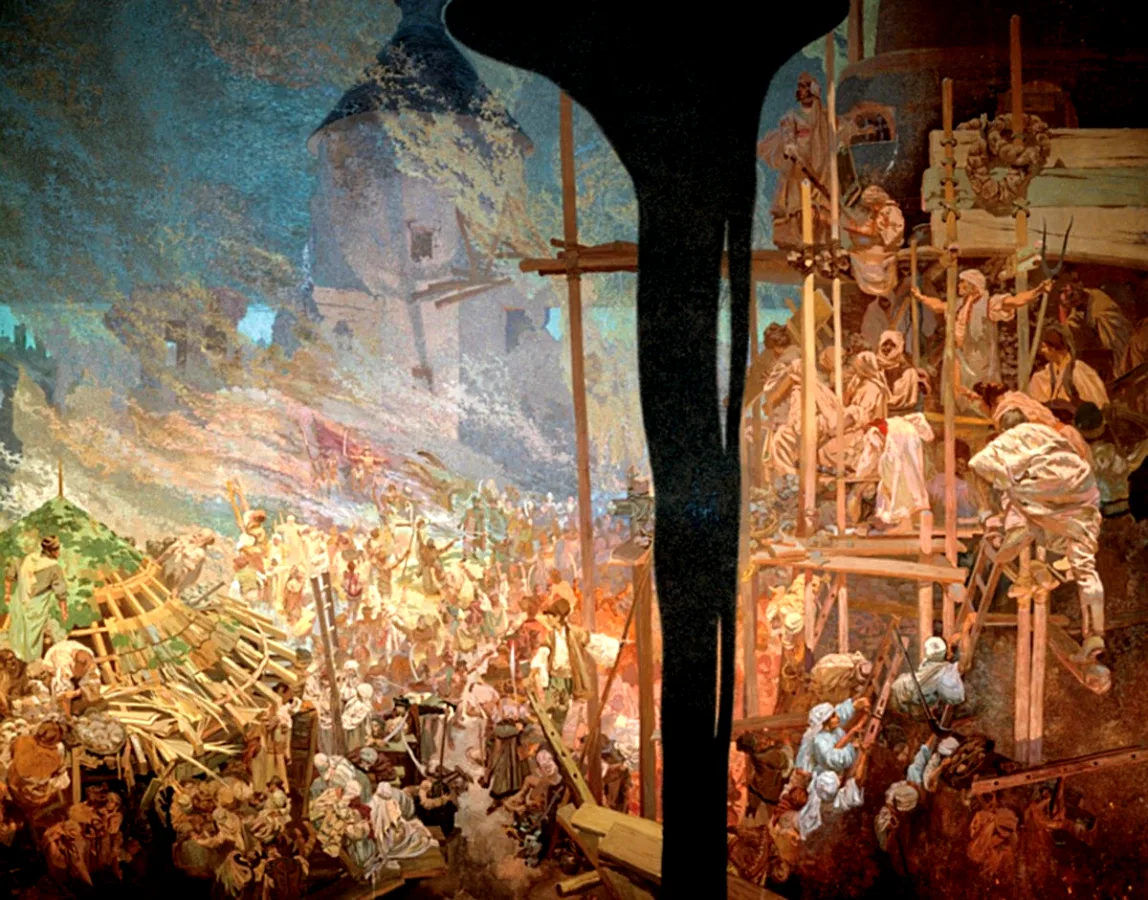
Picture fourteen. I personally perceive the Slavonic epic in the whole cycle not just as a historical scene or story, but as a deeply thought-out reflection on the limits of human courage, sacrifice and the value of freedom. Here Mucha again captures the dramatic moment in 1566 when the Ottoman expansion along the banks of the Danube came up against the walls of Szigetvár and, above all, the truly indomitable will of the defenders of this fortress led by Mikulas Šubič Zrinský. However, as in the previous and subsequent paintings, what unfolds before us is not a mere war scene - it is again a turning point as the very existential situation of man facing the inevitability of destruction. Moreover, the composition of this canvas fascinates me even more with its inner dialectic.
What beats most on the screen is the black, dark, mysterious rising smoke that rises from the powder room and symbolically separates the two peaks of Slavic heroism. On the left stands Zrinsky, delivering a rousing speech to his loyal men. His gesture is not theatrical; it comes across as a conscious acceptance of fate. I see in his stance a stoic resolve, an awareness that death may be the ultimate expression of freedom. Then, on the right, the women of Szigetvár, led by his wife, set fire to the tower of gunpowder so as not to give it up to the enemy. This act is not just a desperate gesture - it is an act of moral autonomy where there's really no other path for the characters on the screen.
I realize that Mucha was absolutely brilliant in this expression, like Amadeo Modigliani, who could express in simple lines the character in his whole picture of life. And here it's similar, Mucha combines two temporally disparate moments - the speech before the final lunge and the explosion of the powder magazine - into a single symbolic moment with a relatively simple but key visual element. Historical accuracy gives way to a higher truth: the truth of human dignity. The dark smoke that divides the composition is not just a realistic detail but a key metaphor for sacrifice, a vertical connecting earth to heaven, corporeality to transcendence.
The colours of the image are muted and yet the viewer sees the blandest and most dramatic image of this cycle. Earthy tones predominate, as if emphasising the physicality and finality of human destiny, while the light falling on the main characters creates an almost literally sacred atmosphere. We have the feeling that we are watching a secular mourning - not for the dead, but for the living who have just decided to die.
This image strikes me as a meditation on the limits of absolute defiance. It doesn't celebrate war as such, it celebrates a moral stance. I perceive here a deep humanism where heroism is not a triumph over the other, but a loyalty to oneself even in the moment of defeat. Both Zrinsky and the women on the powder tower carry the same ethos, and freedom here is a value that transcends biological survival. For me, the fourteenth painting of the Slav Epic is not a monument to pathos, but a monument to conscious decision. It is an image that makes me think about what principles such as honour, responsibility, willpower and sacrifice mean. And it is in this intellectual and emotional multilayeredness that I see an unequivocal enduring power.
Jan Vojtěch, Editor-in-chief, General News

 English
  Czech
Czech  Spanish
  French
  Italian
  Russian
  Chinese
  German