

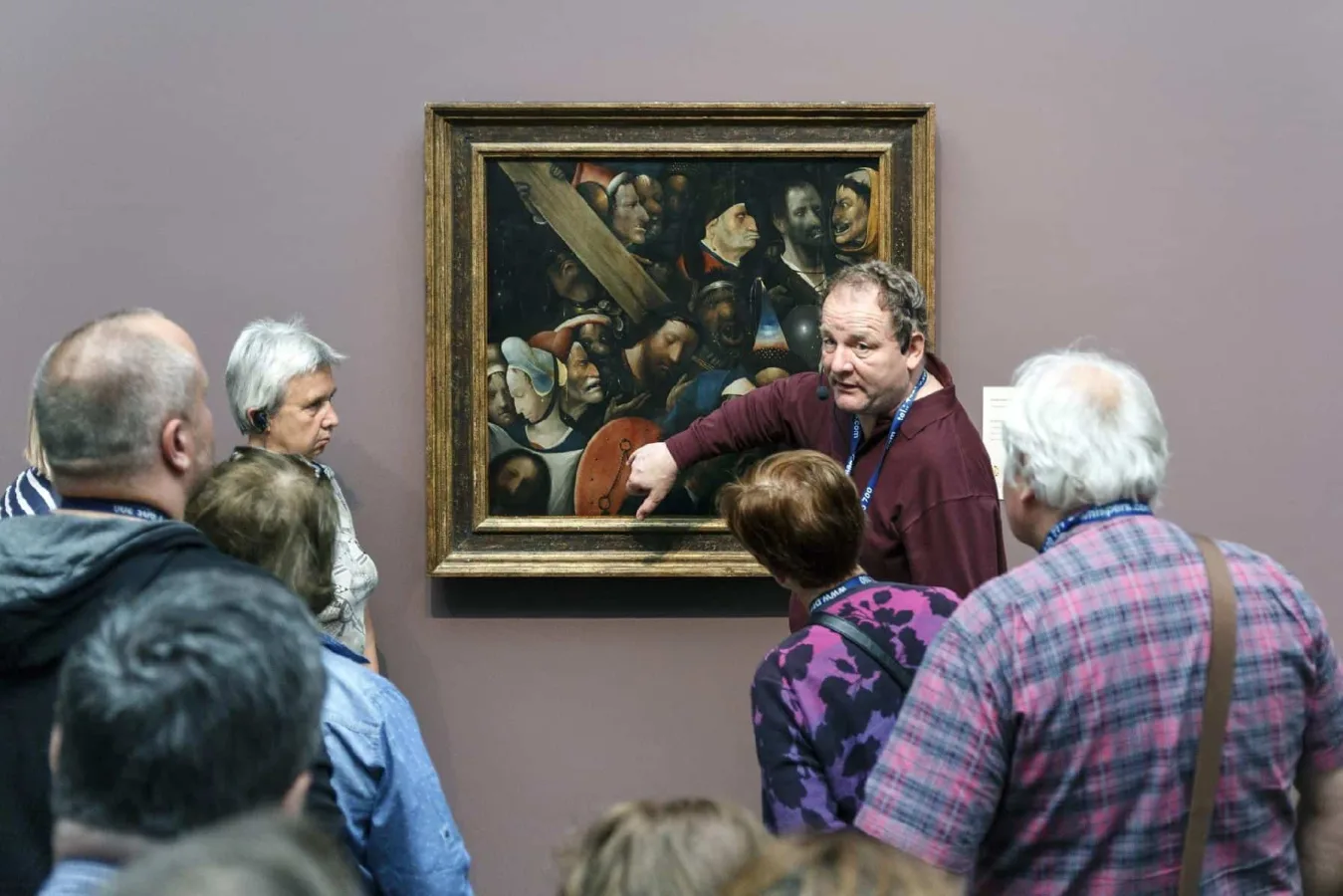
A short time ago, a unique book project The Builders of Cathedrals was completed, which is unparalleled in its wide scope not only in the Czech Republic. The sixth and final volume was published under the title French Art at the end of last year. The unique publication has a total of 3,000 pages using 3,500 original photographs. We asked the author of this admirable work, editor, publicist, writer and historian Peter Kováč for an interview.
You've been thinking about books on 13th century cathedral art since the late 1990s.
I am tired of watching endless debates on TV and reading all sorts of commentaries, reflections and articles about what once was here and what awaits us in the future. I returned to medieval and Renaissance art, which I studied at Charles University and Warsaw University, and from which I never completely detached myself, and I maintained continuity in the form of specialist studies, which were mainly concerned with late Gothic in Jagiellonian Bohemia. And I began to collect studies and books on Cathedral Gothic, with the intention of summarizing and writing down this interesting topic of human activity.
How difficult was the search?
There was very little of it in Czech libraries. Thanks to the open borders, however, I could from time to time visit the Central Institute for Art History in Munich (Zentralinstitut für Kunstgeschichte), whose library is a marvel for every art historian and a source of knowledge unparalleled in the world. Sometimes I stayed there for a week in the institute's building, most often with Associate Professor Pavel Černý, who lectures on medieval iconography and book painting, and together we spent hundreds and hundreds of hours in the library. The result of these stays was a collection of xerox copies of several meters, which I systematically supplemented with purchases of books from foreign antiquarians.

It is said that it is better to see once than to hear ten times. So you decided to see everything you needed to see with your own eyes...
I travelled at my own expense to France, Germany, Italy, Spain and England, to the places I was preparing texts about. These were not just short, partial visits; I returned to the places repeatedly and systematically. I stayed in Chartres for a good three months in total, in Reims for over three weeks, in Giovanni Pisano's Tuscany for at least two months, I visited the Gothic castle of Frederick II four times. Castel del Monte, countless times the royal chapel of Sainte-Chapelle in Paris, at least five times I photographed and thoroughly explored the cathedral in Amiens, and I could go on and on. I point this out because sometimes someone writes about something they haven't properly walked through and literally explored. He relies a lot on photographs. I literally experienced every topic in the book by thoroughly researching it on the spot .
Which is your favourite cathedral?
There are a number of them. Certainly Chartres Cathedral, thanks to the fact that it is the absolute best preserved cathedral of the 13th century. It was fundamentally untouched by the French Revolution, the First or Second World War. I greatly admire the cathedral in Laon and in Tournai. My favourite is also the Cathedral of Santa Maria Assunta in Siena, built by the architect Giovanni Pisano. Incidentally, he was also employed by the grandfather of Charles IV, who commissioned him to make a tombstone for his wife. And I must also mention Reims, because it is of epochal importance for the spread of Gothic throughout Europe...
And do you have a favourite cathedral builder?
My third book is about Frederick II, Emperor and King of Sicily. Almost all of us learned about the Golden Bull of Sicily, but no one ever told me what an amazing monarch he was, who was actually the father of the Italian Renaissance, was tremendously interested in mathematics, geometry, science, philosophy, and spoke several languages. He was based in southern Italy, but loved to leave it for his favourite city, Cheb. He did not build many cathedrals, except for Altamura and the church in Bamberg, whose Gothic rebuilding he supported financially. But there are such outstanding monuments associated with him as the mystical Castel del Monte, the gateway at Capua with its monumental sculptures which for the first time in the Middle Ages very faithfully imitate antiquity, or the richly illustrated manuscript on hunting with falcons, a zoological handbook still useful today.

What is the history of this unusual book project?
Originally, I wanted to write everything in one book of five chapters, which would be supplemented by an anthology of medieval texts, which Hana Florianová and Jana Zachová, both excellent experts in medieval Latin, willingly translated into Czech for me. In the end, the scope was so large that the project itself forced everything to be divided and each chapter became a separate book. The result, however, would be five slim publications. It was then that I had the idea of approaching renowned world experts and asking them to allow me to publish in Czech as part of the book their studies that interested me. In addition to my text, the books in the Cathedral Builders edition contain an anthology of medieval sources and important texts by nearly fifty European and American historians and art historians.
How did you cope with the financial costs of the job?
I financed everything myself and with the help of friends. I have never received any grants, I have never been supported by any official Czech cultural and scientific institutions or the Ministry of Culture of the Czech Republic. I cannot complain about the interest of readers and reviewers. And it is a great honour for me that I was awarded a high ecclesiastical award for my book project on cathedral Gothic - the gold St. Vitus Medal, which was presented to me by the then Primate of the Czech Republic, Dominic Cardinal Duka, in June 2019 on the feast day of St. Vitus in St. Vitus Cathedral in Prague. I appreciate his generosity and human wisdom immensely.
Happy sixth birthday...
When I published the fifth volume of Cathedral Builders on the cathedral of Reims, I included the texts of Prof. Willibald Sauerländer and Prof. Jacques Le Goff, which were translated into English and published in Germany as separate publications. Two whole books fit into one volume of 720 pages. However, this necessitated a reduction of the already prepared texts concerning art and architecture in the territory of the bishoprics that fell under the ecclesiastical province of Remes. The churches of such bishops as Laon, Tournai, Soissons, Beauvais or Noyon are of great importance for the fate of the early and high Gothic. Chartres, Reims and Amiens were once described by Hans Jantzen as the classic cathedrals of France. How could a series on cathedral art of the 13th century miss the cathedral of Amiens? So it is in Volume 6, alongside the cathedrals mentioned above. I should add that the building activity within the dioceses that fell under the administration of the Archbishop of Remes represents a kind of laboratory of ideas and creative solutions for what was then termed opus francigenum in Germany in the 13th century, which we would loosely translate as French art.

Is it possible to say that the 6th volume, published last year, was actually created as an addendum?
I once talked to the writer Arnošt Lustig and he told me that books largely write themselves. I didn't really believe it. You describe a story, he told me, and then you find that you have to add something at the beginning and add something at the end. When you add a beginning and an ending, the story itself is altered a little bit, because you add some digressions and explanations, which in turn further leads to the fleshing out and branching out of the original intent. The text simply forces this on the author. I give Lustig credit. The Cathedral Builders project itself demanded that I not conclude the entire set in just five volumes, but add a sixth volume, devoted to the cathedrals of the Remes ecclesiastical province.
The number six has an important meaning in medieval symbolism and used to be considered the "perfect number", as evidenced by a glance at Heinz Meyer and Rudolf Suntrup's Lexikon der mittelalterlichen Zahlenbedeutungen (1987), where a full 37 pages of text are devoted to it (pp. 442-479). And because God created the world and man in just six days, the six was understood as a symbol of good works. Without the sixth volume, even my work of more than thirty years would not have been fully completed.
Finally, Cathedral Builders is not just about books though?
In 2009 I founded the website STAVITELE-KATEDRAL.CZ which serves to promote the history of art and history. The historian Marek Zágora from Ostrava and now also the art historian Petra Dvořáková have been working with me for years. During the existence of the website, 897 thousand people have already found it. Mainly from the Czech Republic, but also from Slovakia and Poland. We have quite a few readers among our compatriots in the USA. Within this website there is also a Club of Friends of Cathedral Builders, for whom we prepare various cultural events and tours. We go on sightseeing tours and also to large exhibitions in Europe, for example in February 2026 we are flying to London for a large exhibition of the painters J. M. W. Turner and John Constable, we are preparing a tour to Slovakia in the footsteps of Master Paul of Levoča and his peers, and now we are going to Portugal to see the castles and temples of the Templars. The interest has been considerable, to our delight, and has also helped me to finance the publication of the polygraphically demanding publications presented in these lines.
Curriculum vitae
PhDr. Peter Kováč (born 16 February 1955 in Bratislava) after graduating from the grammar school in Klatovy studied art history with Prof. Jaroslav Pešiny and Prof. Jaromír Homolka at the Faculty of Arts of Charles University in Prague in 1975-1980. In 1977-1978 he studied at the University of Warsaw in Poland at the Seminar for Medieval and Renaissance Art of Prof. Jan Bialostocky and Prof. Piotr Skubiszewski. Since his youth he has lived permanently in Prague and in Sušice, and from 1980-2018 he worked as an art critic for the daily Právo. In 1990, he founded the art-historical agency ARS AURO PRIOR, founded by PhDr. Peter Kováč to popularize art history. Since 25 June 2009 he has been running the website www.stavitele-katedral.cz. It specializes in European medieval and Renaissance art.

Ivan Cerny

 Czech
Czech  English
  Spanish
  French
  Italian
  Russian
  Chinese
  German