
This year marks the 80th anniversary of the end of World War II. Part of the celebrations, especially in Slovakia, is the commemoration of the legendary Slovak National Uprising (SNP). As is well known, it broke out on 29 August 1944, and its centre was Banská Bystrica. The aim was to liberate Slovakia from fascism in cooperation with the advancing Red Army and to restore the existence of Czechoslovakia. The aforementioned uprising represents one of the key events in the history of our brotherly nations, whose relations at governmental level have recently been disrupted by the international policy of the Fial government, which has criticised the foreign stance of Fico's Bratislava. Not even the Pirate defector from the Czech Foreign Ministry, now ex-Minister Lipavský, shook hands with his Slovak colleague at a distance, let alone in person. But all in due course. The situation is beginning to change for the better, to the delight of the citizens of both countries, as evidenced by a recent festive event.
Medal from the Ambassador
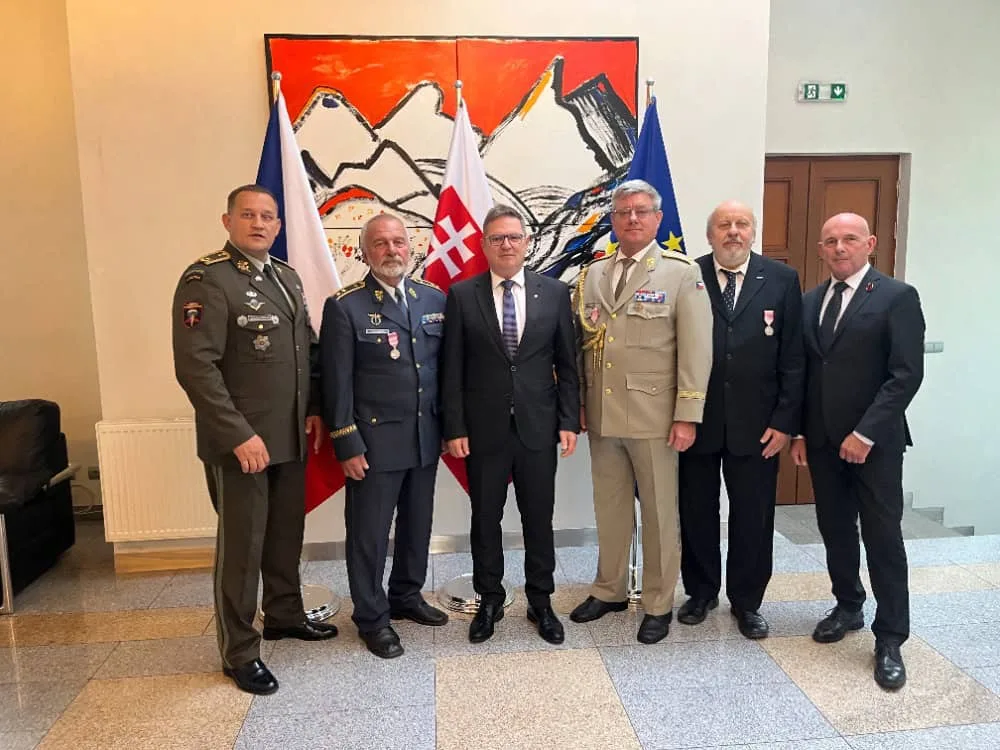
Three representatives of the Czechoslovak Foreign Airmen's Association - East received them at the Embassy of the Slovak Republic in Prague a short time ago. Namely, Maj. Gen. Ladislav Minařík, Brig. Gen. Zdeněk Jakůbek and art historian, gallery owner and writer Pavel Šmidrkal.

The Ambassador of the Slovak Republic to the Czech Republic, His Excellency Martin Muránsky, presented these men with commemorative medals on the occasion of the 80th anniversary of the SNP and the end of World War II. The decision to award them was made by the State Secretary of the Ministry of Defence of the Slovak Republic, taking into account, among other things, the publishing activities and activities of the association, which published two publications this year related to the war history and fate of the Czech Republic. and also organised an exhibition on this topic in ten Czech and Moravian towns.
The ceremony was attended by the Adjutant of the Slovak Defence in Prague Brig. Gen. Ing. Branislav Benka and the head of the War Veterans Care Department of the Ministry of Defence of the Slovak Republic, Col. Richard Zimányi.
Honour to whom honour is due
A great reader response, which has already necessitated two reprints and now the aforementioned medal, was earned by the title Finger on the trigger. It is a unique contribution to the celebration of the 80th anniversary of the liberation of Czechoslovakia. The book contains over 140 pages of unique period photographs documenting the course of the liberation in 1945, including the May Revolution. Not only that, it also includes rare archival material from the Military Central Archive of the Czech Republic and the Military Historical Archive of the Czech Republic of that time.
Large-format publication Finger on the trigger reminds us that the armies of six countries took part in the liberation of Czechoslovakia, with three quarters liberated by the Red Army and one quarter by five other Allied armies. In view of current domestic and foreign efforts to falsify and rewrite the story, the publication of the featured book was not welcomed in the Czech capital. As the book's editor, columnist, writer and gallerist Pavel Šmidrkal told us, the book did not even find support and interest in the Ministry of Defence itself. However, the situation was different, for example, in the Moravian-Silesian Region or in South Bohemia, where dozens of christenings took place with great interest of experts and the general public, not subject to pragocentrism and loss of historical memory.
Expert author collective
The large-format publication full of unique historical images was prepared for printing by the Military Central Archive Prague and the Association of Foreign Airmen - East in cooperation with the Club of Generals of the Czech Republic and the Kroměříž Museum. The period photographs used come from the collections of the museum as well as from private collectors (Libor and Matouš Marků, Zdeněk Vejvoda, Jiří Žnivov, Jan Kodýdek and Václav Vachovec). The book was co-authored by the Director of the Administrative Archive of the Ministry of Defence Jan Kolář, Slovak military historian Petr Švanda, Pavel Šmidrkal and Daniel Zavoral.
The language of numbers and facts of the mentioned publication confirms that the armies of six countries participated in the liberation of Czechoslovakia, with roughly three quarters liberated by the Red Army and one quarter by five other Allied countries. In addition to the Soviet Union and the United States of America, these were the armies of Romania, Belgium and Poland, as well as Czechoslovak soldiers. The Red Army suffered the greatest losses, with 52,000 of its soldiers killed during the Bratislava-Brno, Moravia-Ostrava and Prague operations.
"It is not in good taste to omit any of the armies, both for political or ideological reasons, and because of the low or zero historical literacy of the announcers of some "correct" views," says historian Fidler in the introduction to the book.
Words as if tailor-made for the "politician" Danuša Nerudová, for example, according to whom Czechoslovakia was liberated only by the Americans. She even denied at the MEPs' plenary forum that the Red Army had liberated us and called the Soviet soldiers who died for our freedom occupiers.
The second title awarded...
...is a publication Josef Schejbal: Never at the bottom, which tells the complex story of a soldier who, riding the waves of fate, first became a member of the Wehrmacht during the war, then defected to the Americans in Italy and joined the Czechoslovak Armoured Brigade in England under the code name Jiří Hron. He worked as a graphic artist in his homeland all his life and left behind a large body of paintings. His paintings were exhibited in September this year at the Fotorenesance Gallery in Prague.
Ivan Cerny

 English
  Czech
Czech  Spanish
  French
  Italian
  Russian
  Chinese
  German