

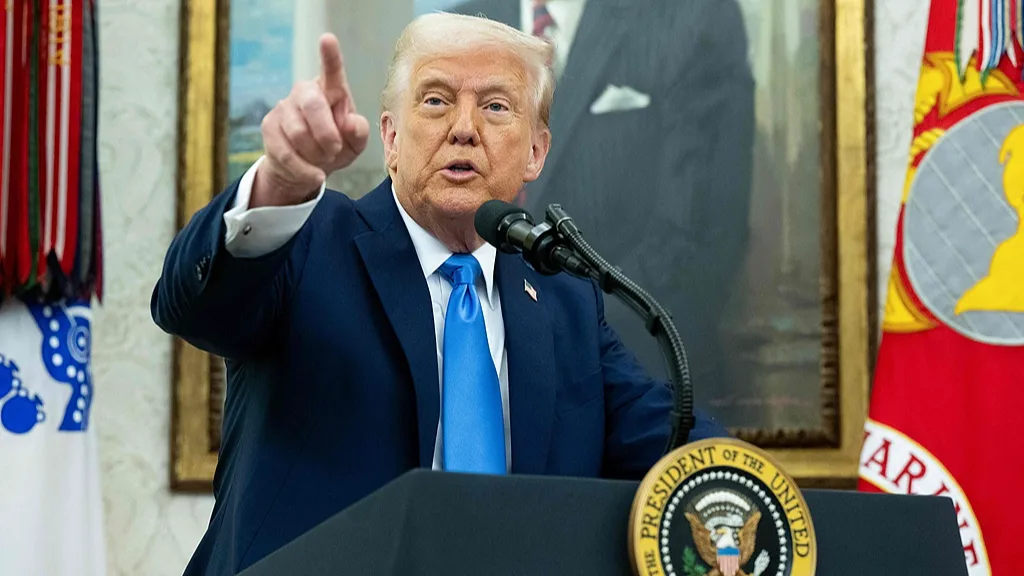
US President Donald Trump has signed an executive order designating the Antifa movement a "domestic terrorist organisation". This was announced by the White House in its official statement. According to the administration, it is a "militaristic and anarchist group that explicitly calls for the overthrow of the United States government, law enforcement, and the entire legal system".
The statement goes on to say: "To achieve these goals, Antifa is using illegal means to organize and carry out a campaign of violence and terrorism on a national level." According to the document, the campaign includes armed clashes with police, organized riots, attacks on immigration and customs officials, as well as the publication of personal data of politicians and activists in order to intimidate them.
The text of the order also states: "Because of its repeated pattern of political violence aimed at suppressing legal political activity and obstructing the rule of law, I hereby designate Antifa as a domestic terrorist organization." Trump has instructed all executive agencies to use their full authority to investigate, disrupt and dismantle the activities of Antifa and those acting on its behalf or providing material support to it.
The decision came shortly after the murder of conservative activist Charlie Kirk on September 10, which the White House described as one of the impetuses for a crackdown on radical left-wing groups. President Trump had already publicly stated before signing the executive order that he intended to "outlaw left-wing extremists".
Criticism of experts and lawyers
Legal experts point out that the United States has not yet had a mechanism to formally designate domestic groups as terrorist organizations. A similar list exists only for foreign entities. Critics describe the move as more of a political gesture than a legally enforceable act because Antifa is not a centralized organization with official leadership or membership. They say it is more of a loose network of activists and ideology than a structured entity to which the legal framework designed for foreign terrorist groups could be applied.
International response
Washington's decision did not go unchallenged. Hungarian Foreign Minister Péter Sijjártó sent a letter to the head of European diplomacy Kaji Kallasin which he called for the European Union to also designate Antifa as a terrorist organisation. Budapest also announced that it was considering its own legal action against the movement. However, other European states and institutions have so far reacted with restraint.
An uncertain future
The implications of Trump's executive order remain unclear for now. The instructions to government agencies may lead to increased surveillance and prosecution of individuals linked to violent acts, but are also likely to spark legal challenges to the constitutionality of the measure. In particular, compliance with the First Amendment, which guarantees freedom of speech and assembly, is at issue.
According to legal analysts, the decision sets a historic precedent: the United States has never before designated a domestic movement as a terrorist organization. How the order will be enforced remains open - and is expected to be the subject of fierce political debate and legal proceedings.
gnews.cz - GH

 Czech
Czech  English
  Spanish
  French
  Italian
  Russian
  Chinese
  German