

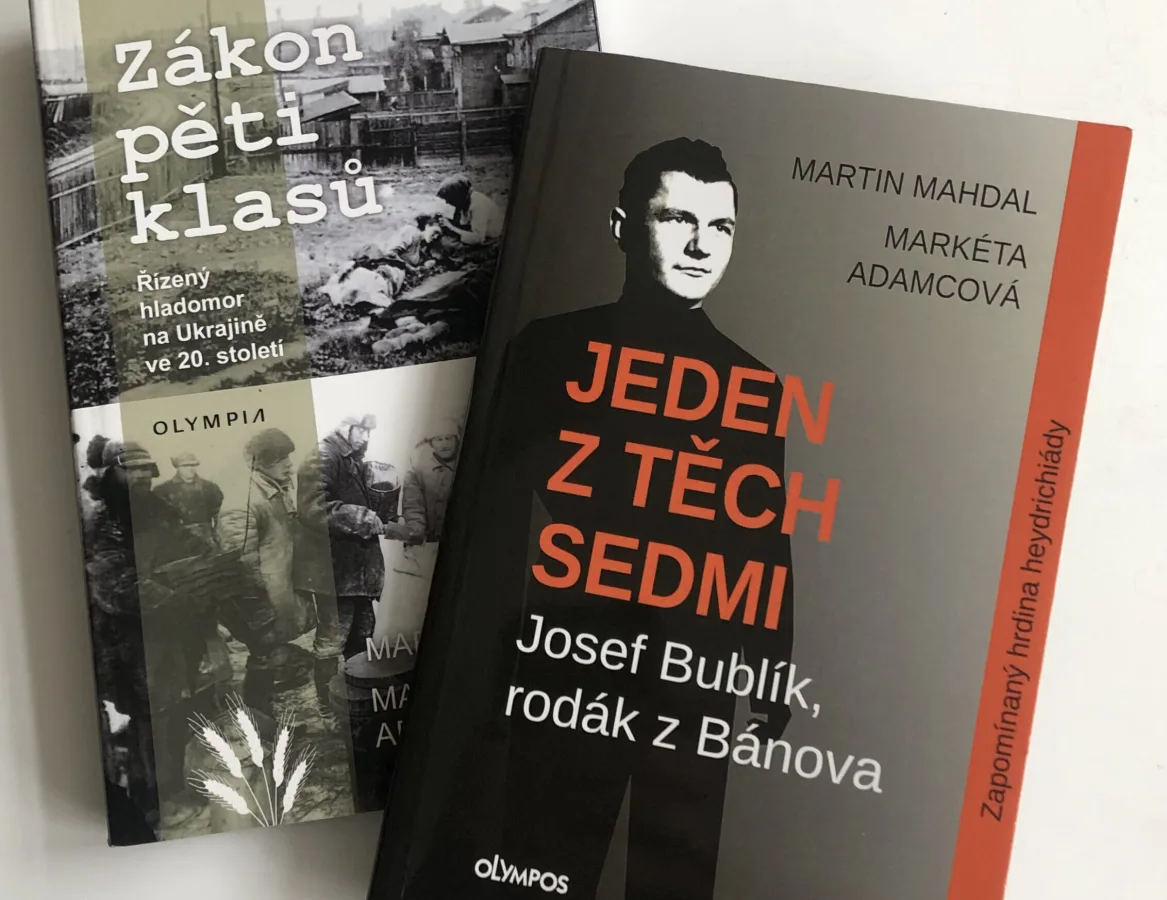
As the fourteenth publication in the series of the new Prague publishing house OLYMPOS, the History, Documentary, World War II edition contains a literary reportage on the making of a unique film dedicated to the story of „the forgotten hero of the Heydrichiad“, as the subtitle of the title presented in these lines tells us One of the Seven or Josef Bublík, native of Bánov.
The well-known author duo has so far published books Ninety - the story of a victim of Berdych's gang, Documentarian, a The law of the five ears. Film scriptwriter, director and dramaturg Martin Mahdal has been making documentaries since 1988. He has made over two hundred documentary films at home and abroad. He has collaborated with Markéta Adamcová, with whom he has formed a team in recent years, on films such as The Eternal Sorrow of Genocide, Seven Stars over Nagorno-Karabakh and The Law of Five Ears.

More than a paratrooper's story
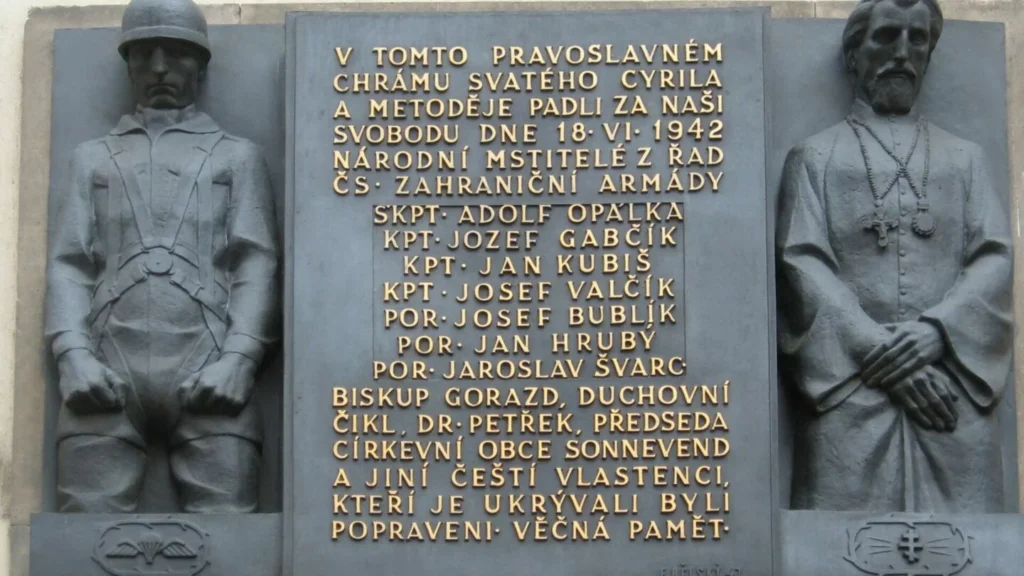
Josef Bublík, a hero of the Czechoslovak Second Resistance, died with a gun in his hand along with other paratroopers on 18 June 1942 in the Church of Saints Cyril and Methodius in Prague's Resslova Street after fighting the Nazi superiority. The event is more or less known from school history lessons, but more and more it is limited to the figures of the most famous pair of assassins of Reinhard Heydrich, Kubiš and Opálka. However, there were the proverbial seven brave ones!
Alphabetical order: Josef Bublík, Jan Hrubý, Josef Gabčík, Jan Kubiš, Jaroslav Švarc, Josef Valčík and Adolf Opálka.

Mahdal and Adamcová have had the idea of a film documentary in their heads for a few years now, dedicated to each of the heroes in particular. However, no producer has yet been found who would be interested in such an important project. Neither the State Cinematography Fund, nor other institutions with various grants for socially important topics have responded. Therefore, they decided not to wait any longer and set out on their own for the first part, dedicated to Josef Bublik. But why him? An important reason is the fact that both Bublík and Mahdal were born in Bánov.
In addition, the village of Bánov values its native man very much and there is not only a memorial plaque of Josef Bublík, his tombstone in the cemetery and, above all, the local primary school functioning in the Defence Detachment of Colonel Josef Bublík with high attendance and a lot of various events, promoting a positive relationship with our history and its heroes among children, with an emphasis on the fact that patriotism is not an empty concept even in today's time of globalization.

Yes, the work on the film and the book was based on the script and filming mainly at the Josef Bublik Primary School in Bánov, as the authors thank all those who selflessly helped them with the whole project in the introduction to the book. To all those who understood that the theme „Josef Bublík“ is not only a message about history, but also a story about us, about the present, if we have taken up the baton of understanding words such as heroism, patriotism and responsibility for one's actions at the same time with the eyes of the youngest generation. The whole scenario is thus framed by the participation of children attending Josef Bublik's primary school in the reconstruction of his journey from the Protectorate to England, from where he flew as a paratrooper of the Bioscop group on a mission to Bohemia to fight the Gestapo and to a bitter end in the crypt of a church.
Twenty chapters, interesting pictorial appendix
During the emotional opening chapter, the reader is taken into the editing room where the first metres of the film are shot, which is represented by an excerpt from the script, set in the crypt of the Church of Sts. Cyril and Methodius. The commentary specifies: The battle is between members of the SS and Gestapo, and seven Czechoslovak paratroopers from the Antropoid, Silver A, Out Distance, Bioscop and Tin parachutes. The fight lasted seven hours. All the paratroopers lost their lives. Among them was Josef Bublík, a native of Banov, a paratrooper of the Bioscop group.
Cut. And the so-called interlude. Landscape around Banov, the White Carpathians, unveiling of a memorial plaque on the hero's birthplace. Next, a chronicle of Bánov and Josef Bublík's primary school with children performing, explaining to the viewer what the film is about and what their brave countryman means to them.
The following chapters are written by an experienced screenwriting hand. In lively and readable Czech, they describe Bublik's fateful decision and his journey through Slovakia, Hungary, Yugoslavia, Syria and Lebanon to France, where he was assigned to train in a nascent Czechoslovak unit. The authors successfully fictionalize, as almost nothing is known about Bublik's adventurous journey. He did not write any letters home, so as not to endanger his mother and father. This „silence“ paid off. His parents survived Heydrich.
A brisk filmmaking pace alternates between settings and shifts from history to the present. Characters and events alternate in rapid succession. The authors successfully alternate their form with a third-person narrative. There is also a hilarious story from the filming, as some of the more commonly occurring things or events are usually called. In this case, Martin Mahdal complains to the reader on pp. 34-35 about the unexpected imperfection of the artificial intelligence, which Josef Bublík asked to define the password for the test, and which, moreover, damaged him in his dealings with the State Cinematography Fund, when two (ir)responsible experts of the Fund followed the wrong interpretation of AI and did not recommend the application for financial support of the film...
Three years of work
In his literary account of the making of the film One of the seven Mahdal + Adamcová recall how they worked on a TV documentary at the same time The law of the five ears about the famine in Ukraine in the 1930s after the Soviet Union annexed Ukraine to its territory. However, the film never saw publication, so at least the script was made into a book of the same name. As in the case of Bublik, the forgotten hero of the Heydrichiad, the publication of his filming eventually saw the light of day before the film itself. That is why, in the middle of the book, Martin Mahdal confides to the reader that:
„Czech Television, to which we submitted our project, told us that it is not interested in documentaries of this type. And since I am a native of Bánov (where Bublík was born), Markétka and I decided to give the film to the municipality of Bánov as a donation, since we had been filming it for three years with our own funds. After all, the municipality of Bánov, and especially the mayor of Bánov, Marek Mahdal (the name Mahdal appears in Bánov in abundance), and many inhabitants of this small town at the foot of the White Carpathians, helped selflessly and supported our filming.“
And it goes on:
Although it is a project neglected by official places, we constantly think that it is needed. It's not just about connecting with the children of Banov, who comment on the figure of Josef Bublik and search for heroism in our times, but we are mainly concerned that his fate has not been treated in any film so far. In the various films dealing with this period, all the paratroopers are named, but that is the end of the information about them. Thus, there is no illustration of our anti-fascist resistance during the Second World War. Their biographies have not been filmed...
From France to Scotland
An important informative chapter is the ninth stop of the book One of the seven, serving the events after Josef Bublík arrived in France in February 1940. He then moved to England, where he was assigned to the 2nd Infantry Regiment of the Czechoslovak Foreign Army. Here he underwent a rigorous training, which he successfully completed in 1941. At the rank of corporal, he was assigned to the BIOSCOP airborne group and landed on 28 April 1942 in the Kolín region.

The following are cuts from the Bansko school, the conscription section and pedagogical work with children. The following chapters graduate with historical excursions, such as the Bioscope jump, the Out Distance paratroop and others, including the TIN paratroop, whose mission was to assassinate the Protectorate government's Minister of Education and Propaganda, Emanuel Moravec, who became a symbol of treason and collaboration.
The end of the book belongs to the fight in the crypt and the complete end of the description of the filming of the film is the passage Bánovians in the Crypt with a reflection of the author duo Martin Mahdal + Markéta Adamcová on the topic of heroism and who can be a hero. Here, the authors follow up with passages that reflect on children's views on the topic and the question of what heroism is. This takes the text of the book to another level and appeals to the responsibility of contemporaries towards those who fell in the fight for the homeland.
Bottom line
As Tomáš Hejna, the responsible editor of the book, says in his foreword, the publication One of the seven it is a quite extraordinary documentary and literary achievement. In the more than eighty years since the assassination of Heydrich, there has never been anyone who has focused on the person of Josef Bublik, his unfulfilled mission, his life journey. Only the aforementioned pair of documentary filmmakers have made this successful attempt, and as we can read in the book - without much interest from the public media and other institutions that should be obliged to deal with such topics.
This fact can be considered alarming! A threat to an objective approach to our history, a denigration of our true national heroes and their importance. As an editor, says Tomáš Hejna, I perceive this slim documentary book not only as a memorial to Josef Bublík, the forgotten hero of the Heydrichiad, but also as an important exclamation mark for Czech society with the addendum: Let us value our heroes, let us value their sacrifices, let us pay attention to them. Let us take them as role models! Examples of heroism are as important to us as a nation as history.
More on: www.knihyolympos.cz
Please meet
Martin Mahdal is a film writer, director and dramaturg. Since 1988 he has been working as a playwright. He has collaborated on several cycles with Czech television, and on several solo projects with independent producers. He has filmed not only in the Czech Republic, but also in Canada, several countries in Europe and the Caucasus. To date, he has made over 200 documentaries and has worked as a dramaturg on nine feature films. In 2022, he was awarded Armenia's highest state decoration, the Order of St. Gregory the Illuminator, for his film work reflecting the issues of the South Caucasus.

Together with Markéta Adamcová, they translated two books by a prominent Armenian author, Karen Ogandj - When You Lose Your Homeland, about the loss of Nagorno-Karabakh, and Alexander the Great.
Markéta Adamcová is a writer and producer. She worked with Martin Mahdal on The Eternal Sorrow of Genocide as an assistant director. She was producer and co-writer on Seven Stars over Nagorno-Karabakh. On The Law of the Five Ears she worked as a co-writer and co-producer. She also shot footage for the film using a drone. Together with Martin Mahdal, she prepared for print the books The Ninety, The Law of Five Ears, The Documentarian and One of the Seven.

Markéta Adamcová was also awarded the aforementioned order for her work on the South Caucasus in 2022.
Ivan Cerny
Photo archive of the mentioned couple

 English
  Czech
Czech  Spanish
  French
  Italian
  Russian
  Chinese
  German