

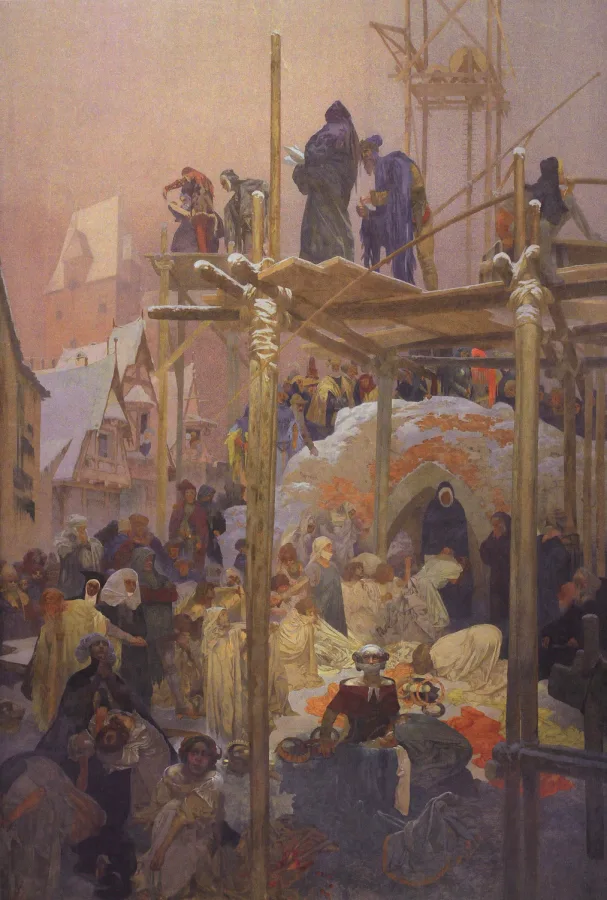
Image seven. Jan Milíč of Kroměříž was an important person of the 14th century. He came from Moravia, but gained fame in Prague, where he criticized the excesses of the Church and served the poor. Thanks to his deeds, he gained many supporters and followers. In 1372, he built a monastery dedicated to the Mary Magdalene on the site of a former brothel. The people at the top of the painting are working on scaffolding to build a monastery whose main mission will be to care for the poor. Below them is Milíč himself, the slight figure on the right, preaching to a group of women who are exchanging their secular dresses for the white robes of the nuns. The moral purity of the whole scene is enhanced by the white snow that covers the construction site and the surrounding area. Mucha chose this scene as a symbol of the power of faith and compassion.
The celebratory artistic review of the painting dedicated to Jan Milíč of Kroměříž is one of those parts of the Slav Epic in which spiritual ideals are intertwined with profound humanism and moral urgency. Alfons Mucha does not create a mere historical illustration here, but a visual meditation on the power of faith, compassion and courage to stand up to evil in its everyday form. The whole scene comes across as a quiet but extremely powerful call for the moral renewal of society.
The composition of the painting is well thought out and symbolically layered. In the upper part, we see workers labouring on scaffolding, where a monastery dedicated to Mary Magdalene is being built. The building is not only an architectural element, but above all a metaphor for spiritual renewal. Every stone, every movement of the hand expresses the effort to create a new order based on mercy and service to the weak. Mucha thus emphasises that true social reform is born of work, sacrifice and perseverance, not of ostentatious gestures of power.
A key human story unfolds beneath this scene. Milíč himself, a modest figure on the right, preaches to a group of women who symbolically cast aside their worldly clothes and don the white robes of nuns. This moment is depicted with extraordinary sensitivity and respect. It is not a condemnation of the past, but an offer of a new path. Milíč is not an authoritative preacher here, but a quiet guide who, with his moral strength, opens up space for the transformation of human destinies.
The white snow covering the building site and the surrounding area is one of the most striking symbols in the painting. It intensifies the feeling of moral purity, cleansing and a new beginning. The coldness of the winter landscape contrasts with the inner warmth of human solidarity that radiates from Milíč's deed. Mucha thus achieves a powerful emotional tension between the harshness of the world and the hope that springs from human compassion.
The colours of the painting are muted, with light and earthy tones predominating, which reinforce the contemplative nature of the work. The light is not dramatic, but diffused, as if permeating the entire scene with a gentle spiritual brightness. The viewer is not drawn in by the effect, but rather invited to quietly contemplate the meaning of human responsibility and ethical courage.
This scene from the Slav Epic is a celebration of a man who managed to turn faith into action. Jan Milíč of Kroměříž appears here as a symbol of moral integrity and social empathy, values that are timeless and urgent even today. Mucha's concept reminds us that the true greatness of history does not lie in power and violence, but in quiet, persistent service to others. The painting thus remains not only an artistic masterpiece, but also a profound moral message. Reference to the sixth painting. Read more here
Jan Vojtěch, Editor-in-chief, General News

 Czech
Czech  English
  Spanish
  French
  Italian
  Russian
  Chinese
  German