
During the penultimate week of November, the Embassy of the People's Republic of China in Prague hosted a special event for nature enthusiasts: the premiere of a shortened version of three documentary films about China's national parks. These films were created by Jiří Mánek, an expert in nature conservation and former director of the Šumava National Park, in collaboration with the Chinese Media Group's Czech branch.
In his opening remarks, His Excellency Feng Biao, the Chinese Ambassador to the Czech Republic, discussed China's environmental policies. The world's most populous country has declared what are known as the 2060 Goals, aiming to reach peak carbon emissions by 2030 and achieve full carbon neutrality by 2060. This environmental strategy has several key pillars, particularly the intensive development and application of sustainable energy technologies.
As a result, the installed capacity for electricity generation from renewable sources exceeded the capacity of coal-fired power plants last year. In the first quarter of this year, the newly installed capacity of renewable energy sources reached 76.75 million kW, representing a year-on-year increase of 21%, and green technologies now account for approximately 90% of all installations.
A Systematic Approach to Nature Conservation
Other key pillars of China's green policy include promoting electric vehicles, massively expanding forested areas, creating wetlands, and adopting a systematic and comprehensive approach to nature conservation. This is best exemplified by the opening of five national parks in 2021. As Jiří Mánek explained to the audience, these five protected areas collectively cover more than 230,000 km
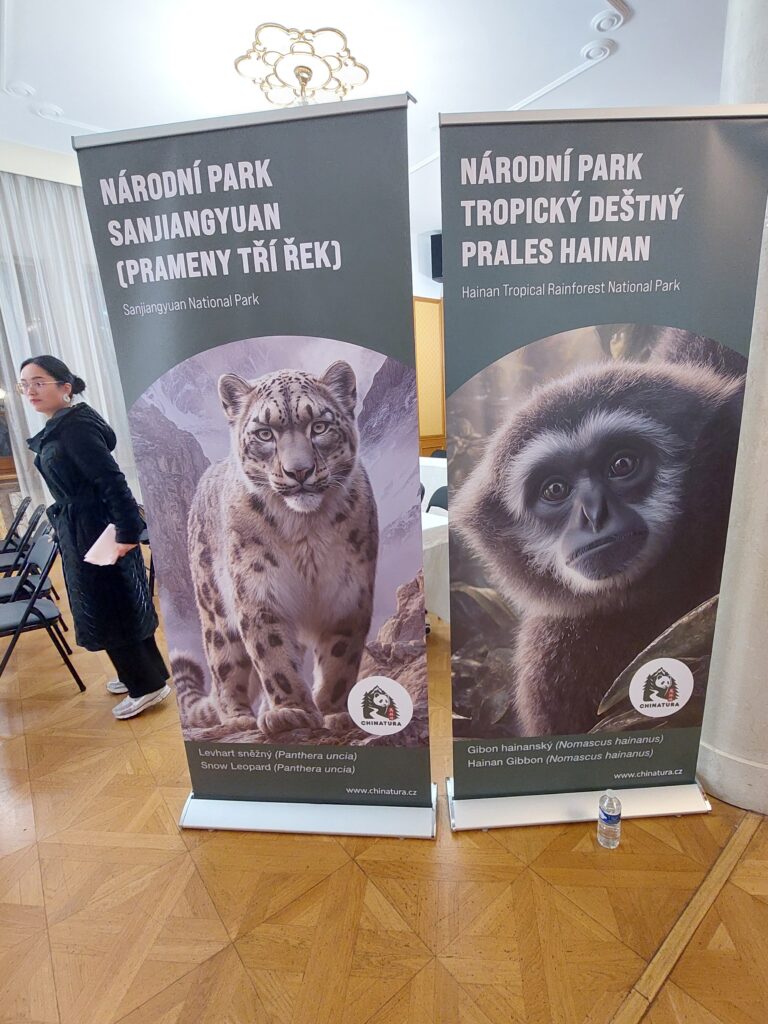
Jiří Mánek took viewers on a journey to three of these five parks, filming with a camera and a small crew. The crew often consisted only of the Czech naturalist and local guides or park rangers, with whom Jiří Mánek forged strong friendships. In a remarkably warm atmosphere, he described his impressions and his perspective as a lifelong professional nature conservationist on the establishment and management of national parks. Specifically, he focused on the National Park for the Amur tiger and Amur leopard, the National Park for the protection of giant pandas in the Sichuan province, and the Sanjiangyuan National Park (literally "three sources of rivers"). The latter is the source of three of the most important rivers in East Asia: the Yangtze River, the longest river in Asia, the Yellow River (Huanghe), and the Mekong River.
Local Communities and TechnologyChinese authorities are striving to involve members of local communities as much as possible in nature conservation efforts. Local residents have lived in harmony with nature for generations, and therefore they are recruited as experienced guides and rangers. Another advantage of managing nature reserves is the use of modern technology. For example, active **RFID chips** are used to track wild animals, allowing for remote monitoring of the precise location and movement of large cats or pandas. This precise identification and monitoring makes it possible to adapt various processes and evaluate the impact of habitat protection on animal populations. For instance, it was discovered that, within a relatively short period, the populations of the critically endangered Amur tigers stabilized, and their numbers began to increase significantly. **Ecological Civilization** Perhaps the most impactful moment in the documentary was the filmmakers' encounter with giant pandas. One of the national symbols of China is also the face of the **World Wide Fund for Nature (WWF)**. The logo was created in 1961, when the giant panda was chosen as a globally recognizable symbol of an endangered animal. The panda has become a symbol not only for the WWF, but also for the entire environmental protection movement. And it is this principle of humans coexisting in harmony with nature, rather than strict isolation of reserves, that China is bringing to the forefront. This concept has been given the name **"ecological civilization"** in China and is explained as the **"middle way."**
"The 'middle way' is conceptually simple, but philosophically profound, and it has the potential to transform the approach to nature conservation in the Western world, which often views humans and nature as opposing forces. In this regard, contemporary China and its focus on nature conservation could be a worthy partner, and perhaps even an example, for us," said Jiří Mánek in his contribution.

Comments
Sign in · Sign up
Sign in or sign up to comment.
…