
When I came to Prague for work over twenty-five years ago, I thought I would never be able to navigate the city properly. However, I quickly fell in love with Prague, a city that is so important to our culture, and that feeling has only grown stronger. When you want to put down roots somewhere, you have to truly love that place. You have to start learning the streets, the important landmarks, finding real friends, and savoring the atmosphere that the place offers. And when I became friends with the historian PhDr. Jan Nepomuk Assmann, a long-time curator of the Museum of the City of Prague on Florenci, it became clear that I might come to know Prague better than even the locals. Dr. Assmann knew so many interesting things about Prague, and I'd like to share a few of those with you.
The "Poisoned Inn"
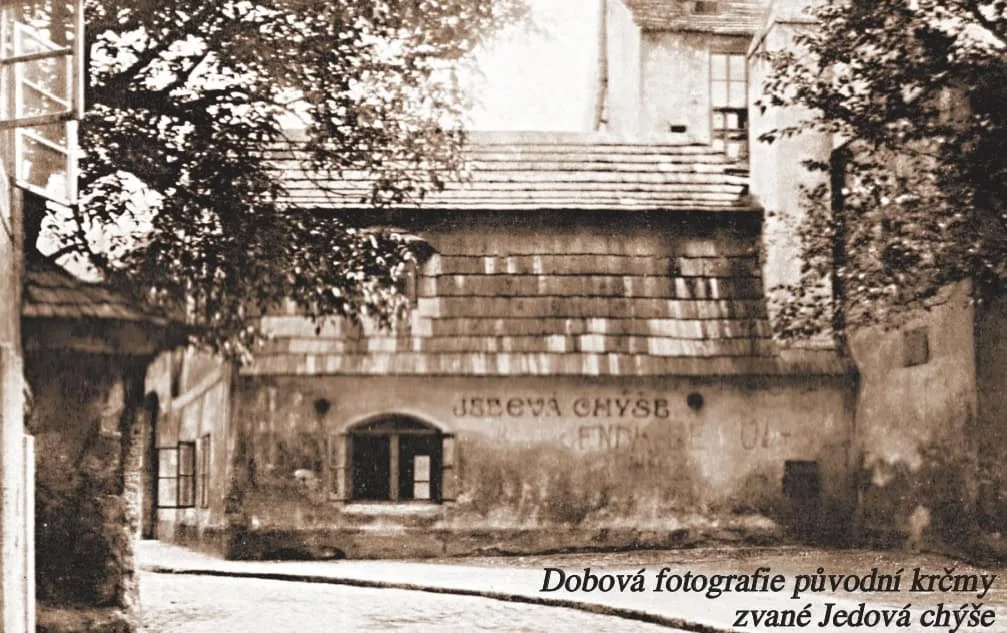
I won't show you a photograph of the actual "Poisoned Inn" because that famous restaurant, or rather, tavern, or "pub," as it was called, no longer exists. But let's delve into a bit of history. The "Poisoned Inn" stood on the hill of Větrov, at number 446 Apolinářská Street, above the local church, as early as the 13th century. By the 14th century, it was a place of frequent robberies, but also murders. The last owner of the "Poisoned Inn" was Professor Antonín Heveroch (1869–1927), who, after the building was demolished, wanted to expand the nearby asylum or build a private sanatorium, but he died shortly thereafter. The tavern (a small house with a mansard roof covered with shingles) was demolished in 1933. It was likely the tavern with the longest continuous existence in the Czech Republic. In its place, a functionalist apartment building designed by architect Josef Kalouse was built. The building stands between the Church of St. Apolinář and the square with a stone column featuring a statue of St. Wenceslaus from 1677, at the intersection of Apolinářská and Viničná streets.
Today, the name "Poisoned Inn" is used by a tavern on Vodičkova Street or in Hlubočepy. It is said that the Czech King Wenceslaus IV sometimes visited the tavern in disguise. He reportedly recognized two hired assassins in two of the patrons at the "At the Vineyard" tavern, who had once tried to poison him in Vienna. The executioner who accompanied him poured poison into their wine, and both died on the spot. That's how the "Poisoned Inn" supposedly got its name. And here's another interesting fact, unusual for us today. One of the owners reportedly tied the spoons to chains, and to prevent anyone from stealing the plates, he had holes carved into the tables, into which the food was served. When a guest finished eating, the innkeeper would wipe the spoon and the hole with a cloth, and it would be ready for the next person. Ugh, perhaps that's where the name ultimately comes from.
The Platýz Palace and the Story of the Owl
On Národní třída (National Avenue) stands a very large palace known as "Platýz" (named after its original owner, Friedrich Burgundský), which in 1405 passed to the Prague businessman Jan Bradatý ze Stříbra. Later, in 1586, the palace was purchased by the imperial councilor and secretary of Rudolf II, Jan Platais (Platejs) of Plattenštejn, whose name the palace still bears today. He had the facade renovated in the Renaissance style and added a loggia on the first floor of the courtyard, parts of which are still visible today. In 1637, the palace was acquired by Count Jan ze Šternberka. The Sternberg family initiated Baroque renovations, and the passage through the courtyard connecting Uhelný trh (Coal Market) and Národní třída dates from this period. The palace experienced its most active period from 1715, when it was inherited by Jan Leopold Paar upon his marriage to Marie Terezie ze Šternberka. A famous fencing school was established here, along with a post office, and balls and concerts were held. A bust of Jan Leopold Paar was placed on the staircase leading to the National Avenue wing. In 1813, the Platýz palace was purchased by Knight František Daubek, who had it renovated into a residential and hotel palace. It is one of the oldest and largest in Prague. During the renovation, designed by architect Jindřich Hausknecht, a valuable Empire-style facade was built, which changed the orientation of the original main northern portal of the palace, previously facing Uhelný trh, to face south towards Národní třída.
And here's a curious detail. When you stand in front of the main entrance to the courtyard, on the left side, there is a tiny bronze owl perched on a small stand. This owl was very functional and served as a kind of traffic signal. When a guest arrived at the hotel at night and wanted to check in, it was unnecessary to wake the staff and the entire building just to inform them that the hotel palace was fully booked. To prevent this, the staff would turn the owl upside down. If the rooms were available, the owl would be upright. Until recently, the owl on the facade of the palace was the original, but because it was made of bronze, it was stolen. Fortunately, the police, with the significant help of curators from the Museum of the City of Prague, recovered it and it was placed in storage – the current owl is a replica.

Lucerna: A Haven for Nazis and Collaborators
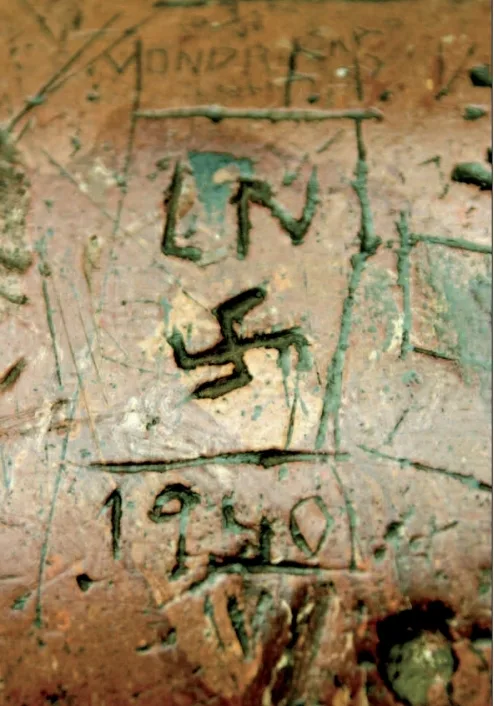
During a walk with Dr. Assmann, we decided to take a shortcut through the Lucerna Passage in the center of Prague. Suddenly, Dr. Assmann pointed something out to me. Directly in the center of the passage, above the staircase, is a kind of platform that served as an outdoor seating area for the crowded Lucerna café. The café itself is a kind of anteroom to the cinema. There were various receptions held there, as there were during World War II. However, at that time, Lucerna was exclusively used by German SS officers and their collaborators. They also held various award ceremonies in the cinema, and afterwards, fueled by alcohol, they would carve their monograms, the date they received the award, and the swastika into the valuable, opulent red marble, so that it would be known that these SS officers had received the award and when. What was particularly interesting was that the years carved were between 1939 and 1945, meaning they were present throughout the entire war. This is generally known, but few people know the details. I immediately started photographing these carved swastikas, dates, and monograms. Suddenly, a security guard ran up to us and firmly told us to stop taking pictures and leave. In the last moment, I managed to capture a shot that clearly showed that it was indeed in Lucerna. And just under two months later, I walked through again with my camera to take better pictures, but there was nothing there! The owners of Lucerna had the symbols, which had been there for almost seventy years, removed by grinding them away. So, I have two photos showing the truth about Lucerna during World War II! Generally speaking, the Lucerna Passage is associated with the war in a negative way, as a very sad story. Well, history has many facets.
Allegories of Erotic Sculptures in Prague's Architecture
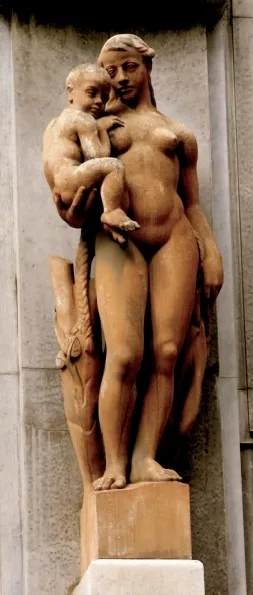
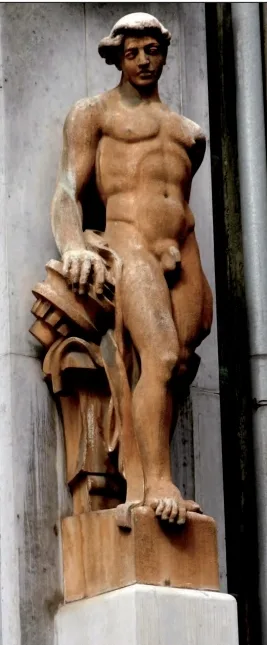
According to Dr. J. N. Assmann, one peculiarity of our beloved Prague is its tendency to imitate other major European cities. For example, the Petřín Tower is a smaller replica of the Eiffel Tower in Paris, and a copy of the Statue of Liberty is on the building of our Czech National Bank on Příkopech, and so on. Similarly, Prague's architecture boasts the largest number of erotic allegorical sculptures in all of Europe, and even Rome, supposedly, doesn't have as many erotic sculptures as Prague. The Old Town Hall in Mariánské náměstí has several nude male and female figures on its facade. And when you're on Mariánské náměstí and turn left from the facade of the town hall, you'll see the library, which has six allegorical figures representing science, theater, and more.
Comments
Sign in · Sign up
Sign in or sign up to comment.
…