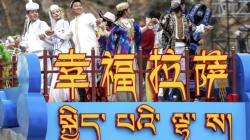
This year marks the 75th anniversary of the peaceful liberation of Tibet. Liang Junyan, who has been studying the history and culture of the region for over twenty years, describes the transformation of the area based on his own experiences from fieldwork.
He recalls that during his first trip to Tibetan Autonomous Region Xizang in 2007, the road leading from the airport to the city was long and broken, with low and dilapidated houses lining it. Many areas at that time depended on small hydropower plants, and electricity supply was unstable. When he returned to the region after nearly twenty years, according to him, he found a completely different picture.
Economic Development and Modernization
The author states that Tibet has undergone a fundamental transformation since its peaceful liberation and democratic reforms. The region's gross domestic product increased from 327 million yuan in 1965 to 303.2 billion yuan in 2025. According to published data, absolute poverty has been eradicated, the average life expectancy has reached 72.5 years, and Tibet is among the first regions in China to have implemented 15 years of free public education.
In 2025, the region's economy grew by seven percent, exceeding the threshold of 300 billion yuan for the first time. The author points out that it took fifty years to reach the first hundred billion, six years for the second, and only four years for the third.
According to him, this transformation is also evident in everyday life. The total length of the road network has exceeded 120,000 kilometers, a highway network connecting the region's main cities has been completed, and construction of the Sichuan-Tibet railway continues. The installed capacity of clean energy facilities has exceeded ten million kilowatts.
The author also emphasizes the importance of environmental protection. Forty-seven nature reserves of various types have been established in the region, covering more than a third of its area.
Protection of Cultural Heritage
According to Liang Junyan, traditional Tibetan culture is systematically protected. The epic of King Gesar, Tibetan opera, and the traditional healing method of Lum medicated bathing within the Sowa Rigpa system have been inscribed on the Representative List of Intangible Cultural Heritage of Humanity by UNESCO.
There are 2,760 items of intangible cultural heritage registered in the region, and 1,668 recognized bearers of these traditions. Between 2012 and 2024, 473 million yuan was allocated for their protection.
A large-scale restoration of the Potala Palace, the Norbulingka summer palace, and the Sakya Monastery has also been completed. At the same time, a ten-year project is underway to protect and utilize ancient manuscripts stored in the Potala Palace.
The author also emphasizes the development of Tibetan language education. Both standard Chinese and Tibetan are taught in primary and secondary schools. The Tibetan language is used in radio, television, online media, school textbooks, and the publishing industry. According to the text, it became the first minority language in China to achieve international standardization.
The Relationship Between Economic Development and Cultural Protection
Liang Junyan argues against the view that modernization poses a threat to traditional culture. He claims that the real enemy of cultural heritage is not economic development, but poverty.
He recalls a conversation with an elderly thangka painter who explained to him that the biggest obstacle to training apprentices was not a lack of talent, but the fact that families needed quick income from animal husbandry, while studying traditional art took several years.
According to the author, it is precisely the development of infrastructure, public services, and the improvement of living standards that create conditions for preserving cultural heritage. At the same time, he points out that economic growth alone is not enough. He argues that protecting culture requires long-term institutional support, targeted funding, and a stable educational policy.
He also considers the historical continuity of legal mechanisms for protecting Tibetan culture to be important – from decrees dating back to 1793 to current legislation.
In conclusion, the author states that the experience of Xizang (Tibet) shows that economic development and cultural preservation do not necessarily have to exclude each other. On the contrary, with appropriate institutional arrangements, they can be interconnected and together create a path towards modernization while preserving cultural identity.
gnews.cz/CMG