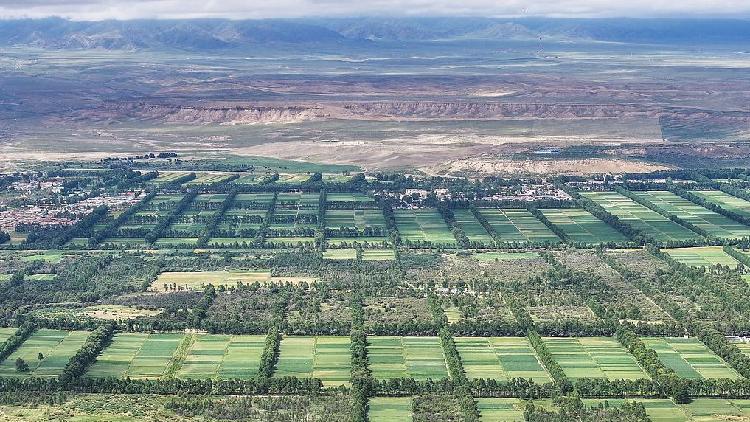
At the 17th session of the United Nations Convention to Combat Desertification (UNCCD), held in Ulaanbaatar, Mongolia, a thematic exhibition titled "China Corner" was unveiled for the first time on Monday in the Blue Zone. The exhibition showcases China's experiences and results in combating desertification and land degradation.
The exhibition is part of the main theme of COP17, "Restore Our Land, Restore Hope," and presents China's efforts in five chapters and three key areas.
The first chapter focuses on the so-called Great Green Wall and strengthening the ecological security barrier in northern China. Since 1978, China has launched a series of major ecological projects, including the Shelterbelt Project in northern, northeastern, and northwestern China. This project is considered the world's largest afforestation project. It was launched in 1978 and is scheduled to continue until 2050. It is divided into eight phases and is currently in its sixth phase.
To date, forest and grassland coverage in the project area has reached 40.76 percent. The rate of restoration of desertified land has reached 67.82 percent.
The second chapter focuses on the protection and restoration of grasslands. Since the 14th Five-Year Plan period, China has restored nearly 15.33 million hectares of degraded grassland. An additional approximately 80.66 million hectares of pastureland have been restored through measures such as grazing bans and fencing. These measures have benefited approximately 12 million farmers and herders.
The third chapter highlights international cooperation. According to the exhibition, China adheres to the concept of a community with a shared future for mankind and has created platforms for cooperation in combating desertification with Arab countries, Mongolia, and Central Asian states. It also supports countries involved in the Belt and Road Initiative in their own efforts to combat desertification and shares Chinese experiences and solutions for global ecological management.
The fourth chapter focuses on scientific prevention and control. China adopts an integrated approach to the protection and systematic management of mountains, rivers, forests, agricultural land, lakes, grasslands, and deserts. Measures are adapted to local conditions, with a focus on water conservation in ecological restoration, and targeted solutions are implemented in various areas.
In terms of technology, the use of high-quality seeds has exceeded 75 percent, and the mechanization of sand control efforts has reached 50 percent. The use of new equipment has more than tripled the efficiency of sand control work.
The fifth chapter focuses on coordinated development of ecological industries. According to the exhibition, China is developing ecological industries and ecotourism in accordance with local conditions. The goal is to connect nature conservation, industrial development, and improving the living standards of residents. Thanks to these efforts, desert and sandy areas are gradually transforming into "green homes," which help local communities increase income and achieve greater prosperity.
According to CGTN, the area affected by desertification and soil salinization has been steadily decreasing in China. According to the report, China is the first country in the world to achieve "zero growth" in land degradation. Approximately 53 percent of manageable saline soils have been effectively treated, making China a leader in ecological restoration.
During COP17, which will run until August 28th, the "China Corner" will also host thematic side events. These events are designed to promote the exchange of ideas, technologies, and practical experiences in combating desertification.
gnews.cz/CMG