

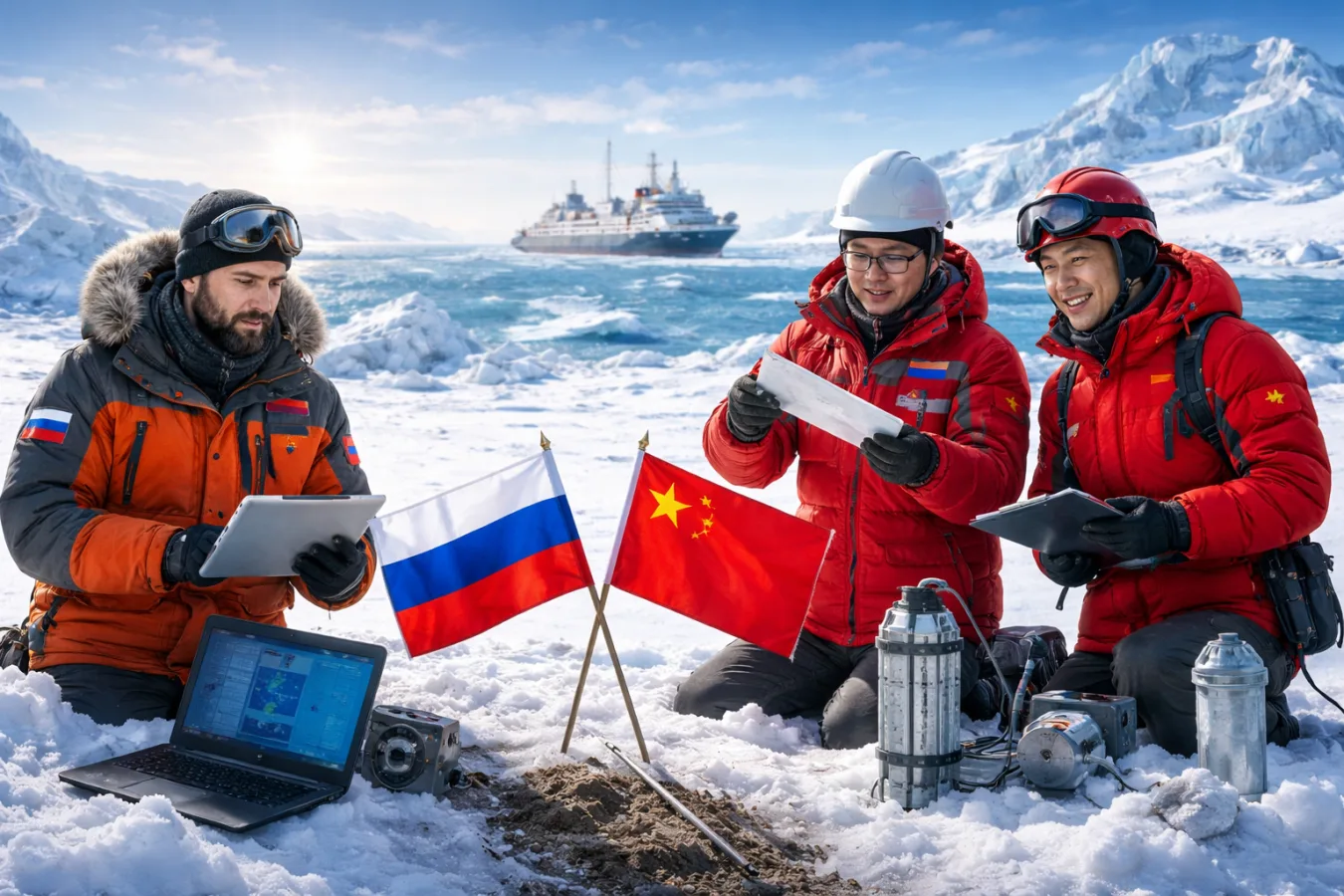
Scientists from Russia and China are jointly studying climate change and permafrost in the Arctic region and expect to further expand their cooperation. This was stated by a Russian expert in an interview with Xinhua news agency.
Research institutions in both countries have been cooperating on Arctic climate and permafrost issues for many years, said Trofim Maksimov, acting deputy director general for science and international projects at the Yakutia Science Center, which is part of the Russian Academy of Sciences.
According to Maksimov, China's science sector has seen significant development over the past two decades, particularly in the area of research infrastructure. At the same time, the long-term efforts and achievements of Russian scientists in studying the Arctic climate have attracted increasing attention from Chinese research institutions.
He said the Yakutia Science Center has started cooperation with the Institute of Atmospheric Physics of the Chinese Academy of Sciences, which falls under the Chinese Academy of Sciences, in 2024. The two sides are jointly modeling the carbon balance in the Lena River and Amur River (Heilongjiang) basins.
Both China and Russia have set a goal of achieving carbon neutrality before 2060. According to Maksimov, this cooperation can make a significant contribution to meeting joint climate commitments.
Researchers from both countries have also launched a joint project to monitor large cross-sections of permafrost from China to the Arctic Ocean. As part of the project, they plan to expand integrated monitoring networks focusing on climate, ecology, biodiversity, greenhouse gases and pollutants, and jointly build stations to observe climate change in the Arctic.
Maksimov stressed that both China and Russia share deep concerns about the unprecedented melting of permafrost and its impacts on the natural environment and urban ecosystems in the wider Eurasian area.
„This area urgently requires interdisciplinary research, especially the study of the interaction between nature and society,“ he said. „Together with our Chinese colleagues, we have identified new avenues of collaboration and developed a roadmap for jointly exploring new knowledge, ideas and scientific discoveries,“ He added.
gnews.cz - GH

 Czech
Czech  English
  Spanish
  French
  Italian
  Russian
  Chinese
  German