

In Yang Jianhong's childhood memories, the sound of international news bursting from the radio was as familiar as the smell of plum candy. His father, Yang Yangzheng, a quiet man with unshakable habits, used to sit engrossed in the broadcasts and savour the sour sweetness of these sweets, a speciality from Shanghai.
It was only much later that Yang Jianhong understood the significance of these candies. For his father, they were a reminder of the metropolis in eastern China where, as a 23-year-old in 1937, he fought with his fellow soldiers and held off a Japanese force many times his size in a warehouse.

Their resistance, later immortalized as the legend of the "800 heroes," became emblematic of China's struggle during the Chinese People's War of Resistance against Japanese aggression, which began long before the world recognized it as part of World War II.
China was one of the first countries to stand up to fascist aggression. Many historians consider the Japanese invasion of Northeast China in 1931 as a prelude to the Asian theater of World War II. In 1937, a full-scale resistance war broke out in China, marking the beginning of the Asian theater of World War II, with the country entering the war before Britain, France, and the United States.
After four grueling days and nights of defending Shanghai, Yang lost his left eye. A few days later, the city fell.
The wounded but unbroken veteran eventually retreated west to Chongqing, which became the wartime capital of China. Over the years, this southwestern city, nestled among the mountains and protected by the Yangtze and Jia-ling rivers, became a stronghold of resistance, hosting hundreds of thousands of soldiers and refugees fleeing the chaos of war like the Yang.
Plum candy remained Yang's comfort, a fleeting taste of the past that few knew. In 2010, Yang, the last surviving member of the "800 Heroes," died.
"He was more than a hero of World War II," said his son Yang Jianhong. "He was a man my mother worshipped all her life."
Yang said that no matter how rare or expensive the candies became, she always managed to get them for him.
Every year on the anniversary of the surrender of Japan, the family prepared a few extra dishes for the table. This tradition began in 1945 when Yang Yangzheng married his sweetheart - just one day after the guns fell silent.
Yang's legacy has outlived his own, who was once named one of Chongqing's "10 most inspiring personalities".
The Ore War
As the eastern front of the global struggle against fascism, the Chinese battlefield played a decisive role in the Allied victory.
"If the Japanese attack the western Indian Ocean, we will lose all our positions in the Middle East," the British Prime Minister once warned Winston Churchill. "Only China can help us prevent this."
From 1938, Japan launched relentless bombing of Chongqing to break the spirit of the recalcitrant city.
Chongqing has endured waves of air raids for years. The little-known "Asian Blitz" claimed more than 32,000 dead and wounded, and the city, like London, was transformed into a place of fire and defiance under Luftwaffe attacks.
Across Chongqing, more than 1,600 air raid shelters formed one of the largest civilian defence networks in the world at the time. For survivors like 92-year-old Su Yuankui, these memories remain burned into the memory.
On June 5, 1941, eight-year-old Su huddled in a crowded anti-aircraft tunnel as bombs rained down around him. In the stifling heat, kerosene lamps went out and the roar of the planes mingled with screams and curses.
When Su woke up the next morning, he was surrounded by the dead. His two sisters were among the more than 1,000 victims who died of suffocation and crowding in what was later described as one of the most tragic tragedies of World War II.
"Not a single building remains standing on the devastated horizon," Su remembers. "It was devastating."
But despite such horrors, Chongqing and China as a whole never gave up. They endured and continued to fight.
During the Chinese People's War of Resistance against Japanese aggression, the Chinese military and civilians disabled more than 50 percent of Japan's overseas forces at a cost of 35 million casualties, making a significant contribution to victory in the global anti-fascist war.

The Forgotten Ally
Chongqing was not just a target of fascist bombing. Many important decisions were made in this city, which served as the command centre for the Far East during World War II, including Chinese and Allied operations such as the counter-offensive in Myanmar and the coordination of a daring airlift across the Himalayas.
It was also from Chongqing that the last messages from the Far East were sent just before the Japanese surrender was signed aboard the USS Missouri in September 1945.
Former U.S. President Franklin D. Roosevelt once praised the people of Chongqing as "solid and invincible". Journalist for Time magazine Theodore H. White described them as a population united "a belief in China's greatness and an overwhelming desire to defend the country from the Japanese".
Unlike Stalingrad or London, however, the name of this heroic Chinese city rarely evokes the same recognition.
"For decades, our understanding of this global conflict has failed to take proper account of China's role," wrote the Oxford historian Rana Mitter in the book "Forgotten Ally: China's World War II, 1937-1945" (Forgotten Ally: China in World War II, 1937-1945).
In his book, which the Wall Street Journal described as "historic justice for China," Mitter argues that "if we want to understand China's role in today's global society, we should recall the tragic, titanic struggle the country waged in the 1930s and 1940s".
At the site of the bomb crater, the people of Chongqing built a wooden tower with the distinctive inscription "Fortress of the Spirit". Today, the site is marked by the Liberation Monument, an important city landmark.
Not far from here he works Su Yuankui in an office near the ruins of the June 5th Tunnel Tragedy. In front of a banner that reads "Defend Dignity, Defend Justice," he tells of his long legal battle for justice for the victims of the Japanese bombings.
In 2015, a district court in Tokyo, Japan, dismissed a lawsuit filed by Su and other survivors, 188 plaintiffs in total, in a shockingly short trial that lasted just 48 seconds.
"If you step on someone's foot, you owe them an apology," Su said. "But they don't acknowledge, let alone apologize for killing so many people."
Su stressed that the pursuit of justice is not about revenge. "It is a reminder to the world that peace must not be taken for granted," he said.
With each passing day, however, the living witnesses disappear. Many of the bombing survivors Su once considered his friends are now bedridden and their first-hand testimonies are dying with them.
Constant efforts for peace
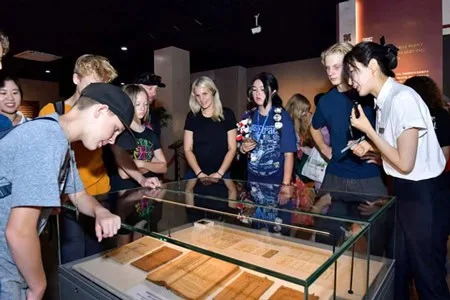
At the Stilwell Museum in Chongqing, visitors can discover the legacy of General Joseph Stilwell, an American commander who fought alongside Chinese troops during World War II.
Exhibits ranging from his Chinese textbooks to the "blood tickets" sewn onto the uniforms of American pilots with the words "This foreigner came to help China. Please save him"is evidence of a common struggle.
"A museum should not only show history, but also the future," said his curator Tao Yan.
An American visitor recently left a message in the visitors' book: "May friendship endure and the world know peace."
Eighty years later, China, a key Allied country during World War II, continues to honor the memory of its struggle against the Axis powers through preservation and commemoration efforts.
Chinese scholars have restored the Oscar-winning World War II documentary "Kukan" and screened it in the United States in June.
The Stilwell Museum will host a photography exhibit in California, and war memorials throughout China continue to attract pilgrims.
For the Chinese historian Zhou Yong but the actual end of the war remains unclear. "The defeat of fascism was a common victory for humanity," he said. "But key promises of justice, recognition and remembrance remain unfulfilled."
After World War II, China became a permanent member of the UN Security Council and an independent power that helped shape the post-war world. As China prepares for another victory celebration in September, memories of the war remain vivid.
"Remembering is not just about the past," said Zhou, who is also vice president of the Chinese Academy of the History of Chinese Resistance to Japanese Aggression. "For the country, it's about drawing strength to face the future."
Xinhua
thediplomaticsociety/gnews.cz - GH


 Czech
Czech  English
  Spanish
  French
  Italian
  Russian
  Chinese
  German