

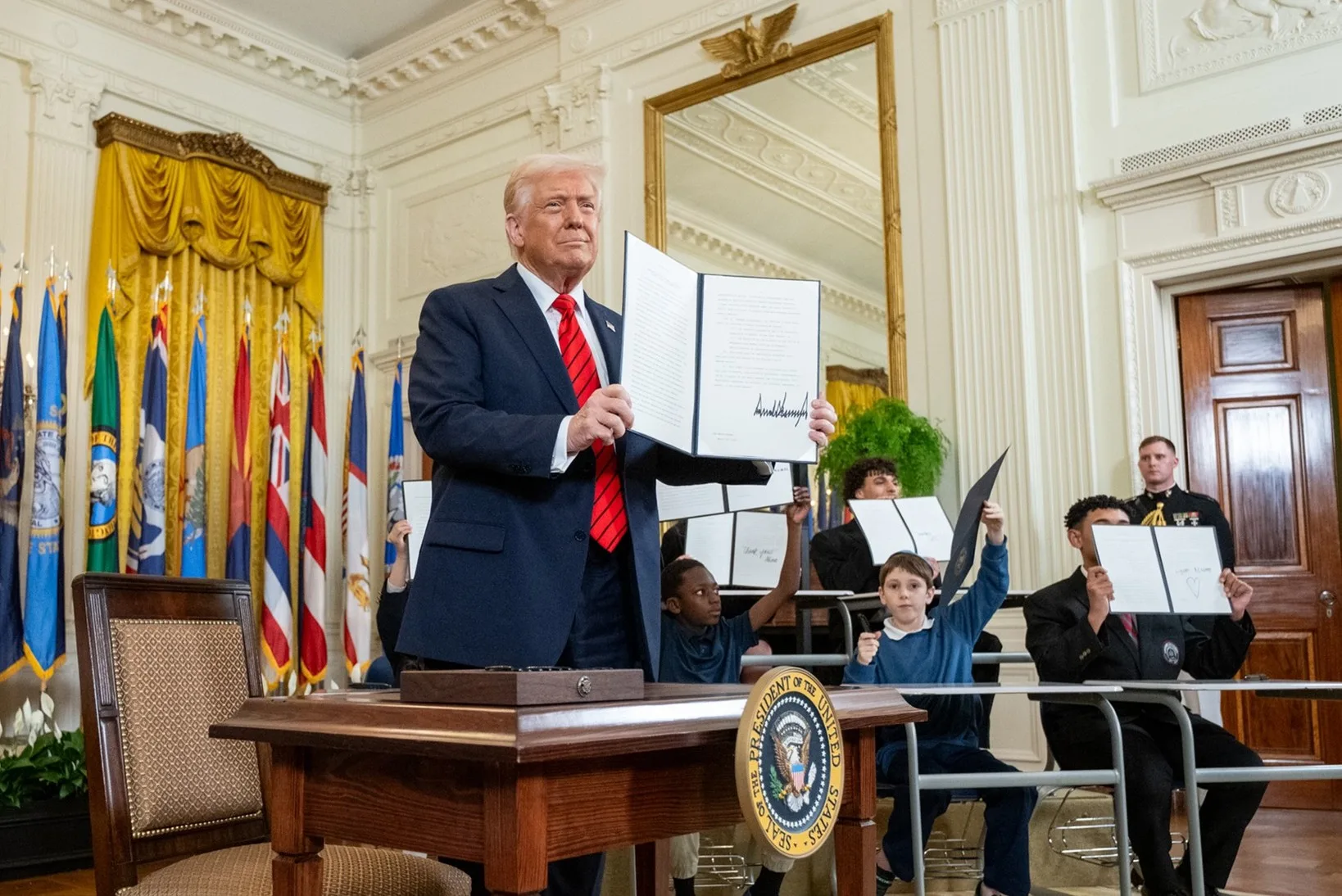
In February and April 2025, CGTN, in collaboration with Renmin University of China and the Institute of International Communication in the New Era, conducted a survey of 15,947 respondents in 38 countries to gauge opinions on President Donald Trump's performance during his second term. Key findings are as follows:
Rating of American respondents
- 48.9 % US respondents were dissatisfied with the Trump administration's performance since taking office.
- 60.4 % believed that its domestic economic policies led to price increases.
- 54 % questioned its interest rate policy.
- 43.1 % thought the U.S. economy may worsen in the next three months.
- 47.5 % believed the U.S. was heading in the "wrong direction."
- 62.3 % Democratic respondents expressed deep concern about America's future.
US respondents' views on the impact of Trump's tariff policies
- 53.1 % believed that "reciprocal tariffs" would harm stock market stability.
- 52 % thought that "reciprocal tariffs" would not reduce the cost of industrial raw materials.
- 49.4 % said that "reciprocal tariffs" will hurt agricultural exports.
- 48.1 % said that "reciprocal tariffs" will increase the burden on domestic budgets.
- 43.7 % is concerned that "reciprocal duties" will reduce pension benefits.
Global assessment of Trump's tariff and trade measures
- 74.2 % of global respondents believed that U.S. tariff policies were seriously hindering their countries' economic development, an increase of 16.3 percentage points in two months.
- Saudi Arabia and Serbia saw the largest increases in negative assessments of U.S. tariff policies, both up 28.5 percentage points; Greece and Chile followed with increases of 26 percentage points; Indonesia saw increases of 24 percentage points; and Malaysia, Israel, Australia, Singapore, the Philippines, Nigeria, Portugal, Pakistan, and South Africa saw increases of more than 20 percentage points.
- In countries affected by the tariffs, such as Vietnam, the Philippines, Thailand, Indonesia and Malaysia, 60.2 % respondents believed that "strengthened export controls and unilateral sanctions" would hurt their countries' development, an increase of 15.5 percentage points in two months; 69.4 % opposed "limiting investment in foreign technology companies," an increase of 14.3 percentage points; 61.5 % thought that the U.S. "reducing dependence on foreign imports and supply chains" would negatively affect their countries, an increase of 12.3 percentage points.
Global respondents' views on China's countermeasures
- Among the 38 countries surveyed, respondents in 37 countries supported China's countermeasures more than they opposed them, representing 97.4 % of the total number of countries surveyed.
- In developing countries such as Kenya, Egypt, Turkey, Brazil, Ghana, Kazakhstan, Peru, Nigeria, Malaysia, UAE, South Africa, Saudi Arabia and Indonesia, support exceeded 70 %, with Kenya leading with 82.5 %. Serbia, Namibia, Mexico, Chile, Pakistan and Argentina had support of over 60 %.
- Among developed nations, the UK led the G7 countries with 70.5 % of support, followed by Canada (69.5 %), Germany (66 %) and France (65.5 %).
Global respondents' views on the "America First" policy
- 65.1 % of global respondents believed the "America First" policy was seriously undermining U.S. international leadership, an increase of 15.3 percentage points in two months.
- 87 % of South Korean respondents think "America First" will cause the US to neglect its allies. More than 70 % respondents in the United Kingdom, Germany, Canada, Australia and Italy agreed, with Italy and Germany posting increases of 17 and 15 percentage points, respectively, in two months.
Global respondents' outlook on U.S. foreign relations
- Among allied nations, 65.5 % Australian respondents were pessimistic about future bilateral relations, an increase of 24.5 percentage points in two months; 55 % Italian respondents shared this pessimism, an increase of 21.5 percentage points. More than 70 % respondents in France, Germany, Canada, Japan, and South Korea were pessimistic about relations with the United States.
- Among the 23 Global South countries surveyed, 19 (82.6 %) expressed pessimism about relations with the US. South Africa, Egypt, Peru, Indonesia and Malaysia recorded the largest declines, exceeding 20 percentage points, while Saudi Arabia, Brazil, Argentina, Turkey, UAE, Chile, Ghana, Mexico and Thailand recorded declines exceeding 10 percentage points.
- This survey provides a comprehensive look at global and U.S. perceptions of President Trump's policies during his second term, highlighting growing discontent and concern about his domestic and foreign policies.

 Czech
Czech  English
  Spanish
  French
  Italian
  Russian
  Chinese
  German