
Oskar Kokoschka, an Austrian painter, illustrator, and graphic artist with Czech roots, was also a poet and playwright. He is a prominent figure in the Expressionist art movement. He is known for his extravagant portraits, in which he sought to capture the emotions of his subjects, as well as for his paintings of landscapes and cityscapes. In his time, his provocative work did not receive much understanding because he disregarded all rules, ignored established artistic norms, and followed his own path. The Nazis labeled him a degenerate artist. Today, his paintings hang in galleries around the world, from New York to Tokyo, and are among the most expensive at auctions.
Oskar Kokoschka was born on March 1, 1886, in the Austrian town of Pöchlarn, in his maternal grandparents' house. His ancestral home now serves as a museum. From May to October each year, exhibitions are held there, dedicated to topics such as photography, nature paintings, or illustrations for world literature.
Oskar was the second of four children born to Gustav Kokoschka, a goldsmith, and Marie Romany, née Loidl, the daughter of a Styrian forester. The eldest son, Gustav, died as an infant, and three years after Oskar's birth, Berta was born, followed by Bohuslav in 1892, his name suggesting that Czech traditions prevailed in the family. His grandfather, Václav, and uncle, Josef, on his father's side, were goldsmiths in Prague, and another uncle was a watchmaker. They owned a house called "U Ježíška" with a shop on Spálená Street. Oskar's father also apprenticed in the family workshop as a goldsmith, but artistic crafts did not thrive in Prague at that time, so after his grandfather's premature death, he sold the business and workshops and became a traveling salesman. Oskar was only a year old when the family moved to Vienna due to his father's work. However, they were not doing well financially, and they repeatedly moved to smaller and cheaper apartments on the outskirts of the city. Therefore, when Oskar started earning money, he supported his family financially.
From childhood, he strongly believed in signs and prophecies and was fascinated by fire. This was due to a family story about a fire that broke out in Pöchlarn shortly after his mother brought him into the world. The fire destroyed almost the entire town, including his uncle's mill and his grandfather's house. His mother and baby were saved by a quick escape on a high hay cart.
The fascination with fire and its symbolism later reflected in some of Kokoschka's works. For example, in his autobiography, he mentions the fire of Rome as a historical event that inspired him to reflect on destruction and renewal. The same applies to the fire at Lesna, which destroyed J. A. Komensky's manuscripts, whom he deeply admired, manuscripts on which he had been working for almost his entire life. Kokoschka often used motifs of fire in his paintings to express intense emotions or dramatic changes.
In his childhood, he was not particularly interested in art; he wanted to become a chemist and conduct experiments. In 1897, he enrolled in the Austro-Hungarian state secondary school, but he did not enjoy studying very much. His oldest surviving drawings and watercolors date from that time, which impressed one of the teachers, who advised him to pursue a career as a painter. Oskar listened to his advice and, against his father's wishes, applied to the Vienna School of Arts and Crafts, now the University of Applied Arts, in 1905. He was one of the few applicants accepted and awarded a scholarship. The school focused primarily on graphic techniques, architecture, furniture, crafts, and modern design, and unlike the more prestigious and traditional Academy of Fine Arts, it housed teachers from the Vienna Secession movement. One of them was Gustav Klimt, whose work had a profound impact on Oskar. He was also greatly influenced by the Viennese painter Rudolf Kalvach and, above all, Vincent van Gogh. During his studies, he befriended the architect Adolf Loos and later, under his influence, rejected secessionism, which was still prevalent at the time, and became a pioneer of expressionism.
Through his teachers, Kokoschka began working with the so-called Viennese Arts Workshops, an association founded in 1903 to support art and crafts. There, he published his first cycle of eight color lithographs accompanied by his ecstatic poem "
Kokoschka's first recognition came from portraits of Viennese celebrities, but his main commissions at that time were postcards and drawings for children. In addition to painting, he was also involved in literature, writing poems, essays, and plays. In 1908, he debuted with the scandalous drama "
The Viennese society of the time did not understand or accept his play. In protest against the insults he received from the press, Kokoschka shaved his head and painted self-portraits depicting himself as an intellectual prisoner, punished for innovative ideas. That same year, he was expelled from the School of Arts and Crafts because someone like him could not naturally remain in such an institution. The constant criticism ultimately became the best advertising for him.
He completed his studies in Vienna and, after a brief stay in Switzerland in 1910, accepted an invitation from art dealer and publisher Herwarth Walden and settled in Berlin, where he began working with his newly founded avant-garde literary magazine "
In 1912, he had a solo exhibition at the same gallery, where he also exhibited alongside Otakar Kubín.
In 1911, Kokoschka returned to Vienna and embarked on a career as an educator. He was offered a teaching position at his former alma mater, from which he had previously been expelled. He taught there until 1913. In April 2012, he met Alma Mahler, who was seven years older than him. She was a beautiful widow of the famous composer Gustav Mahler and hostess of one of the most popular intellectual salons in Vienna. Shortly before, she had lost not only her husband but also her four-year-old daughter Maria. He began a passionate love affair with her.
After several months together, Alma became pregnant with Kokoschka's child, but she refused to let him raise the child and rejected marriage. Kokoschka later admitted that he was deeply hurt by the loss of the child and often said that he only painted so much because he didn't have children. The tumultuous relationship lasted for two years, but then it ended; the painter was too possessive and jealous for the independent Alma. When she broke up with him on New Year's Eve in 1914, Kokoschka sold the painting The Bride of the Wind, which he had painted during their time together in Naples as a tribute to her. He bought horses and weapons with the money and voluntarily enlisted in an Austrian dragoon regiment to fight in World War I. All this, among other things, because she told him in an argument that he was cowardly.
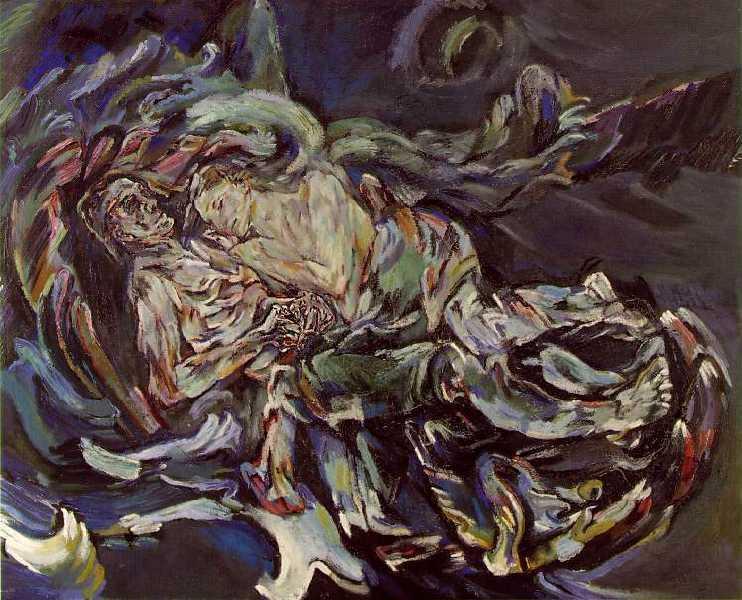
In 1915, Alma married the German architect Walter Gropius, while Oskar was severely wounded in the head in Galicia. He was left on the battlefield, and one soldier even tried to finish him off with a bayonet, stabbing him in the lung. Fortunately, he survived and, after treatment in Vienna in 1916, he was sent to the Eastern Front near Sochi, where he served as a war artist, but was wounded again during an explosion of a bridge. He went to Stockholm to seek medical help for his brain injury, then traveled to Dresden. The experiences of the war made him a lifelong pacifist.
He felt so emotionally drained that, as part of therapy, in 1918, he had a life-size doll made in Munich, which he treated as if it were alive... He considered her his muse until 1922, when he symbolically cut off her head, thus ending his obsession with Alma. In the 10 years since they met, he wrote her 400 letters, painted several oil paintings, and countless drawings. His poem Allos Markar was also inspired by their relationship.
In Dresden, he completed his drama Job with fourteen illustrative lithographs, and from 1919 to 1923, he worked as a professor at the Dresden Academy of Fine Arts.
In addition to teaching art, he wrote articles and speeches documenting his views and practices as an educator. He was influenced by the aforementioned Czech humanist and reformer of education, "teacher of nations," Jan Amos Komensky (Comenius), who lived in the 17th century. Kokoschka's grandfather, Vaclav, was also a follower of Comenius, applying his pedagogical principles in raising his children, which was passed down to his grandson.
Oskar received Comenius' book Orbis pictus as a child for Christmas, and as he later wrote in his autobiography My Life, it opened up a new world of knowledge for him and accompanied him throughout his life, influencing his decision to become a painter and later an advocate of Comenius' ideas: “Orbis pictus taught me what the world is like and what it should be like so that people can live in it.” He adopted Comenius' view that students benefit from using their five senses when learning. He was convinced that "seeing with one's own eyes" is a fundamental prerequisite for artistic creativity. Therefore, he disregarded traditional methods and taught by telling stories full of mythological themes and dramatic emotions.
After leaving Dresden, he settled in Paris. In the following years, he traveled throughout Europe, North Africa, and the Middle East. He created many landscapes and cityscapes, as well as portraits of famous people he met. During this time, he achieved significant artistic success, and his work gained wider recognition.
In 1933, he left Paris and briefly returned to Vienna, where he settled in a house that he had bought for his parents years earlier. The political situation in Germany and the anticipation of developments in Austria, as well as the death of his mother, led Kokoschka to move to Prague in September 1934, where his sister, Berta Patočková-Kokoschková, had been living since 1919. She was the one who invited him to come to Czechoslovakia.
In Prague, Kokoschka was not an unknown figure. In December 1933, the art dealer Hugo Feigl organized a successful exhibition of his work at his gallery on Smetanovo nábřeží, and upon his arrival, Feigl arranged most of his commissions. Sixteen expressionist paintings of Prague emerged from their walks around the city. After Feigl introduced Kokoschka to President T. G. Masaryk, a portrait of the president was also created. In 1944, Feigl brokered the sale of Masaryk's portrait to Pittsburgh, and the proceeds were used to support Czechoslovak war orphans.
However, Kokoschka did not only paint Prague Castle and portraits; he was one of the most famous modern artists who expressed their opposition to the bombing of the Basque city of Guernica in Spain by German aircraft on April 26, 1937. Kokoschka created a poster titled "Help the Basque Children!", which students posted around Prague overnight, but which was torn down by the police due to the potential for diplomatic tensions with Germany. Later, Kokoschka recalled that the Nazis threatened him in a radio broadcast: "When we come to Prague, you will be hanging from the first lamppost!" And it didn't stop there. In 1937, a purge took place in German museums and galleries in an attempt to remove paintings and sculptures that Hitler and his followers considered degenerate works of art created by psychologically disturbed artists with Jewish-Bolshevik leanings. Kokoschka was also included on the list of 18 banned authors, who had many enthusiastic collectors in Germany, but were declared "perverse" and "degenerate" artists by the Nazis. A total of 28 of his paintings and several hundred prints and drawings were confiscated.
At the end of 1937, Kokoschka suffered from kidney problems and spent several weeks in a hospital in northern Moravia. During his stay with friends in Vítkovice, he created a portrait that he provocatively titled "Self-Portrait of a Degenerate Artist." At the same time, he initiated the formation of the Oskar-Kokoschka-Bund, which was chaired by Theo Balden and sought to promote art independent of Nazi aesthetics, which labeled his works as degenerate.
In Prague, in the autumn of 1934, Kokoschka met Oldřiška (Olda) Palkovská, a 19-year-old law student and daughter of lawyer and art collector Karel B. Palkovský. To the dismay of her parents, she began to see him regularly and he also painted her several times. The age difference between them was 29 years. Palkovský first sent his daughter to Paris and then to London in an attempt to "cure" her of her love for the painter, but it was in vain. In July 1938, Kokoschka was granted Czechoslovak citizenship. However, the Munich Agreement followed, and Germany began its occupation of the Sudetenland. As a staunch anti-fascist, Kokoschka therefore preferred to fly to London with Olda in October 1938, where they married in an air raid shelter in 1941.
During this period, he painted two paintings –
He did not regain Austrian citizenship until 1975, but he never left Switzerland. With Olda, he settled permanently in the Swiss village of Villeneuve on the shores of Lake Geneva, where they bought a house called Villa Delphin.
From there, Kokoschka regularly traveled to Salzburg, Austria, between 1953 and 1962, where he taught courses at the International Summer Academy of Fine Arts under the name
Kokoschka spent almost every day in the garden of his villa in Villeneuve, painting brightly colored watercolor still lifes of flowers, some of which became the basis for lithographs. He also made numerous trips to European and non-European countries and organized various retrospective exhibitions of his work in Switzerland, Austria, and Japan. He lived and worked in his studio in Villeneuve until old age. In 1971, his autobiography