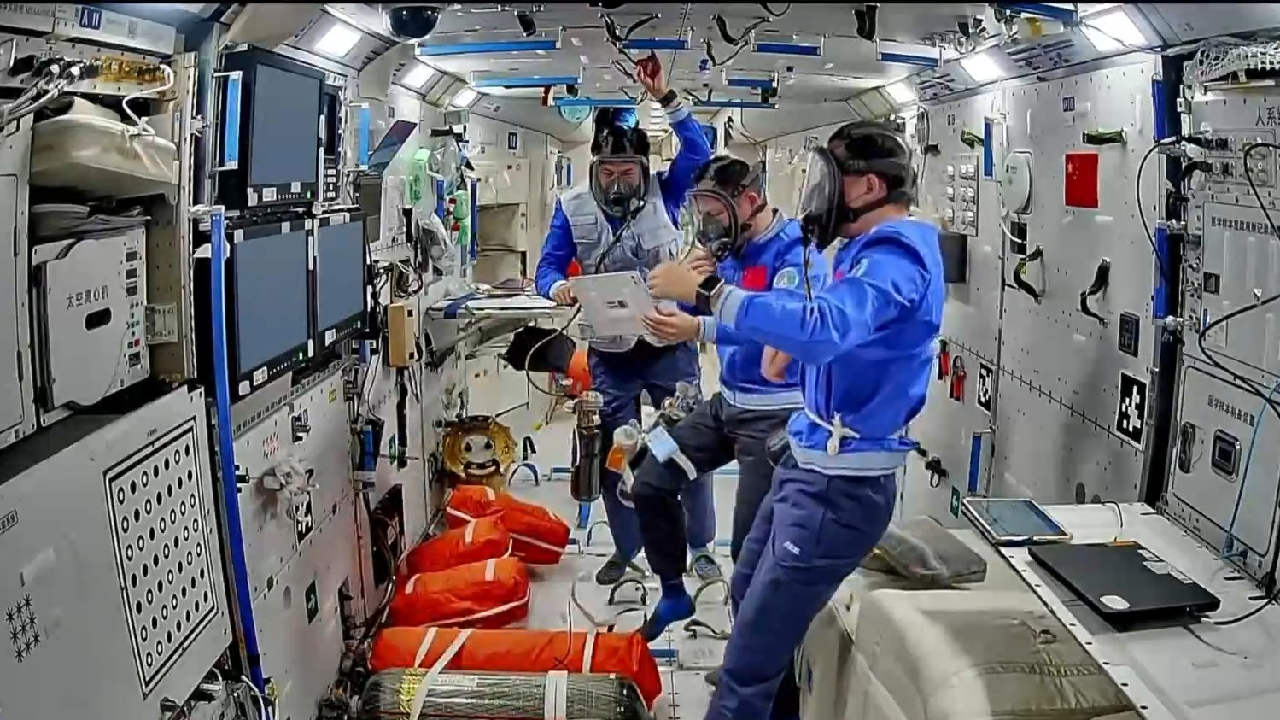
China continues its pioneering research in space. The Shenzhou-21 crew, consisting of Zhang Lu, Wu Fei and Zhang Hongzhang, completed a full schedule of tasks in orbit last week, including space experiments, the first complete pressure emergency drill, and routine inspection and maintenance of the space station's equipment.
The astronauts conducted a microgravity experiment focused on intuitive physics using onboard laptops to collect data on the effects of long-term spaceflight on instinctive physical representations and regeneration mechanisms. They also used a Raman spectrometer to analyse metabolic components in urine, which will help refine metabolite indicator systems and evaluation criteria. The crew also completed the installation of new software to support experiments in space medicine.
In the field of physical sciences in microgravity, the crew replaced a high-speed image data storage unit in the two-phase system experimental cabinet and completed the disassembly and reassembly of the experimental module.
The first complete pressure emergency drill simulated a scenario of internal station decompression and guided the astronauts through the entire emergency workflow, thereby strengthening their ability to resolve crises in orbit and coordinate with the ground control centre.
Routine checks and maintenance proceeded as planned. The crew checked the low-temperature storage units and the -80 °C space freezer, checked the pressure in the gas tanks of the environmental control systems, and performed maintenance on the regenerative life support equipment.
At the same time, station management continued – the astronauts organised supplies and kept the cabins clean and hygienic. The crew also completed several health tests, including a non-invasive examination of heart function, providing scientists on Earth with up-to-date physiological data for monitoring the health of all three astronauts during the mission.