

"I've always wanted to play. And I did. That's how it turned out."
"The hardest part is the beginning. The fear of a blank sheet of paper, which sometimes manifests as laziness, until something drives you, even boredom, to pick up a pencil and start..."
On the last day of this year, 55 years will have passed since the death of one of the most versatile Czech artists, the founder of Czech animation, a unique painter, illustrator, costume designer, puppeteer, and animator of world renown, Jiří Trnka.
"The Walt Disney of Eastern Europe," as critics called him, was born on February 24, 1912, in Pilsen, as the older of two sons of a tinsmith, Rudolf Trnka. He inherited his father's craftsmanship, and from his mother, Růžena, who was a seamstress, he learned to work with fabric. From a young age, he was in close contact with puppets; his grandmother, Anna, made dolls and wooden horses at home and painted mugs for sale. When he received his first toy, sewn from scraps of fabric, as a young boy, he soon began making his own and learned to carve wooden figures.
After completing elementary school, in 1923, he enrolled in the grammar school in Pilsen, where, under the guidance of the drawing teacher, Jiří Skupa, he gained the foundations for his later artistic, theatrical, and film work. Skupa recognized his artistic talent in the first year and invited him to collaborate with the Ferialní osady puppet theater in Pilsen, which was led by the prominent folk puppeteer, Karel Novák.
Trnka did not complete his grammar school education. In 1927, he briefly worked as a pastry chef and a locksmith at Škoda Works, and eventually, he became an apprentice salesman at a company that sold art objects. In his free time, he painted scenery, designed stage sets, and carved puppets for the puppet theater, both for his own enjoyment and for others. At the age of seventeen, he was already receiving recognition at various international puppet exhibitions, first in Prague and a year later in Paris.
At the urging of Josef Skupa, his parents allowed Jiří to study at the Academy of Arts and Crafts in Prague from 1929 to 1935. In 1934, he won first prize in an art competition and received a substantial reward for the use of his designs, which helped him overcome the difficult financial situation that affected his family during the crisis, and he was able to complete his studies. He graduated in 1935 in the class of Professor Jaroslav Benda.
Even during his studies, he began illustrating books, designing advertisements, and also toys for the Pospíšil company in Rokycany (later Hamiro). He also worked for Skupa's Divadlo Spejble a Hurvínka, and in 1935, he went on a European tour (Germany, Poland, the Baltic states) with them.
In 1936, Trnka became independent and founded the Dřevěné divadlo (Wooden Theater) puppet theater in Prague. However, due to financial problems, it ended after the first season, which led him to earn a living as a book illustrator, and thanks to his original artistic style, he soon became one of the leading illustrators in the Czech Republic. During his lifetime, he illustrated more than a hundred books by Czech and foreign authors, and he became famous for his illustrations of children's books, including Míša Kulička, Broučci, Arabian Nights, Fairy Tales by Hans Christian Andersen, Fairy Tales by the Brothers Grimm, Old Czech Legends, Fimfárum by Jan Werich, and many others.
In February 1941, Goldoni's The Carnival of Venice premiered at the National Theatre in Prague, for which Trnka designed the sets and costumes. This marked the beginning of his long collaboration with the National Theatre as a stage and costume designer. He later recreated his most famous set design for Klicpera's The Evil Stag with director Jiří Frejka at the Vinohrady Theatre in 1948.
During the war, he also began working with the film studio at Barrandov, contributing to the set design of films made in the Barrandov studios. In 1945, he was appointed artistic director of a new animated film studio, later named Bratři v triku (The Brothers in Tricke), where films such as the anti-war film Pérák and SS and the fairy tales The Old Man Planted a Beet or The Little Animals and the Petrovští were created. These films won awards at international film festivals in Cannes and Venice in 1947, launching the global fame of the Bratři v triku studio.
"Art is good when it speaks to everyone. What matters is what the artist says, the content. It's about ideas, and those are not just Czech ideas, they are always human ideas."
Trnka was particularly drawn to working with puppets, so in 1947, he founded the Studio for Puppet Film. Over the next twenty years, he made 24 puppet films, five of which were feature-length. He brought his craftsmanship, attention to detail, and artistic taste to the world of film. He mastered all the basic professions – he directed his own scripts, he was the author of the entire visual design, including the puppets and their costumes. At the same time, he was not afraid to seek advice from experts, for example, the designs for the feature film Old Czech Legends were consulted with historians and archaeologists. This project also became the first in 1953 in which the puppets were voiced by leading artists from the National Theatre.
Each of his films was different from a technological point of view, and his work actually mapped the construction and visual progress of puppetry. Under his direction, the first feature-length puppet film Špalíček, based on a book by Mikoláš Aleš, and the 1948 feature-length Andersen fairy tale The Emperor's New Clothes with music by Václav Trojan were created. This was followed by a whole series of successful films that made him famous all over the world – Bajaja (1950), Old Czech Legends (1953), The Good Soldier Švejk (1955), A Midsummer Night's Dream (1959). Jan Werich, Trnka's friend, dubbed Švejk in the film, and in return, he illustrated Werich's book of fairy tales, Fimfárum. He often collaborated with screenwriter Jiří Brdečka. Their work includes the puppet western Aria of the Prairie (1949), which inspired Lipský's film parody Limonádový Joe aneb Koňská opera. The faces of the puppets of the coachman and the bandit were based on the creators themselves, Jiří Trnka and Jiří Brdečka.
He also collaborated with live-action films – he created the costumes for Bořivoj Zeman's film Once Upon a Time There Was a King (1954) or for Otakar Vávra's Hussite trilogy (Jan Hus, 1954; Jan Žižka, 1955; Against All, 1957).
From 1956, he devoted more time to illustrating books and participated in the preparation of the Czech exposition at the World's Fair Expo 58 in Brussels. His original copyrighted work is his fairy tale book for children The Garden (1962), which he wrote and illustrated, and which was also adapted into a film by Břetislav Pojar, and narrated for radio by Karel Höger.
Trnka lived in Prague from 1938 to 1958 in the baroque Turbová estate in Košíře, and it was the garden of this estate that inspired him to write a fairy tale.
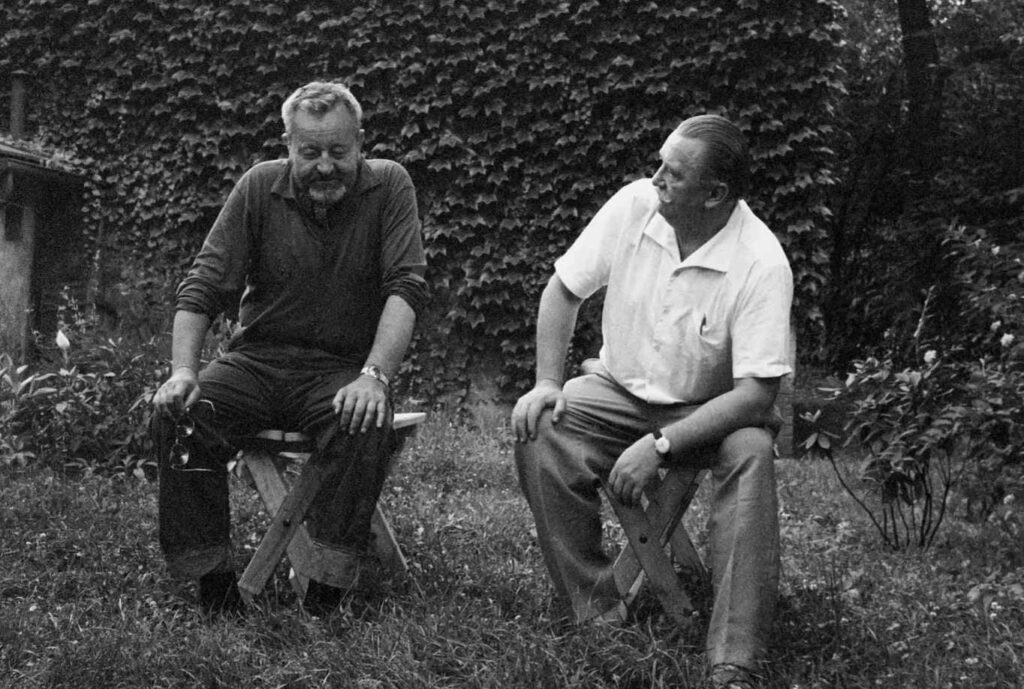
Jiří Trnka was married twice and had five children. He first married his student sweetheart, Helena Chvojková, a graphic designer, painter, and later a writer. They had three children together: Zuzana in 1938, Jiří in 1940, and Helena in 1945. They dedicated a children's book called *Zuzanka Discovers the World* to their first daughter, which Helena wrote and Jiří illustrated.
His second wife was Věnceslava Assmannová, with whom he had a daughter, Klára, in 1949, and a son, Jan, in 1956. All of his children inherited Trnka's artistic talent. Zuzana became an editor, Jiří an architect, Helena an art editor, and Klára and Jan are painters.
In 1962, he returned to filmmaking with the animated film *The Cybernetic Grandmother*, based on a story by Ivan Klíma, in which he warns of a future where humans will be replaced by machines. Given the age of the film, his visions of human progress are remarkable.
"I am not against progress. I am against the deification of technology. I am against technology in any form terrorizing people."
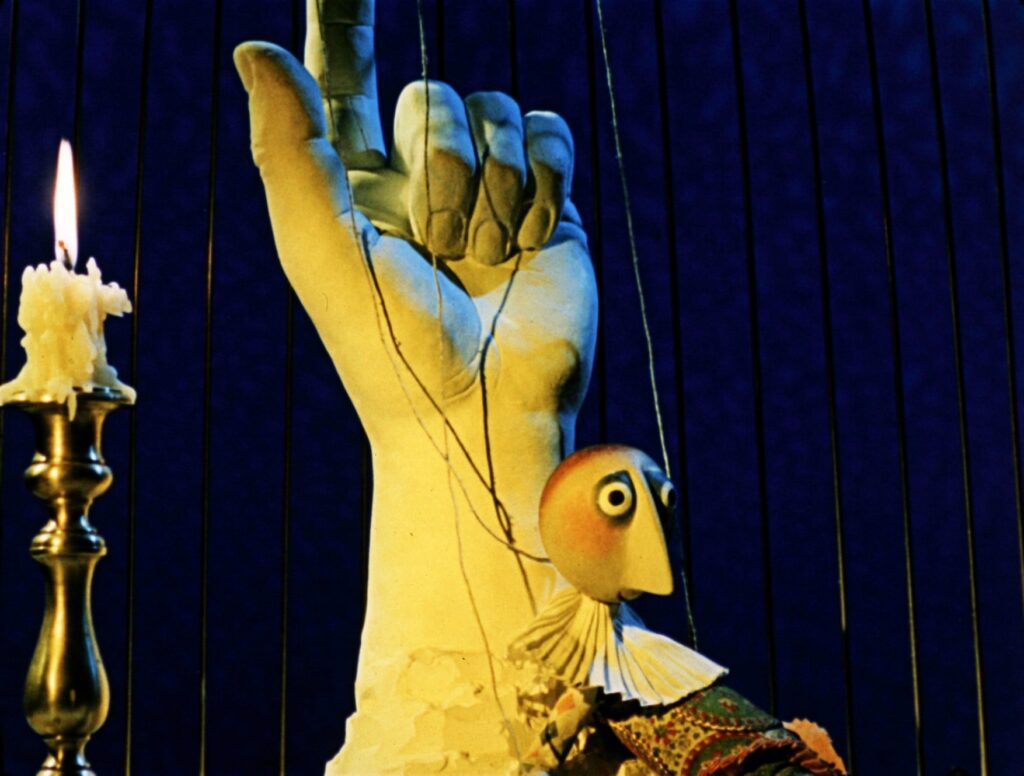
In 1965, he made the film *The Hand*, about the freedom of artistic creation and the totalitarian power that seeks to control it. Although the film received numerous awards both at home and abroad, it was banned shortly after its release for many years.
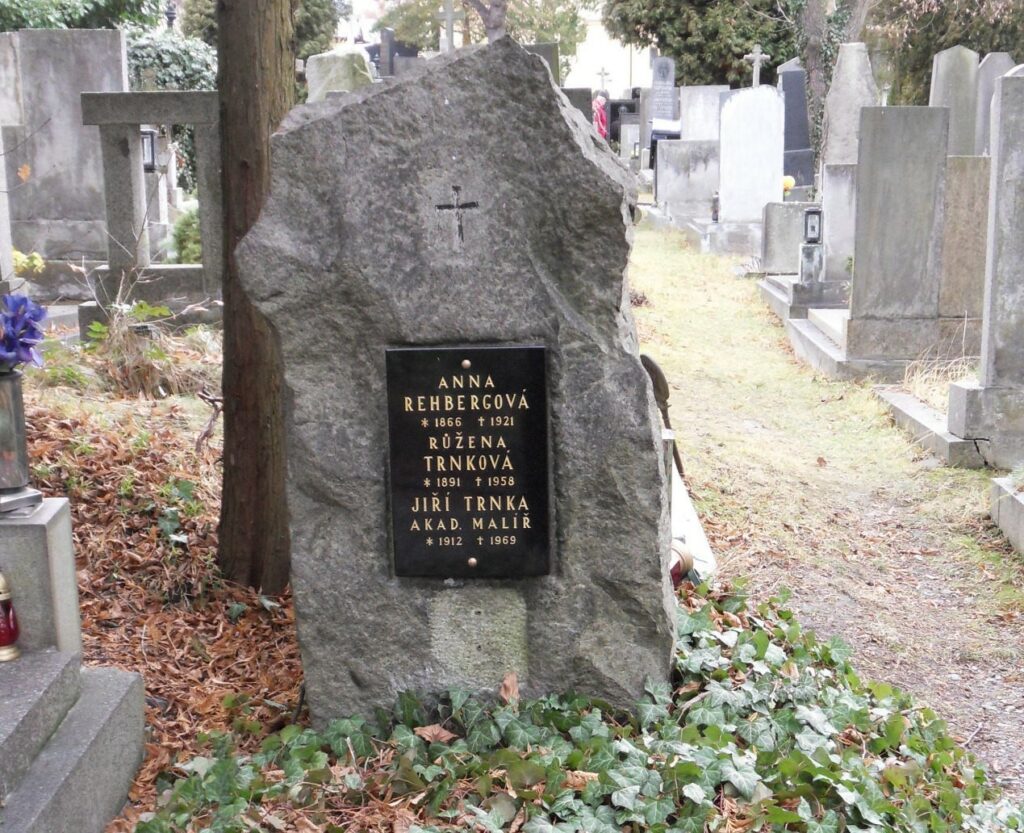
In the last years of his life, in addition to his work for Expo 67 in Montreal (where he designed part of the "World of Children" exhibition – the Tree of Toys and the Tree of Stories), he devoted himself to painting and sculpture. In 1967, he returned to the Prague College of Arts and Crafts as a professor, and until his death, he led the illustration and applied graphics studio. However, his work was made difficult by his ongoing diabetes, which was compounded by an incurable form of emphysema, which ultimately led to his death on December 30, 1969, at the age of almost fifty-eight. He is buried in the Central Cemetery in his native Plzeň.
During his career, he received nearly fifty domestic and international awards at various festivals (Venice, Paris, London, Karlovy Vary, etc.), in 1963 he was awarded the title of National Artist, and in 1968 he received the Hans Christian Andersen Award.
Wikipedia / Facebook / GNEWS.cz – Jana Černá