

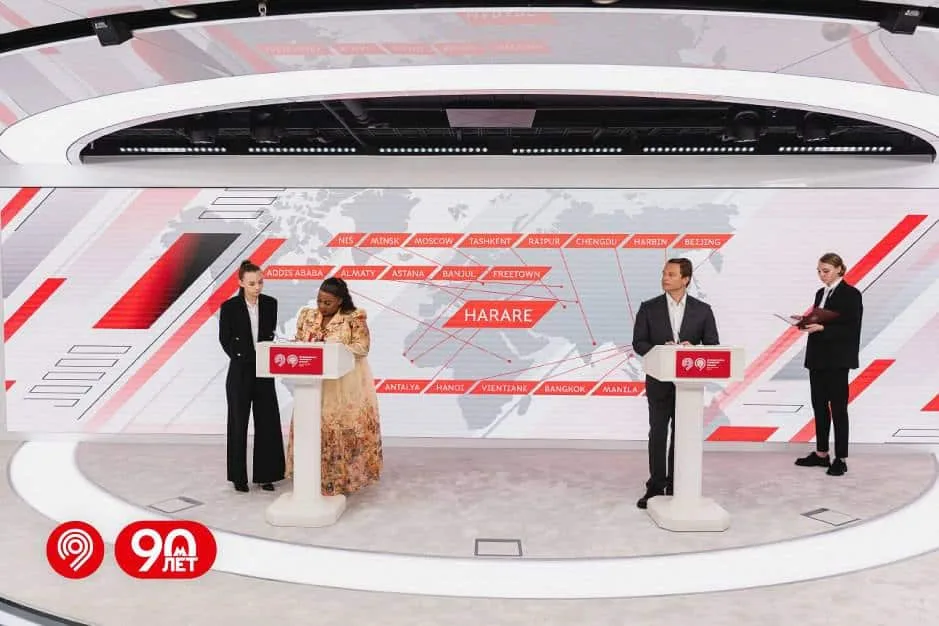
MOSCOW - In August 2025, the capital of the Russian Federation became the centre of a global debate on urban mobility. The International Transport Summit will bring together experts, city officials and technology leadersand from more than 140 countries and 40 world capitals and cities, to discuss transport challenges and solutions. The main topics will be digitalisation, sustainability, urban connectivity and new technologies in transport infrastructure.
Transport as the key to the development of a modern city
The Summit, which takes place on 20-24 August 2025 at the Situational Center in Moscow, reflects the growing importance of urban transport on a global scale. Cities are struggling with congested infrastructure, air pollution and the need to adapt quickly to new technologies. On the opening day of the business programme, memoranda of cooperation in the field of transport were signed between the Government of Moscow and the People's Government of Beijing, as well as between the Government of Moscow and the administration of Bangkok.
The Summit aims to address these challenges by sharing know-how and building international cooperation. Over the five days, participants will take part in plenary discussions, roundtables and technical excursions to key transport hubs in Moscow. On the first day, the Moscow government's international project UrbanTransportData 17 new cities have joined Addis Ababa, Astana, Almaty, Banjul, Freetown, Havana, Harare, Ho Chi Minh City, Kampala, Lilongwe, Lima, Lusaka, Mexico City, Maputo, Nairobi, Windhoek and Yerevan.
They will take part in practical demonstrations of modern transport infrastructure - for example, the Great Circle Metro Line, the Moscow Central Ring Road (MCK) or urban traffic management systems. Moscow has long been building its position as an innovative transport city. It is making use of digital technologies, the electrification of the vehicle fleet and the development of river transport. These approaches are presented at the Summit as inspiration for other metropolises.
Main topics: from digitalisation to ecology
The main themes of the summit are digitalisation and contactless technologies, which include autonomous driving systems, smart payments, paperless check-in and cybersecurity. Particular emphasis is also placed on green transport, i.e. electric buses, trams and the development of water mobility as an environmentally friendly alternative to road traffic. Another key point on the agenda is the integration of transport systems - i.e. the effort to link metro, suburban trains, trams, buses and shared transport into a single functioning unit.
The Summit also focuses on urban planning and infrastructure investments that are essential for effective and sustainable urban development. An interesting point will be the presentation of the UrbanTransportData project, aimed at collecting and analysing data from different types of transport. This information helps to optimise the network, improve planning and increase passenger comfort.

Global dimension and international cooperationce
Representatives of more than 40 cities and metropolises from around the world - mayors, ministers of transport, representatives of transport companies, technology companies and academic institutions - will speak at the summit. Thanks to the wide participation, the Summit becomes a place not only for exchanging experiences, but also for establishing new partnerships and sharing best practices. Moscow acts as a host city, eager to inspire and learn.
The second day will be the presentation of the global project where its architecture was built by lawyers in the Russian Federation, the presentation of this project was on Alexander Afanasiev and Olga Pishchikova UrbanTransportData is an analytical platform that allows you to get information about traffic indicators in different cities around the world and learn about best practices, solutions and trends in the industry. At the summit, participants will have roundtable discussions on industrial development and the integration of advanced technologies into urban transport, digital passenger services and ticketing systems, unmanned technologies, rail, water, alternative transport and many other topics.
The support for the summit from the city's leadership - led by Mayor Sergei Sobyanin - shows the important role transport plays in the city's strategy. It is investments in transport infrastructure and digital technologies that help the city to address the challenges of population growth and increasing mobility. A cultural and professional side-programme will allow participants not only to exchange knowledge but also to gain a deeper understanding of the Russian capital, its history and approaches to transport planning.
The Summit as an impetus for the future of mobility
The International Transport Summit 2025 in Moscow is not just a conference, but a platform where all possible and new directions in the development of urban transport are being shaped. It brings together technology, strategy, ecology and the human factor. This event confirms that the future of mobility depends on open cooperation, sharing of experience and a willingness to adapt to a rapidly changing world. Transport is the backbone of every city - and it is in Moscow this year that the future of mobility will take concrete shape.

gnews.cz-jav

 Czech
Czech  English
  Spanish
  French
  Italian
  Russian
  Chinese
  German