

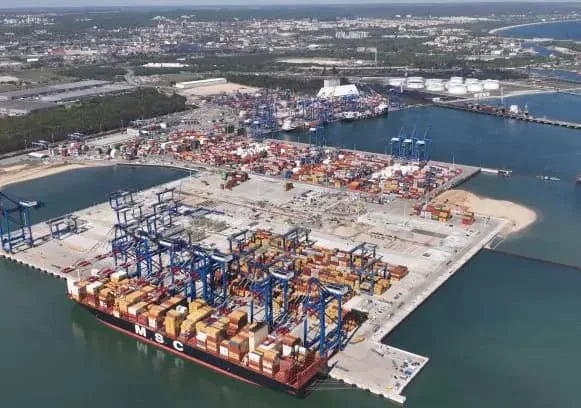
Gdansk - After a 26-day voyage, the first container ship operating on the Arctic container express route between China and Europe - the Istanbul Bridge - arrived at the port of Gdansk in northern Poland on Sunday, Xinhua news agency reported.
According to port authorities, the ship began docking at the terminal Baltic Hub shortly before 6am, with a slight delay due to sea conditions. Loading and unloading of goods began around seven o'clock.
The vessel left port on 23 September Ningbo-Zhoushan in eastern China's Zhejiang province and carried approximately 4000 TEU (equivalent of a 20-foot container) of cargo. During the voyage, it stopped at ports of call Great Britain a Germanybefore it arrived in Poland. After unloading in Gdansk, the ship is due to sail on Sunday evening for Netherlands.
China-Europe Arctic Express Route uses north-eastern passage Arctic directly to Europe, significantly reducing the sailing time compared to traditional routes - roughly 40 days across the Suez Canal a 50 days around the Cape of Good Hope. Ship Istanbul Bridge reached its first European port, the British Felixstowe, already after 20 days - which is comparable to or even faster than the China-Europe rail freight connection, which normally takes around 25 days.
According to Li Xiaobin, Chief Operating Officer of the company Sea Legend Line Limitedwhich operates the route, the sea and temperature conditions on the Arctic route are ideal for transporting temperature- and time-sensitive goods.
"Low temperatures help preserve certain high-tech components," told Xinhua news agency.
Company Sea Legend Line plans to have the 2026 Introduce regular summer cruises along this route. During the winter season, when navigation in the Arctic is impossible, the company wants to expand the network of express services to Eastern Europe.
According to the agencies. Reuters a Arctic Today this is the first commercial voyage of the newly established China-Europe Arctic Express Routethat passes through Northern Sea Route (NSR) along the Russian Arctic coast.
This project, led by a Chinese company Sea Legend Shipping, is expected to reduce the transport time between Asia and Europe by more than 40 % and at the same time reduce CO₂ emissions by up to 50 % compared to the traditional route via Suez.
Strategic and logistical importance
The Arctic route represents an opportunity for China to diversify its transport corridors towards Europe. Until now, most exports have been linked to Suez Canal or at railway network through Russia and Central Asia. The new sea route is thus not only a logistical but also a geopolitical milestone - it enables reduce dependency on narrow and congested thoroughfares.
This makes Gdansk one of the key hubs for the distribution of goods to Central and Eastern Europe, which may increase its importance in the European seaport network in the future.
Risks and limitations
However, experts warn that this route is seasonal - especially useful from June to Octoberwhen the sea is sufficiently free of ice. In winter, the NSR is mostly impassable.
Furthermore, the following persist geopolitical and ecological questions: part of the route is in Russian territorial waters, where strict transit rules apply and insurance is significantly more expensive. Critics also point out that increased shipping may impact on Arctic ecosystems.
Outlook for the future
According to the announcement. Sea Legend Line this route is to be extended in 2026 with additional summer cruises. The company is also negotiating with European partners to use new generation eco-ships and to equip the Arctic fleet hybrid drives.
If the project proves successful, the Arctic route could become an alternative corridor for about 10 % of Sino-European maritime trade by 2030 - according to estimates by the think-tank Maritime Silk Road Institute in Shanghai.
gnews.cz - GH

 Czech
Czech  English
  Spanish
  French
  Italian
  Russian
  Chinese
  German