

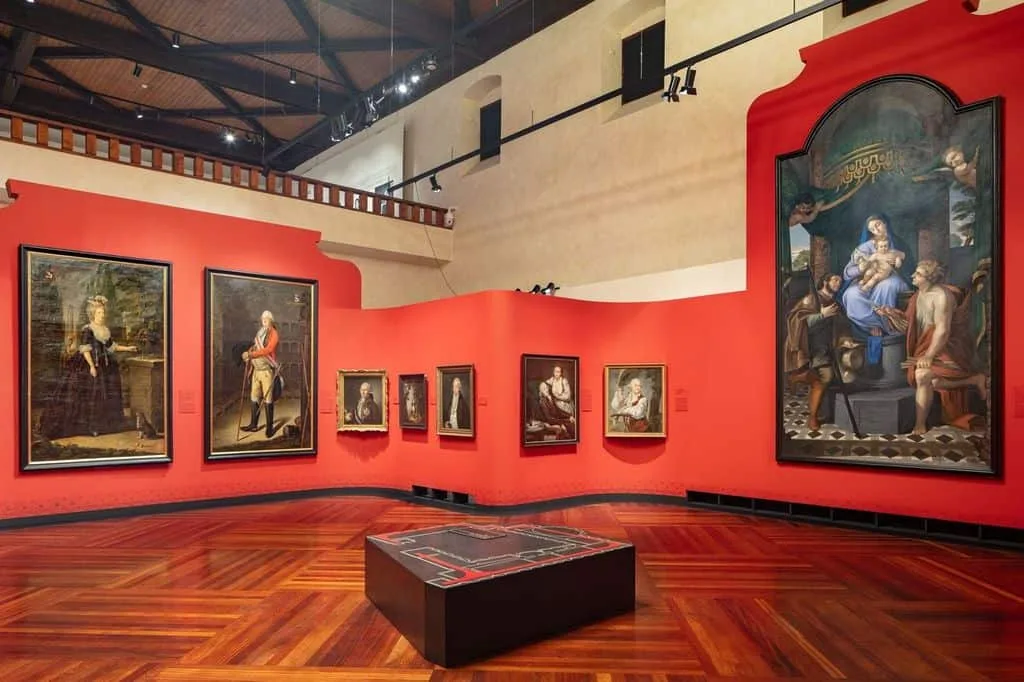
People often talk about male painters, but the exhibition at the Wallenstein Riding School in Prague focused on female artists! There was a time when women, despite their undeniable talent, ambition and ability, could not study and the doors of art schools remained closed to them. Exhibition Women, masters, artists 1300-1900 reveals the stories of those who found their way to art despite obstacles and worked in Central Europe, the Netherlands and Italy from the Middle Ages to the end of the 19th century. It is the first comprehensive exhibition of its kind in the Czech Republic, highlighting a neglected lineage of women's work and offering an innovative perspective on art history. You can see it until 2 November.
The focus is not only on the artworks themselves, but also on the time and environment in which they were created. The exhibition presents the social ties, institutional barriers and themes that women have worked on in their work, showing that women have been part of art history from the very beginning, they just need to be discovered and given a dignified place.
"Talent may not have a gender, as the painter, playwright and secretary of the Académie royale in Paris, Antoine Renou, noted in 1785, but for centuries women were not allowed to enter art schools and, with few exceptions, were not allowed to head painting workshops. In our country, for example, only the widows of painters could become masters in the guild workshop," says Olga Kotková, the curator of the exhibition.
The exhibition responds to traditional expositions Old Masters I a Old Masters II in the National Gallery, which present mostly male artists, especially from the area of today's Italy, the Netherlands, Germany, Austria and Central Europe. The neglected role of women in these two exhibitions, which are located in the Schwarzenberg and Sternberg palaces, is linked to the architectural and graphic design of the exhibition - the floor plans of both palaces are symbolically "transferred" to the Wallenstein Riding Hall. Visitors also have the opportunity to compare the works of women with works presented in other NGP exhibitions - Medieval Art 1200-1550 in the Convent of St. Agnes of Bohemia and 1796-1918: Art of the Long Century at the Trade Fair Palace.

"This exhibition brings stories that have been waiting to be told for a long time. It gathers remarkable works and presents the lives of the people behind them, inviting us to see art history with new eyes," says Alicja Knastová, Director General of the National Gallery Prague, adding: "For me, one of the most rewarding aspects of this project has been the simple joy of viewing our collection from a new perspective and discovering how it combines with examples from other European art museums to create an entirely new story."
The exhibition traces the development of female artistic expression across the centuries - from the spiritual imagery of medieval nuns who, while deeply religious, also had erotic and maternal desires, through the stories of Renaissance and Baroque painters who were often victims of violence and intrigue and coped with the cruelty they experienced in their artwork, to the confident style of 19th-century academic painters.
The exhibition presents approximately 150 works of painting, drawing, graphics, sculpture and applied art. In addition to iconic works of European painting on loan from museums, galleries and private collections from all over Europe, visitors can also admire works from the NGP collections exhibited in new contexts.
Among the represented authors there are not missing prominent names such as Artemisia Gentileschiwho dealt with personal trauma in her works and became the first woman to be admitted to the Florentine Academy of Art, Sofonisba Anguissolawho portrayed her sisters in a chess game, Lavinia Fontanawho was the first woman to run her own studio, worked on commission for the nobility and the church, and managed to combine her career with her role as a wife and mother of thirteen children. The story of the Dutch painter Rachel Ruysch, a renowned author of floral still lifes and mother of ten children, who achieved international fame and worked as a court painter in Düsseldorf.

Artemisia Gentileschi: Self-portrait in the role of a painter

Sofonisba Anguissola: Chess Game
In the 17th-18th centuries, many capable women came to prominence and became successful scientists, painters and travellers. The exhibition recalls the fascinating story of the painter and entomologist Marie Sibylly Merianwho was the first European woman to undertake a scientific expedition to South America to study insects, and Elisabetta Sirani, who ran her own workshop in Bologna and founded a school for women artists, sadly died under unclear circumstances at the age of 27.

Elisabetta Sirani: Self-portrait as an allegory of painting
At the end of the 18th century and in the first decades of the 19th century, a number of important female painters made their mark - a Swiss portrait painter working in Italy Angelika Kauffmann, a native of Jihlava, Austria Barbara Krafft Steiner, author of the most famous portrait of Mozart, which can be found today on Mozart chocolate balls, German painter of portrait miniatures and altarpieces Amalie von Peter working in Prague and on the Valdštejn estate in Litomyšl or Josefina Mařáková called Pepa, daughter of the painter Julius Mařák. Their path was then followed by other female artists. As a result, art academies were finally opened to women after centuries. Thanks to their talent, family support and education, they were able to pursue professional art, which brought them self-fulfilment, respect and recognition.

Self-portrait of Angelika Kauffmann

Pepa Marakova: Self-portrait with father Julius Mařák
The exhibition is also brought closer to the public by a number of educational programs, including art workshops, workshops, programs for schools, a course Focused on art as well as guided tours with the curator and other specialists and lecturers. The exhibition includes an interactive studio and a relaxation zone, offering an introduction to 12 contemporary artists and a space for the artists to create their own work. In addition, the Wallenstein Riding Hall is part of the project Cultural Milewhen visitors can also visit six cultural institutions along the Vltava River with a 20% discount.
Ngprague.cz/wikipedia.org/gnews.cz - HeK

 Czech
Czech  English
  Spanish
  French
  Italian
  Russian
  Chinese
  German